
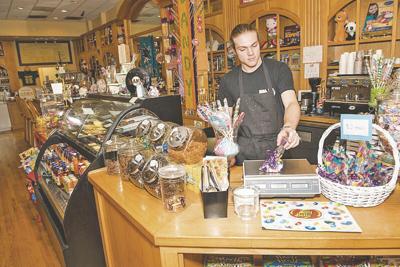
How a local minimum wage ordinance in Redwood City might be implemented to make the city more affordable for those working two or three jobs and affect the availability of trained workers are among the questions business owners in the city are contemplating following the City Council’s June discussion to explore increases ahead of the state’s schedule.
Several councilmembers agreed the city should explore creating a local minimum wage ordinance during the council’s June 12 budget discussion, with Councilwoman Alicia Aguirre emphasizing the need for city’s leadership in making the region more affordable for low-income residents. A local ordinance would accelerate the state’s process for increasing the minimum wage for local workers to $15 an hour, slated to rise incrementally until it reaches $15 an hour for all workers Jan. 1, 2023
“That’s a no-brainer for me,” said Aguirre, at the council’s June 12 meeting. “$15 is nothing in this community to live and to pay rent and to put your school children in the daycare centers.”
California’s new minimum wage of $10.50 for companies with more than 26 employees went into effect Jan. 1. While the state’s minimum wage is rising, some city officials across the county are pushing to phase in wage increases ahead of the state’s schedule in response to the Bay Area’s high cost of living, which trumps that of other regions in the state.
Last year, the San Mateo City Council voted to phase in a two-step wage increase for all businesses, regardless of size, with the minimum hitting $12 Jan. 1, 2017, then $13.50 the following year and $15 by 2019. Charitable nonprofits have an extra year to adapt.
Though Jon D’Angelica, a partner of Martins West Gastropub at 831 Main St., said he supports the intent of a local minimum wage, its wide application to all businesses discounts the nuances of a restaurant pay scale. Wait staff at his restaurant make minimum wage but that is supplemented by tips, he said, making them the only employees at his restaurants who would be affected by the change, while kitchen staff, who make $2 to $3 above minimum wage but often work two or three jobs to make ends meet, would not see any change.
“From our picture, those are the guys you really want to help with this,” he said, of the kitchen staff at Martins West. “[But] this law doesn’t affect them at all.”
Because California state law does not currently make provisions for a tip credit, D’Angelica said increasing the minimum wage would only make it more difficult for restaurant owners to increase the wages for the employees who need it most. A tip credit would allow restaurant owners to pay those earning tips below minimum wage if their hourly wages combined with tips bring them over the minimum. By contrast, increasing the minimum wage would increase the earnings for staff members who may be earning enough already, said D’Angelica, who added that a bartender working full time at one of his restaurants could earn up to $80,000 a year.
“The application of [minimum wage], at least in our opinion, doesn’t really hit our understanding of what the intent was,” he said.
A law also prohibits restaurants from pooling tips and sharing them between kitchen and wait staff, which D’Angelica said leaves owners with few options to more evenly distribute wages amongst their employees, whose wages constitute the largest expense for restaurant owners. Having seen a local minimum wage take effect in Oakland and San Francisco, D’Angelica said a dramatic increase in the minimum wage has the potential to put even successful restaurants out of business in an industry with narrow profit margins.
Ralph Garcia, owner of Ralph’s Vacuum and Sewing Center at 837 Main St., said profit margins for many owners of Redwood City retail stores have been narrowing with rising rents and the growing prevalence of internet sales. In addition to selling vacuum cleaning machines, sewing machines and supplies at his store, Garcia offers onsite repair visits for larger machines. He has had to cut back on offering those services in recent years, saying he hasn’t been able to find someone to repair machines at a wage he is able to afford to pay. Garcia said a minimum wage of $15 an hour wouldn’t come close to the $30 or $40 an hour he would have to pay someone with the expertise to repair the machines.
“I can’t pay a repairman that much money and the customer won’t pay that much to have them repaired,” he said, adding that he is now the only employee of the four full-time employees working at his business who can make service repair trips.
Even when Garcia did employ someone to respond to service calls, he said that person found it difficult to find affordable housing near his store, which he has operated in three locations in Redwood City for 40 years. Garcia favored a focus on additional housing and on keeping rents down for retail business owners as strategies for making the city an affordable place to live and work.
Several strategies
Aguirre acknowledged the need for several strategies aimed at improving affordability in the city, but said she’s long felt the city could do more to increase wages for workers in the city.
“I think it lets folks know that this is something Redwood City is ready to embrace,” she said, adding that she often hears from business owners struggling to keep their employees local. “So let’s start putting more money in their pocketbooks. It’s not a lot, but it’s a start.”
A professor at Cañada College, Aguirre said most of the students she works with have one or two jobs in the service industry to make ends meet, which highlighted the need for her to do something to increase their wages.
Aguirre said data from San Mateo and a focus on strong community outreach, especially to small businesses that might not be associated with the city’s Chamber of Commerce, would be key to making sure the council thinks through how the ordinance would affect a variety of businesses.
She said the council’s finance and audit committee is slated to discuss minimum wage at a meeting in late August and hopes it will have recommendations on the study and process of implementing a local minimum wage that the council can discuss in the fall.
Recommended for you
Concerns, questions
For Dave Tanner, owner of the construction and landscaping company at 2366 Bay Road, finding workers with the skills needed to build and landscape the homes he designs has become increasingly challenging as workers have sought less expensive places to live. Though he said he pays all of the 18 full-time employees he hires over the proposed minimum wage, he is not optimistic about finding many more local workers to fill his jobs once a minimum wage is imposed, which he said could make jobs requiring less training more attractive.
“The minimum wage just makes it harder to me to find people who are willing to do hard work and learn trades,” he said.
Tanner also wasn’t convinced a minimum wage would adequately bring wages for low-income workers to a level that would make the city more affordable. He anticipated that the cost of goods and services rising in the area with a local minimum wage could come back to negatively affect lower income workers.
“It costs everybody more money,” he said. “So the cost of living to help them in one way is taken away in other ways.”
Carlos Lopez, owner of Young’s Ice Cream & Candy Bar at 2020 Broadway and Espresso Lane at 865 Woodside Road, was also not sure increasing the minimum wage would make a noticeable difference for workers already making those wages. Many of his 20 workers are high school or college students who work at one of his two businesses for months at a time, he said, adding he currently pays them above the minimum wage
“You kind of have to, to be competitive,” he said, adding that offering higher wages and more flexible hours than students might find at a restaurant has allowed him to keep a reliable, trained staff employed.
Though he didn’t expect his business to see much change initially should a local minimum wage be passed, he indicated he would feel pressure to increase wages to stay competitive. With the cost of the goods he sells at his stores staying constant, Lopez could foresee challenges with maintaining a profit margin with the change.
The Redwood City-San Mateo County Chamber of Commerce is currently conducting a survey and will have more information about what its members think of the concept once that is completed, said President/CEO Amy Buckmaster.
Regional approach?
Though Councilman Jeff Gee supported the idea of increasing wages to make the city more affordable, he wondered how implementing a wage in the city could affect business owners with locations in multiple cities, citing concerns the policy landscape could be difficult to navigate.
“I just think for a county of our size with 20 cities and the county, it makes it really difficult if you have businesses in several locations,” he said.
Gee was hopeful the council would consider those business owners and the possibility of working with cities and the county to implement a regional ordinance in future discussions of a local minimum wage.
“I would hope and wish that we could do something more regionally but I know how difficult that is, too,” he said.
Councilwoman Shelly Masur, who sits on the council’s finance and audit committee with Aguirre, said she would be looking at how San Mateo and other cities in the state have implemented a minimum wage at the committee’s August meeting as they devise recommendations for the city’s approach, which could be delivered as early as September. Though she acknowledged the limitations of a minimum wage ordinance in making the region more affordable, she was hopeful the council could implement a policy that would increase the wages of its lower-income employees and go into effect ahead of the state’s law.
“We have a lot of things to do to make it possible to have Redwood City stay a diverse community, and one of those things is how much the people get paid,” she said.
(650) 344-5200 ext. 102


(1) comment
Wage price spiral. increase the wages and then prices are increased. Then the wages have to be increased to keep up with the price. Then the price has to be increased again to keep up with the increases wages. A candy shop worker should earn $15.00 an hour? What's wrong with getting a "real" job?
Welcome to the discussion.
Log In
Keep the discussion civilized. Absolutely NO personal attacks or insults directed toward writers, nor others who make comments.
Keep it clean. Please avoid obscene, vulgar, lewd, racist or sexually-oriented language.
Don't threaten. Threats of harming another person will not be tolerated.
Be truthful. Don't knowingly lie about anyone or anything.
Be proactive. Use the 'Report' link on each comment to let us know of abusive posts.
PLEASE TURN OFF YOUR CAPS LOCK.
Anyone violating these rules will be issued a warning. After the warning, comment privileges can be revoked.