

Despite divergent opinions among San Mateo High School students and teachers over a new program requiring cellphones to be locked away through the school day, the resulting campus culture transformation is undeniable, said a chief official.
“I can’t imagine us going back to having 1,800 phones out all day,” said Adam Gelb, a San Mateo High School assistant principal charged with overseeing implementation of the program launched this year.
Officials introduced Yondr pouches with an intent to amplify student focus in the classroom by limiting exposure to distractions, while considering the additional benefit of encouraging more interpersonal communication.
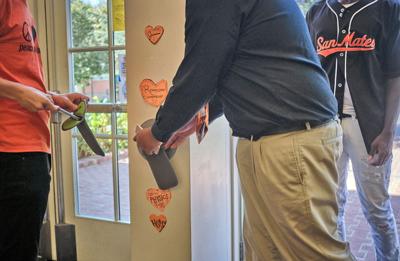
When students arrive, they are required to lock their cellphones into the pouch which is sealed by teachers or staffers each morning by using a magnetic bay. Students keep their phones with them in the pouches until the final bell rings when they are unlocked each afternoon.
Gelb said the program is overwhelmingly popular among teachers who are freed from the uphill battle of competing against the potent devices in the fight for pupils’ attention.
“The teachers are ecstatic,” said Gelb. “They love it.”
Less enthusiastic are students, said Gelb, who acknowledged the transition has been challenging for those who are accustomed to unencumbered access to their phones.
He balanced that perspective though by noting a portion of those initially opposed to the program are beginning to come around.
“They feel frustrated at first but, for the most part, most of them are adapting to the transition,” he said.
Yondr
To that end, Gelb said some students are finding it refreshing to be freed from the potential interruption of a text message, call or social media notice for a sustained stretch.
But others feel the school could have allocated resources in a more efficient fashion, said Gelb, who noted the program cost about $20,000 to purchase pouches for each student with a phone, plus install the locking bays.
Gelb said the school fronted the initial cost of purchasing a pouch for each student with a phone, but the $12 replacement cost if it is lost or damaged must be paid by the pupil.
For the part of the company, Yondr markets itself and a gateway to phone-free spaces. Also common at entertainment venues sensitive to the threat of crowd members recording material intended solely for a live audience, the San Francisco company is growing in popularity among educators.
San Mateo High School is the company’s largest ever public school client, said Gelb, who said his campus is regularly sharing information regarding implementation with other district schools. District spokeswoman Laura Chalkley said the program is not considered a pilot program for expansion — yet.
“Right now we don’t have plans to expand across the district, but we are certainly supportive of San Mateo High School. We’ll look at the data before making any decisions,” she said in an email. Gelb said a forthcoming survey gauging student experience will be a vital source of feedback on the program.
Implementation and emergencies
Outside of the mixed reviews from teachers and students, Gelb said parents largely support the initiative. Prior to rolling the pouches out, he said officials hosted a variety of discussions with the school community to set expectations.
Recognizing the anxiety potentially forming over limited communications in case of an emergency, Gelb said great attention was paid to assuring students, parents, teachers and other campus staffers understand response protocol.
Pointing to the emergency guidelines established by the county Office of Education in case of a violent threat or natural disaster, Gelb said officials believe their undivided attention will keep students safer.
“Nowhere does it say get a cellphone out and send a text,” said Gelb, regarding the school’s safety plan.
Recommended for you
To further smooth implementation, he said the school has hosted one drill per month to assure the entire school community is familiar with appropriate responses sans phones.
Regarding personal emergencies occurring off campus, Gelb said parents and families are again adopting the communication method employed before the birth of cellphones. Should a student need to be alerted at school, families are instructed to call the main office and a staffer will relay the message.
“We take a lot of pride getting messages to students when there is an emergency,” said Gelb.
Another indirect benefit of the phone-free environment is students’ enhanced attention to who is on campus and whether someone may be acting out of the ordinary, said Gelb.
“Students are a lot more aware of who is walking around,” he said.
Interaction
Gelb said the campus culture improvements invited by the phone restriction is most notable during brunch, lunch and other breaks when students interact during free time previously consumed by screen time.
“When I walk through the halls and see students engaging and communicating and using their voices when they want something, or asking a friend how they are doing rather than sending a text, that’s priceless,” he said.
While the image harkens back to a seemingly simpler time before public spaces were consumed largely by mobile technology users, Gelb admitted a generation of digital natives may not part easily with their phones.
In the case of those grappling with phone addiction issues, Gelb said the school’s counseling department is available to help students navigate the challenges they are experiencing.
“The goal is to give them coping skills to feel like they can get through the day without checking a screen,” he said, while noting medical exemptions are available to those with a documented need for unrestrained access to their phones.
He also said some have made the case that phones are essential instruments for finishing their coursework, to which he said a comparable tool is offered by the Chromebook laptops provided to students.
‘A team effort’
The absence of phones also reduces the threat of cheating on quizzes and tests, said Gelb, advancing the pouches’ popularity with instructors previously charged with scouring the classroom for those skirting the rules.
Scofflaws still exist though, admitted Gelb, as some students have identified workarounds to break their phones free from the pouches. If a student is caught with their phone during school hours, he said confiscation and parent intervention are among the initial steps in a punitive system which could escalate to detention.
Nodding to the sheer mass of students at San Mateo High School, the district’s largest campus, Gelb said launching and operating such a wide-scale initiative has been a challenge for teachers, administrators and staff.
“It’s a team effort,” he said, lauding the enhanced obligation of all campus employees to assure the program is running efficiently, including support staff such as those at the main office who are tasked with facilitating some of the communication which otherwise would have been conducted through students’ phones.
In all, he said the variety of efforts contributed to establishing an environment much more conducive to learning with the additional benefit of redefining what facetime means for students.
“I barely see a phone throughout the whole day, I think that has changed the whole culture and climate,” he said.
(650) 344-5200 ext. 105


(1) comment
After I finished reading this article, two things popped into my little head. First, waiting for a group of parents to hire a starving civil rights attorney and sue the district for infringing on their kid's freedom of speech and expression. Second, the kid's have probably already figured out the easy work-around. Just buy a “burner phone.” Throw the phone mommy and daddy pays for in the Yondr pouch and use the “burner phone.”
Welcome to the discussion.
Log In
Keep the discussion civilized. Absolutely NO personal attacks or insults directed toward writers, nor others who make comments.
Keep it clean. Please avoid obscene, vulgar, lewd, racist or sexually-oriented language.
Don't threaten. Threats of harming another person will not be tolerated.
Be truthful. Don't knowingly lie about anyone or anything.
Be proactive. Use the 'Report' link on each comment to let us know of abusive posts.
PLEASE TURN OFF YOUR CAPS LOCK.
Anyone violating these rules will be issued a warning. After the warning, comment privileges can be revoked.