An artificial intelligence transformation as profound as the Industrial Revolution is occurring. While I remain a firm believer in the enormous power and promise of AI to solve complex problems, such as curing diseases, I also believe we have a deep responsibility to keep our economy human centered.
Optimism is necessary, but without guardrails, it is negligence. We must heed closely the warnings of economists who echo Keynes’ prediction of “technological unemployment.” Today, this threat is underscored by institutions like Goldman Sachs and prominent academics such as MIT’s Nobel Prize winner, Dr. Simon Johnson, who warn of imminent and severe labor disruption. We are entering a period where AI’s efficiency is expected to eliminate jobs faster than the market creates new ones.
We cannot simply tell a displaced worker to “wait for the market to correct itself.” Unemployment is not just an economic statistic; it is a public health crisis. To protect our residents during this transition, I have brought forward three first-in-the-nation initiatives, which my colleagues on the Board of Supervisors unanimously adopted.
First, we adopted a policy regarding AI displacement and retraining in county operations. If the county implements AI to increase efficiency, we will not use it to fire people. Instead, we are mandating a commitment to human investment. If a role is rendered obsolete, we will retrain that employee, equipping them with new skills to transition into different roles that serve the public within the organization, to retain them until they leave through natural attrition. This explicitly guarantees that AI innovation will not come at the cost of human livelihoods.
Second, simply protecting existing jobs wasn’t enough; we must define the future of work. Now, if a county department wants to use AI to automate tasks, they must calculate the number of future jobs eliminated and present a plan to find and create new, human-centric jobs that improve service delivery and require the empathy and judgment a machine cannot provide, in numbers equal to or greater than the positions being automated. This mandate ensures technology serves as a tool for expansion of job types, not just extraction.
Third, to bridge the gap in the private sector, the Board of Supervisors recently approved my Workforce Entry and Economic Growth Initiative. We saw that recent graduates were struggling to find entry-level roles, the very career rungs AI is beginning to remove. The economic data is alarming: While the county’s overall unemployment rate hovers near 3.5%, the rate for young adults (ages 20-24) nationally spiked in 2025 to approximately 9.2%, reaching a level not seen since the end of the COVID pandemic.
Recommended for you
This $2 million program addresses that crisis head on. It subsidizes wages for small businesses to hire local graduates, effectively derisking the hiring process for employers while giving our recent graduates a foothold in the economy. It is the first initiative in the nation specifically designed to counter early career AI displacement by incentivizing the private sector to bet on human potential.
These policies signal it is incumbent upon both government and industry to work together to smooth this period of technological unemployment as AI scales. We cannot leave our residents, especially our new graduates, to face the storm alone.
Our work is essential and just getting started. In addition to office jobs eliminated by AI, as AI models scale alongside consumer-ready humanoid robots, whole sectors of the essential service economy, including domestic labor, retail and hospitality, will face direct employment contraction in the next decade. Even sectors currently experiencing labor shortages, like home elder-care, will be filled by these robots, closing off vital transition pathways for displaced workers who would otherwise seek new careers there. Everyone has a stake in these outcomes, as the economy is destabilized and the safety net is stretched to provide for the vulnerable. But a displaced workforce is not an unavoidable fate; it is a choice.
As consumers, we can exercise our power by intentionally supporting companies that value a human workforce. We can challenge the AI sector to adhere to an ethical, humancentric future, seeking not to mimic and eliminate the human workforce, but enhance it. We can demand it in government contracting. We can offer government collaboration to AI’s market customer. Work with us to retrain workers, embracing employee retention not as a financial burden, but as a core principle for our collective economic resilience. Collaborate with us to come through the period of technological unemployment faster, discovering the jobs of tomorrow. We can usher in an era of unprecedented innovation while still ensuring a paycheck remains firmly in the pockets of all of our neighbors.
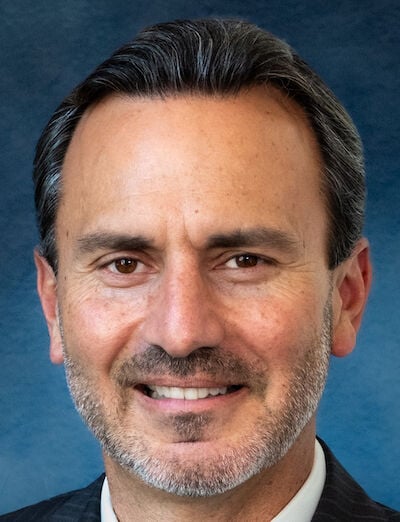
Ray Mueller is a member of the San Mateo County Board of Supervisors.
Stick to core duties: budget wisely and deliver services effectively. AI industrial policy is emphatically not your job. Boards of Supervisors lack authority or expertise to dictate private-sector AI adoption. In the 1990s, governments wisely chose not to regulate or restrict job losses from internet and e-commerce adoption, allowing the Bay Area to unleash Silicon Valley's explosive growth and prosperity. Had local governments imposed heavy "guardrails" like today's AI proposals, we would never have built the world's leading tech economy here.
Ray seems mostly worried about his base getting the hook because of AI. He even suggests that we park affected county employees somewhere, with pay and benefits, until they retire. Most interesting is his lack of concern about the cost to the taxpayers who will be stuck having to fund yet to be discovered services as if we don't already have enough regulators and bureaucrats who are never evaluated for performance or efficacy. Ray is out of his wheelhouse and should stick with issues assigned to the Board, ineffective as it is.
Supvr. Mueller is on top of a critical issue, but the competing tension is the cost of living here, and the need for efficiency in a bloated governance system - which burdens residents & taxpayers. Note that gov't workers also have pension benefits which make them very expensive compared to private sector workers. I don't have an immediate solution, and AI will be an ongoing problem requiring study and regulation. However one approach is to transition to a clean energy economy, training our new or displaced workers to build and operate THAT, while the Boomer workforce supports the fossil fuel economy in it's decline. We should have enough jobs for everyone, but a) the Federal Gov't needs to stop blocking our essential economic transition and b) it's not the County's job to provide welfare work at taxpayer expense.
If a public employees are fired or laid off because AI has made government more efficient, then so be it. There should be no guarantees for any public employee, like there’s no guarantee for any private employee. Lay them off, and let them find another job
Keep the discussion civilized. Absolutely NO
personal attacks or insults directed toward writers, nor others who
make comments. Keep it clean. Please avoid obscene, vulgar, lewd,
racist or sexually-oriented language. Don't threaten. Threats of harming another
person will not be tolerated. Be truthful. Don't knowingly lie about anyone
or anything. Be proactive. Use the 'Report' link on
each comment to let us know of abusive posts. PLEASE TURN OFF YOUR CAPS LOCK. Anyone violating these rules will be issued a
warning. After the warning, comment privileges can be
revoked.
Please purchase a Premium Subscription to continue reading.
To continue, please log in, or sign up for a new account.
We offer one free story view per month. If you register for an account, you will get two additional story views. After those three total views, we ask that you support us with a subscription.
A subscription to our digital content is so much more than just access to our valuable content. It means you’re helping to support a local community institution that has, from its very start, supported the betterment of our society. Thank you very much!



(4) comments
Stick to core duties: budget wisely and deliver services effectively. AI industrial policy is emphatically not your job. Boards of Supervisors lack authority or expertise to dictate private-sector AI adoption. In the 1990s, governments wisely chose not to regulate or restrict job losses from internet and e-commerce adoption, allowing the Bay Area to unleash Silicon Valley's explosive growth and prosperity. Had local governments imposed heavy "guardrails" like today's AI proposals, we would never have built the world's leading tech economy here.
Ray seems mostly worried about his base getting the hook because of AI. He even suggests that we park affected county employees somewhere, with pay and benefits, until they retire. Most interesting is his lack of concern about the cost to the taxpayers who will be stuck having to fund yet to be discovered services as if we don't already have enough regulators and bureaucrats who are never evaluated for performance or efficacy. Ray is out of his wheelhouse and should stick with issues assigned to the Board, ineffective as it is.
Supvr. Mueller is on top of a critical issue, but the competing tension is the cost of living here, and the need for efficiency in a bloated governance system - which burdens residents & taxpayers. Note that gov't workers also have pension benefits which make them very expensive compared to private sector workers. I don't have an immediate solution, and AI will be an ongoing problem requiring study and regulation. However one approach is to transition to a clean energy economy, training our new or displaced workers to build and operate THAT, while the Boomer workforce supports the fossil fuel economy in it's decline. We should have enough jobs for everyone, but a) the Federal Gov't needs to stop blocking our essential economic transition and b) it's not the County's job to provide welfare work at taxpayer expense.
If a public employees are fired or laid off because AI has made government more efficient, then so be it. There should be no guarantees for any public employee, like there’s no guarantee for any private employee. Lay them off, and let them find another job
Welcome to the discussion.
Log In
Keep the discussion civilized. Absolutely NO personal attacks or insults directed toward writers, nor others who make comments.
Keep it clean. Please avoid obscene, vulgar, lewd, racist or sexually-oriented language.
Don't threaten. Threats of harming another person will not be tolerated.
Be truthful. Don't knowingly lie about anyone or anything.
Be proactive. Use the 'Report' link on each comment to let us know of abusive posts.
PLEASE TURN OFF YOUR CAPS LOCK.
Anyone violating these rules will be issued a warning. After the warning, comment privileges can be revoked.