February is Black History Month, an appropriate time to remember San Mateo’s Williams family who overcame discrimination — and sometimes segregation — to contribute much to the history of the Peninsula and even the nation.
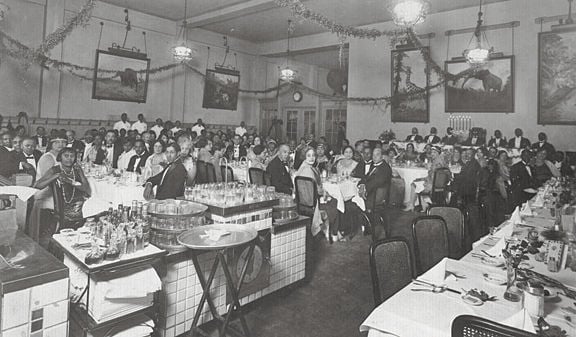
An exhibit entitled “Noah’s Ark: San Mateo’s Historic Restaurant” opens Jan. 23 at the San Mateo County History museum at Courthouse Square on Broadway in Redwood City. The exhibit that ends April 15 includes items from the restaurant operated by black entrepreneur Noah Williams, perhaps the most popular restaurateur on the Peninsula during the 1920s. In addition to its menu of Southern cuisine, Noah’s Ark was renowned for its décor that stressed the biblical Noah’s Ark throughout. Huge paintings of animals were hung on the walls, and some of those paintings will be featured in the exhibit which also has a variety of photos from the restaurant that opened in 1925 and closed in 1931, a victim of the Depression.
The restaurant on Third Avenue, as well as an earlier cafeteria Williams ran on B Street, was very popular with students from San Mateo Junior College, now College of San Mateo. Williams gave students a discount, allowing his ads to boast that “You will always find a J.C. crowd at Noah’s.” Despite its popularity, Blacks could not dine at Noah’s, even though the staff was African-American, according to the La Peninsula magazine, the journal of the San Mateo County Historical Association.
Blacks “could not patronize the restaurant because their presence might prompt white customers to leave, and the black community in San Mateo was too small for Mr. Williams to maintain his business,” the magazine said in its spring 2016 edition. Williams solved the dilemma by closing Noah’s Ark on Mondays, but informally opening it to black patrons on that day of the week.
The restaurant served more than 1,500 people during its first weekend alone. The opening in January 1925, was a major event with the mayors of San Mateo, Burlingame and Hillsborough in attendance.
Recommended for you
“Everyone ate at Noah’s,” Paul Buchanan wrote in a Daily Journal story in 2000. The patrons included movie stars “staying at the nearby Benjamin Franklin Hotel, such as Ginger Rogers and Laurel & Hardy.” California Gov. Friend Richardson was quoted as saying he “longed for some of Noah’s specially cooked ham.”
Noah Williams, who was 74 when he died in 1962, was the father of Les Williams, who is spotlighted in a separate exhibit at the museum, one on San Mateo County and World War II. The son was a member of the famed Tuskegee Airmen. He reached the rank of captain, serving as the pilot of a B-25 bomber.
Les Williams helped battle discrimination in the armed forces, which was segregated in World War II. He is mentioned in the book “The Freeman Field Mutiny” by James Warren. According to the book, Williams was one of the black officers who went to a whites-only officers club at the Indiana base on March 10, 1945, “and ordered drinks and cigarettes” but were refused service. President Truman ended military segregation just three years later.
The Freeman Field incident “illustrated that the black officer was capable of showing initiative and anger,” Warren wrote. “Moreover, he could also organize and use regulations to his advantage. This action was unprecedented.”
After the war, Les Williams, who died in 2015 at the age of 95, ran a dancing school and went on to attend Stanford University and become an attorney. The San Mateo County Bar Association diversity award bears his name.
The Rear View Mirror by history columnist Jim Clifford appears in the Daily Journal every other Monday. Objects in The Mirror are closer than they appear.
Thanks for sharing this history and timely info about the exhibit at the San Mateo County History Museum. Hadn't known about the remarkable Williams family.
Keep the discussion civilized. Absolutely NO
personal attacks or insults directed toward writers, nor others who
make comments. Keep it clean. Please avoid obscene, vulgar, lewd,
racist or sexually-oriented language. Don't threaten. Threats of harming another
person will not be tolerated. Be truthful. Don't knowingly lie about anyone
or anything. Be proactive. Use the 'Report' link on
each comment to let us know of abusive posts. PLEASE TURN OFF YOUR CAPS LOCK. Anyone violating these rules will be issued a
warning. After the warning, comment privileges can be
revoked.
Please purchase a Premium Subscription to continue reading.
To continue, please log in, or sign up for a new account.
We offer one free story view per month. If you register for an account, you will get two additional story views. After those three total views, we ask that you support us with a subscription.
A subscription to our digital content is so much more than just access to our valuable content. It means you’re helping to support a local community institution that has, from its very start, supported the betterment of our society. Thank you very much!







(1) comment
Thanks for sharing this history and timely info about the exhibit at the San Mateo County History Museum. Hadn't known about the remarkable Williams family.
Welcome to the discussion.
Log In
Keep the discussion civilized. Absolutely NO personal attacks or insults directed toward writers, nor others who make comments.
Keep it clean. Please avoid obscene, vulgar, lewd, racist or sexually-oriented language.
Don't threaten. Threats of harming another person will not be tolerated.
Be truthful. Don't knowingly lie about anyone or anything.
Be proactive. Use the 'Report' link on each comment to let us know of abusive posts.
PLEASE TURN OFF YOUR CAPS LOCK.
Anyone violating these rules will be issued a warning. After the warning, comment privileges can be revoked.