
By Heather Murtagh
Daily Journal Staff
The brutal murder of a 14-year-old boy is heinous in any setting, but when the crime is committed by a pair of teens does it warrant the death penalty?
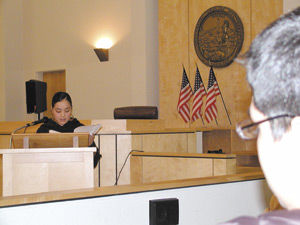
In 1924 Chicago, 19-year-old Nathan Leopold and 18-year-old Richard Loeb set out to commit what became known as the crime of the century. It is also the crime Peninsula High School juniors and seniors are using to decide how teens who commit heinous crimes should be handled. As part of a new juvenile justice unit, two English teachers combined elements of expository writing, speech, research and analysis for their students culminating in a judicial setting with closing arguments.
Each student chose if they wanted to represent the prosecution or the defense. While some of the students argued on the side of the prosecution, citing equality of the law or using an eye-for-an-eye logic, others said killing a killer is perpetuating a cycle of violence.
"They killed like men. They should die like men. Not like children being protected by the parents. Kill the killers like they killed,” said 17-year-old Martin.
On the other hand, students argued killing is never justified. Nor, was it the right of anyone to kill another. Spending life in jail, however, would force the teens to face their actions.
"A life sentence would prevent them from killing again. Let them suffer. Yes they killed an innocent young boy. If you were to kill these teens you’re telling future generations you have the right to kill if there is good reason. Wrong. No one has the right to kill,” said 17-year-old Jane.
More important than the arguments were the lessons learned without realization.
Senior Aline described the unit as being unlike any other English assignment. Others in second period agreed. Hearing the arguments of others also opened the opinions of the students. It also shined light on the legal system and differences in punishments for similar crimes, said 17-year-old Daisy. English teachers Vickie Rhodes and Tabitha Romano put together the curriculum over dinner last year. In preparation, students learned argumentative techniques in both writing and speech. Students researched the case, learned legal terms and needed to present themselves professionally during the closing argument presented in a superior courtroom on campus.
Rhodes noted a high interest from the students who enjoyed the atypical approach to English.
Recommended for you
Rhodes hopes to expand the unit to a full mock trail — a first for the continuation school.
The trial students researched made headlines in the 1920s and highlighted the teen killers.
Loeb and Leopold came from wealthy backgrounds, were considered highly intelligent and had a strange, but unique relationship together.
The pair began planning an attack in November 1923, setting up aliases and what to do after the murder before making a move in May.
In 1924 Loeb and Leopold kidnapped an acquaintance, 14-year-old Bobby Franks, who they then beat, killed and dumped. When dumping the body, Loeb and Leopold poured sulfuric acid on Franks’ face to attempt to hide the victim’s identity.
After killing Franks, Leopold called Franks’ parents saying their son had been kidnapped and to await instructions. The plan fell apart the next day. Ultimately, a pair of glasses belonging to Leopold linked the pair to the crime. The glasses he forgot he was wearing had fallen from his jacket and onto the body.
Judge John Caverly questioned the mental and emotional state of those able to commit such crimes.
He sentenced both Loeb and Leopold to life plus 99 years in prison. Caverly found the boys could not be sentenced to death given their young age. A cellmate killed Loeb on Jan. 28, 1936. Leopold watched Loeb in prison as doctors unsuccessfully tried to save Loeb.
Leopold was released from prison in 1954 and died from heart complications in 1971.
Heather Murtagh can be reached by e-mail: heather@smdailyjournal.com or by phone: (650) 344-5200 ext. 105.







(0) comments
Welcome to the discussion.
Log In
Keep the discussion civilized. Absolutely NO personal attacks or insults directed toward writers, nor others who make comments.
Keep it clean. Please avoid obscene, vulgar, lewd, racist or sexually-oriented language.
Don't threaten. Threats of harming another person will not be tolerated.
Be truthful. Don't knowingly lie about anyone or anything.
Be proactive. Use the 'Report' link on each comment to let us know of abusive posts.
PLEASE TURN OFF YOUR CAPS LOCK.
Anyone violating these rules will be issued a warning. After the warning, comment privileges can be revoked.