
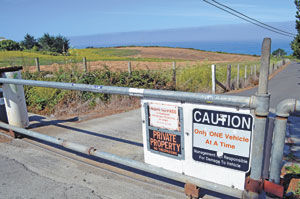
The battle to reopen Martin’s Beach to the public will proceed in Sacramento Tuesday, despite a near hostile legislative amendment induced by politicians’ fear of using eminent domain and alleged lobbying efforts afforded by the billionaire landowner.
The crescent-shaped strip of coast just south of Half Moon Bay was catapulted into the spotlight after venture capitalist Vinod Khosla bought the coveted and secluded cove in 2008 for $37.5 million and enraged environmental activists by quickly closing it to the public.
Concurrent efforts to restore Martin’s Beach to the public include pending legislation proposed by state Sen. Jerry Hill, D-San Mateo, that would require Khosla to negotiate with the state or face eminent domain, and a civil case filed by the nonprofit Surfrider Foundation scheduled to receive closing remarks July 16.
Attorney Joe Cotchett and former congressman Pete McCloskey represent Surfrider in its claim that Khosla violated the California Coastal Act by failing to garner mandated permits before closing the beach. Should Surfrider succeed, Khosla would have to apply for permits through the California Coastal Commission.
A new factor is in play as the Coastal Commission was granted discretionary authority to levy fines against those who block public beach access because of a trailer bill enacted when Gov. Jerry Brown signed the state’s budget Friday.
Once open to the public for more than 100 years, Martin’s Beach now epitomizes the dispute over the rights of private property owners versus the public’s long-established entitlement to access the California coastline.
Khosla’s attorney, Jeffrey Essner, previously said the public was allowed to access the beach before for a fee, so there was no right of public access.
“This lawsuit represents a clash between the constitutional right of a property owner to exclude (the public) from his private property and the cause of a political and activist organization to gain access,” Essner said during a May court hearing. Essner represents Martin’s Beach LLC, the company Khosla established to purchase the beachfront land.
Still, Hill said the situation could have larger ramifications for access to public land and efforts to stop that.
“Certainly with the disparity of wealth which we see today, this may be the first of many new attempts to buy away California and privatize it,” Hill said. “And we’re all very conscious of the loss of the middle class. It’s in our consciousness now more than ever and I think that’s why this is resonating around the country and around California. And again, Californians are very protective of their coastline and access to their natural resources. So we’re very sensitive to that. So that’s why I think it’s becoming, in many cases, a cry for a voice.”
Legislative journey
Hill’s Senate Bill 968 was approved 21-11 in the state Senate last month, but only narrowly made it through the Assembly Committee on Natural Resources last week due to weighty lobbying efforts allegedly funded by Khosla.
SB 968 would give Khosla until Jan. 1, 2016, to negotiate with the State Lands Commission to reopen Martin’s Beach or allow the state to use eminent domain to create an access road off Highway 1.
The bill will be heard in the Assembly Judiciary Committee 9 a.m. Tuesday but, ultimately, Hill said his goal is to negotiate a reasonable settlement with Khosla to reopen Martin’s Beach.
But Hill and McCloskey said it’ll take work to carry the bill through the Assembly Judiciary Committee as some expressed concerns after hearing from Khosla’s lobbyist.
Cotchett, McCloskey and Hill said Rusty Areias, a former assemblyman and coastal commissioner who was allegedly hired by Khosla, nearly instigated a hostile amendment that would have stripped SB 968 of the term eminent domain.
“What a lobbyist can do, and it’s lobbying 101, is you just create a little bit of fear, uncertainty or doubt in any issue,” Hill said. “The goal is that it never gets to that point and that access be granted by Mr. Khosla and certain conditions can be applied to allow that. And at the end of the day we want to make sure that eminent domain is a viable option that the (State) Lands Commission could use.”
McCloskey said Areias claims Khosla wants to negotiate and avoid eminent domain. However, McCloskey said he’s not buying it based on four years of attempts to contact Khosla and his refusing to testify until Surfrider was forced to subpoena him in court.
Recommended for you
“This is really a conservation issue, access to the California coast is the whole purpose of the [California] Coastal Act. … I recognize [Khosla’s] property rights. But he’s refused to attend any mediation hearings, settlement conferences. This man is not friendly to talking about reasonable settlements,” McCloskey said. “I think this issue could be best characterized as legislative courage against arrogant wealth.”
Areias could not be reached for comment.
Coastal Commission fines
Despite Hill’s bill, the State Lands Commission was granted the power to levy eminent domain in 1975, however, it’s never done so.
With the state’s budget approved, for the first time in history the Coastal Commission can now impose fines against those who violate the California Coastal Act by preventing public access to coastal resources, said Sarah Christie, legislative director for the California Coastal Commission.
“It’s something the commission has been trying to get for over 20 years, under four different governors. We are essentially the only regulatory state agency that doesn’t have penalty authority,” Christie said.
Public access violations are the Coastal Commission’s largest classifications of backlog complaints and they can also be the most difficult to resolve, Christie said. With this new discretionary authority, Christie said the Coastal Commission will hopefully be able to resolve existing violations quicker and deter future ones from occurring.
If Khosla is found in violation of the Coastal Act, a court could order fines up to $15,000 per day or the Coastal Commission could impose more than $10,000 a day for a maximum of five years.
Cotchett argues the courts already levy fines at the behest of the Coastal Commission and that the community is frustrated that the state hasn’t acted on Martin’s Beach.
“The law is on the books, that they could stop him. ... Why is it the Coastal Commission, having had a number of complaints before them, has not acted in four years? There’s been access in the past, you cannot lock that property up and deny the public access. You can only do it with the permission of the California Coastal Commission,” Cotchett said.
Cotchett said if putting up signs and locking the gate to Martin’s Beach is found to have violated the Coastal Act, Khosla would need to apply for permits, which he’d be hard-pressed for after this much public upset.
Christie said the Coastal Commission is working on gathering data and studying the aspects of the nuanced Martin’s Beach case.
“I think it’s fair to say this is a complicated case. There are a lot of extenuating facts and circumstances associated with this violation and we are proceeding very deliberately,” Christie said.
Although eminent domain has some in the Legislature concerned, Christie said many overlook how often it is used to expand highways, train tracks and its potential for use in high-speed rail. Instead of using it just to pour concrete, Christie said Hill’s bill would entail purchasing a piece of property for the betterment of coastal resource access.
“[Eminent domain is] a tool that governments use to provide for critical public needs and I think public access is a critical public need,” Christie said. “I’m not saying it’s warranted in every situation, but the public benefit of access to this stretch of coast is self-evident.”
(650) 344-5200 ext. 106


(0) comments
Welcome to the discussion.
Log In
Keep the discussion civilized. Absolutely NO personal attacks or insults directed toward writers, nor others who make comments.
Keep it clean. Please avoid obscene, vulgar, lewd, racist or sexually-oriented language.
Don't threaten. Threats of harming another person will not be tolerated.
Be truthful. Don't knowingly lie about anyone or anything.
Be proactive. Use the 'Report' link on each comment to let us know of abusive posts.
PLEASE TURN OFF YOUR CAPS LOCK.
Anyone violating these rules will be issued a warning. After the warning, comment privileges can be revoked.