Local firefighters have returned home after battling wildfires throughout the state, but many expect to be back on the frontlines before long.
The wildfire season is far from over and the most destructive months historically are yet to come. This season, fires have already torched more than 740,000 acres, damaged or destroyed over 2,000 structures and killed 12 people, including six first responders.
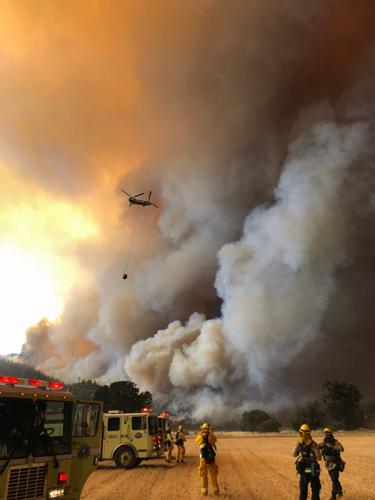
Kirk Steers/San Mateo Consolidated Fire Department
As of mid-August, 12,500 firefighters from all over the country and as far away as Australia and New Zealand were battling 11 wildfires across the state. San Mateo County fire departments sent three strike teams — each comprised of five engines manned by four firefighters — plus 80 additional first responders in overhead positions, mostly to the Carr and Mendocino Complex fires.
One of those strike teams was led by Emil Picchi, battalion chief of the Woodside Fire Protection District. He and his crew arrived in Redding the day after the Carr Fire started.
“These were relatively new subdivisions and well-manicured houses like any Bay Area community and this fire came through and picked and chose what it wanted and eliminated more than it kept,” he said. “It was as if you just removed one neighborhood in Foster City.”
As the fire approached one neighborhood, Picchi’s team searched each home to see if it was inhabited. An emergency evacuation means people can’t come back to their homes while the fire is burning, but it doesn’t force them to leave.
A placard is placed on each property outlining conditions, access points or water sources, such as a pool, to inform other firefighters who might be assigned to defend that home once the fire hits.
The most important thing is to clear out any vegetation or debris from the perimeter of a structure, he said.
“The fire was starting to creep over the ridges as we were preparing homes and it did hit that following morning,” he said. After it hit, all that was left on many properties was a foundation with a pile of ash on top. “You couldn’t even imagine what the house looked like prior.”
Brutal conditions
Picchi saw conditions while fighting the Carr Fire he’d never seen before in his 26 years of being deployed to fight wildfires throughout the state.
“Rarely have I seen trees in a wildfire uprooted and thrown the way they were thrown,” he said. “You’ll see trees burn down through the core and topple over, but there were huge trees completely uprooted and swung across the road.”
Steve Stanovcak, a captain in Picchi’s strike team, said it wasn’t just the fire wreaking havoc on Redding neighborhoods.
“We’re in neighborhoods and [street] light poles are down, trees snapped over and it wasn’t fire damage, but wind damage,” he said. “I think the wind was created by the fire. It was storm damage, I’d never seen that before.”
After the fire hit a neighborhood, Picchi’s team searched through the remains to extinguish smoldering hot spots. The work entails a lot of hiking, digging and hard, physical labor in brutal conditions. They’re covered in multiple layers, carrying some 20 pounds of gear and nearly a gallon of water, plus hand tools and chain saws. It was 112 degrees during the day, 98 degrees at night and the sky was almost always filled with smoke.
Stanovcak said there was about a quarter mile of visibility in Redding and he barely saw blue skies or the sun in his nine days there.
Even back at camp, only the air conditioned-trailers where firefighters slept offered reprieve from the smoke. Those trailers have three levels and can accommodate 45 people. Stanovcak said it’s like sleeping on a submarine, which is a big upgrade from sleeping outside in the smoke and heat as they often have fighting wildfires in past years.
Salvage work
Firefighters also spent much of their time helping homeowners salvage whatever they could.
“Everything was significant to them. Because they’ve lost so much they’re happy to find the smallest things,” Stanovcak said.
Recommended for you
One elderly man, a Vietnam veteran, lost everything but a collection of river rocks he wanted to save. Stanovcak and Picchi along with their entire strike team spent some 20 minutes helping load the rocks into a truck.
“He and his wife were trying to haul the river rocks by themselves and there was a couple of tons of it. He saved up for over three years to buy those rocks and he wanted them for when he’d rebuild the house,” Picchi said. “This man was sitting there crying because we stopped to offer some help. We’re here to help, it doesn’t matter what the job is. If we can make it a little better out of a lousy situation, OK let’s do it.”
The Carr Fire is now almost entirely contained, as is the Mendocino Complex fire, which was officially the largest in California history.
Kirk Steers, a San Mateo-based firefighter, was deployed for 16 days to first fight the Cranston Fire in Southern California before relocating to the Mendocino Complex.
“That was exciting for us,” Steers said. “Obviously the devastation isn’t the exciting part, but we’re trained to do this. We’ve dedicated our lives and careers to fighting fires and it’s exciting when you get a chance to perform and do what you’re trained to do.”
This was Steers’ 15th deployment.
“I volunteer to go every time,” he said. “I enjoy the hiking, firefighting, the different locations and everything about wildland firefighting.”
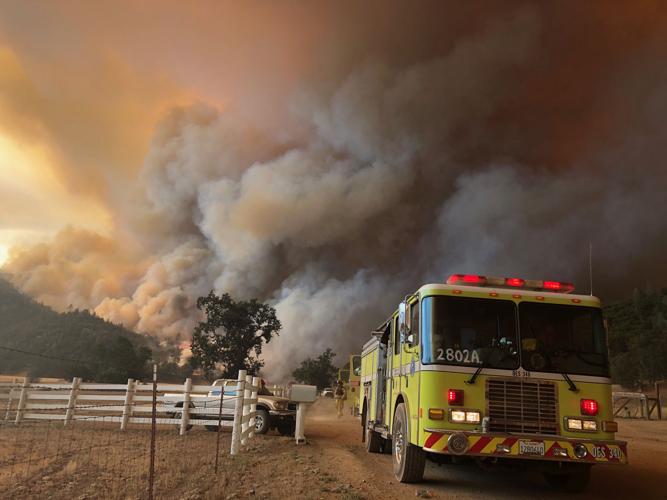
Kirk Steers/San Mateo Consolidated Fire Department
Defending a ranch
Steers’ crew arrived three days after the area began burning, and he said many people didn’t want to leave their homes.
“It’s more common than you’d think. People are determined to protect their property at all costs,” he said.
Steers was assigned to defend one property with three houses on it. A family with a mother, father, grandmother and three sons refused to leave.
The fire came ripping through the area so quickly and intensely that Steers’ crew had to relocate for a short while, but still the family stayed.
The fire fortunately went around them, but it consumed every other home in the area.
“I don’t think people realize how real the threat is and by the time they see it, it’s too late. That’s how people die,” Steers said.
That was Steer’s first day in Mendocino. Days later, his team spent an entire night defending a ranch completely surrounded by flames and ended up saving the home, barns and horses. The fire crept up within 10 feet of the barns while the owner watched from a safer location not far away. By morning, the entire surrounding valley was black.
Steers said the smoke is the hardest part about fighting wildfires as responders often only wear a handkerchief to protect themselves; firefighters don’t use the self-contained breathing apparatus that they use when fighting structure fires because it’s too bulky and only provides oxygen for about 30 minutes.
On their way out of town, Steers’ team stopped in Ukiah for breakfast and happened to run into the owners of another home they were able to save.
“They hadn’t heard about their house and we were able to let them know it was OK and showed them pictures,” he said. “That never happens. You rarely get to see the people whose home you protected.”
Keep the discussion civilized. Absolutely NO
personal attacks or insults directed toward writers, nor others who
make comments. Keep it clean. Please avoid obscene, vulgar, lewd,
racist or sexually-oriented language. Don't threaten. Threats of harming another
person will not be tolerated. Be truthful. Don't knowingly lie about anyone
or anything. Be proactive. Use the 'Report' link on
each comment to let us know of abusive posts. PLEASE TURN OFF YOUR CAPS LOCK. Anyone violating these rules will be issued a
warning. After the warning, comment privileges can be
revoked.
Please purchase a Premium Subscription to continue reading.
To continue, please log in, or sign up for a new account.
We offer one free story view per month. If you register for an account, you will get two additional story views. After those three total views, we ask that you support us with a subscription.
A subscription to our digital content is so much more than just access to our valuable content. It means you’re helping to support a local community institution that has, from its very start, supported the betterment of our society. Thank you very much!





(0) comments
Welcome to the discussion.
Log In
Keep the discussion civilized. Absolutely NO personal attacks or insults directed toward writers, nor others who make comments.
Keep it clean. Please avoid obscene, vulgar, lewd, racist or sexually-oriented language.
Don't threaten. Threats of harming another person will not be tolerated.
Be truthful. Don't knowingly lie about anyone or anything.
Be proactive. Use the 'Report' link on each comment to let us know of abusive posts.
PLEASE TURN OFF YOUR CAPS LOCK.
Anyone violating these rules will be issued a warning. After the warning, comment privileges can be revoked.