
By Dana Yates
Daily Journal Staff
When Susan Hahn retired as a social worker last year she was looking forward to the benefits associated with 40 years of hard work. Instead she found herself without health insurance and forced into two part-time jobs to cover the basic costs of drugstore checkups.
Hahn, 63, retired last year and doesn’t qualify for federal medical insurance for another two years. She quickly learned the $900 in Social Security she collects each month is not enough to cover living expenses and health insurance. As her federal Cobra coverage expired, she found her cheapest health insurance alternatives ranged between $750 and $975 a month.
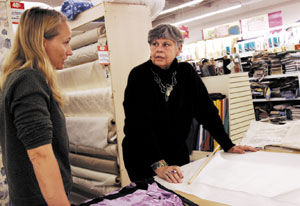
Now she works two jobs at a quilting store in San Carlos and as sewing instructor in Redwood City to earn about $1,400 a month. She still can’t afford health care insurance, but she can afford occasional out-of-pocket doctors appointments and regularly visits traveling clinics at a nearby Longs drug store. Each day she worries it will be the day something goes wrong.
She’s not the only one living with her fingers crossed.
San Mateo County health officials estimate the total number of uninsured adults is between 60,000 and 80,000 and 13 percent of adults between 19 and 65 reported being uninsured, according to the 2004 Community Assessment: Health and Quality of Life in San Mateo County.
Like affordable housing, the issue of universal health care in San Mateo County is now making its way to policy makers. Headed by county supervisors Jerry Hill and Adrienne Tissier, a blue ribbon committee of community members and experts began meeting last month to discuss the problem and how to fix it. It plans to meet for a year before reporting to the Board of Supervisors with its findings.
Without health care coverage and access to preventive medicine, seriously ill patients are more likely to flood the county’s medical center. The cost falls on the county and, ultimately, taxpayers.
Even the number of uninsured is questioned by some. Members of the Peninsula Interfaith Action Network, a coalition of congregations working to improve quality of life through policy change, argue closer to 87,000 county residents go without insurance.
People without insurance are usually not counted until they have to rely on county services, said Barbara Keefer, a member of PIA working on the blue ribbon committee.
In March, PIA held a public meeting at St. Matthew’s Catholic Church in San Mateo in which hundreds of residents — insured and not — pressed Hill to pursue ways to improve health care coverage in the county.
The problem, as Hahn sees it, is the inability of working residents to get affordable health care. There are state-sponsored programs for very low-income residents and children. Hahn makes $200 too much each month to qualify for state help. By cutting back on work hours, she risks not being able to pay other expenses.
"I’ve always worked with low-income housing projects, with drug and alcohol dependency programs in [San Francisco]. I find it ironic I can’t get the same service they get.” Hahn said.
Hahn’s mother died of breast cancer and she worries she could fall victim to the same fate without regular checkups. A regular checkup will cost well more than $300 if she pays out of pocket, Hahn said.
Recommended for you
The silver lining in the county’s health care crisis is that children 18 and under are already covered through its Children’s Health Initiative, which the Board of Supervisors passed in 2003.
For Jessica Alger, 30, of Millbrae, the program provides some peace of mind as she tries to take care of her two young children. When she’s not watching her children, she’s working as a waitress at Embassy Suites in Burlingame. Alger works part time and does not have health care coverage. She would like to get a second job, but then she would make too much money to qualify for the federal Moving to Work program, which encourages self-sufficiency in low- and very low-income residents.
Alger has had a broken tooth for some time, but can’t afford the dentist appointment and procedure to fix it. Instead, she’s focused on making sure her children stay healthy, she said.
"If I could afford it, I would fix it,” Alger said.
By the numbers
13 percent — San Mateo County residents who report being uninsured.
83.5 percent — Have a regular physician’s office or clinic they use when in need of medical care.
86.4 percent — Have have some type of health insurance coverage, down significantly from 90.7 percent in 2001.
23.8 percent — Report their job does not offer health benefits to employees, up significantly from 19.8 percent in 2001.
10.2 percent — Were unable to purchase a needed medication in the past year because of the cost
60,000 to 80,000 — Estimated number of adults in San Mateo County without health care insurance.
* 2004 Community Assessment: Health and Quality of Life in San Mateo County.
Dana Yates can be reached by e-mail: dana@smdailyjournal.com or by phone: (650) 344-5200 ext. 106. What do you think of this story? Send a letter to the editor: letters@smdailyjournal.com.


(0) comments
Welcome to the discussion.
Log In
Keep the discussion civilized. Absolutely NO personal attacks or insults directed toward writers, nor others who make comments.
Keep it clean. Please avoid obscene, vulgar, lewd, racist or sexually-oriented language.
Don't threaten. Threats of harming another person will not be tolerated.
Be truthful. Don't knowingly lie about anyone or anything.
Be proactive. Use the 'Report' link on each comment to let us know of abusive posts.
PLEASE TURN OFF YOUR CAPS LOCK.
Anyone violating these rules will be issued a warning. After the warning, comment privileges can be revoked.