When San Francisco was developing in the mid-1800s, it was all work and no play for the inhabitants of the small pueblo.
The excitement of gold fever attracted mainly men who could live a robust, non-structured life that all boomtowns experienced. Drink and carousing around was the main recreation in the winter months when gold picking stopped due to the cold and wet weather. This cycle continued until the gold ran out and this frontier town began to grow up. After the gold rush boom, the men who stayed brought their wives and children to the still undeveloped town with dirt streets, no sewer system, no electricity and no organized entertainment. Families needed some type of entertainment that fit their needs and the saloons and whorehouses didn’t fit the bill.
The mid-1800s were still a world of ignorance as most people’s exposure had been confined to a unexplored world relating to animals. The first exposure of exotic animals began with a few men who had experienced the world in their travels. The sailors tales of huge, dangerous “things” excited the men in the bars and slowly some of these exotic animals began showing up in a few bars. Monkeys, parrots and other small animals began appearing in bars such as “The Cobweb Palace” in North Beach. Mr. Woodward, a successful businessman, built a mansion on four acres, by Mission and 16th streets. His fascination with exotic animals and paintings from Europe led him to opening his grounds to the public. The response was immediate and prosperous so he kept collecting more animals, built rides and games that attracted the people of San Francisco.
Meantime, other types of entertainment began, such as the shoot-the-chutes by Golden Gate Park and along the Great Highway by Cliff House. It became obvious that without control these exhibits weren’t always kind to the animals and health issues arose from uncontrolled supervision.
The San Francisco Park Commission was established in 1870 to oversee the development of parks and playgrounds and businessman, Herbert Fleishhacker, became president of the organization in 1922. This successful civic leader brought to the board an enthusiasm for animals that resulted in his proposing the city build a mammoth swimming pool and a zoo.
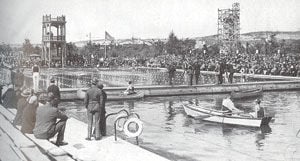
He ran into another animal enthusiast, George Bistany, while on his travels in Manila and hired him on the spot to oversee Fleishhacker’s vision and construct a zoo for San Francisco. Fleishhacker acquired 60 acres of land south of Sloat Boulevard, along the Coast Highway and immediately made plans to build the largest swimming pool in the world. He never thought small. The pool was to be 1,000 feet long and 100 feet wide and filled with ocean salt water. The lifeguards numbered between 12 to 24 and some had to row around and supervise in boats due to its immense size. It was completed in 1925 and opened to an enormous crowd of 5,000 who came to watch the Amateur Union’s men swimming championship. This event marked a long and satisfying activity that thousands enjoyed over the years. To the west of the pool stood a Mediterranean-style bathhouse with green glazed-tile roof. It could accommodate 800 swimmers in the changing rooms with lockers for valuables. There was a dining room on the top floor and a mini-hospital to care for victims of slips and falls. The pool could accommodate 10,000 bathers in the 6,500,000 gallons of salt water that was designed to be heated (but it didn’t always seem so). The cool breezes from the ocean made swimming a challenge if the fog was heavy or it was raining. Mortimer Fleishhacker, Herbert’s brother, felt sorry for the mother’s trip to the pool so he donated $50,000 for a Mothers Building that could be used by the mothers to take care of their children and relax for a spell.
As time went by, the pool and Mothers Building deteriorated and the public decided that it was too costly to repair and keep in shape for the dwindling number of people who used it. In 1971, a storm damaged the pool’s outflow pipe and the city had to use fresh water. This created a algae problem that couldn’t be solved. By 1981, the pool was being used to bury debris and eventually the surface was made into a parking lot.
Rediscovering the Peninsula by Darold Fredricks appears in the Monday edition of the Daily Journal.
Keep the discussion civilized. Absolutely NO
personal attacks or insults directed toward writers, nor others who
make comments. Keep it clean. Please avoid obscene, vulgar, lewd,
racist or sexually-oriented language. Don't threaten. Threats of harming another
person will not be tolerated. Be truthful. Don't knowingly lie about anyone
or anything. Be proactive. Use the 'Report' link on
each comment to let us know of abusive posts. PLEASE TURN OFF YOUR CAPS LOCK. Anyone violating these rules will be issued a
warning. After the warning, comment privileges can be
revoked.
Please purchase a Premium Subscription to continue reading.
To continue, please log in, or sign up for a new account.
We offer one free story view per month. If you register for an account, you will get two additional story views. After those three total views, we ask that you support us with a subscription.
A subscription to our digital content is so much more than just access to our valuable content. It means you’re helping to support a local community institution that has, from its very start, supported the betterment of our society. Thank you very much!






(0) comments
Welcome to the discussion.
Log In
Keep the discussion civilized. Absolutely NO personal attacks or insults directed toward writers, nor others who make comments.
Keep it clean. Please avoid obscene, vulgar, lewd, racist or sexually-oriented language.
Don't threaten. Threats of harming another person will not be tolerated.
Be truthful. Don't knowingly lie about anyone or anything.
Be proactive. Use the 'Report' link on each comment to let us know of abusive posts.
PLEASE TURN OFF YOUR CAPS LOCK.
Anyone violating these rules will be issued a warning. After the warning, comment privileges can be revoked.