

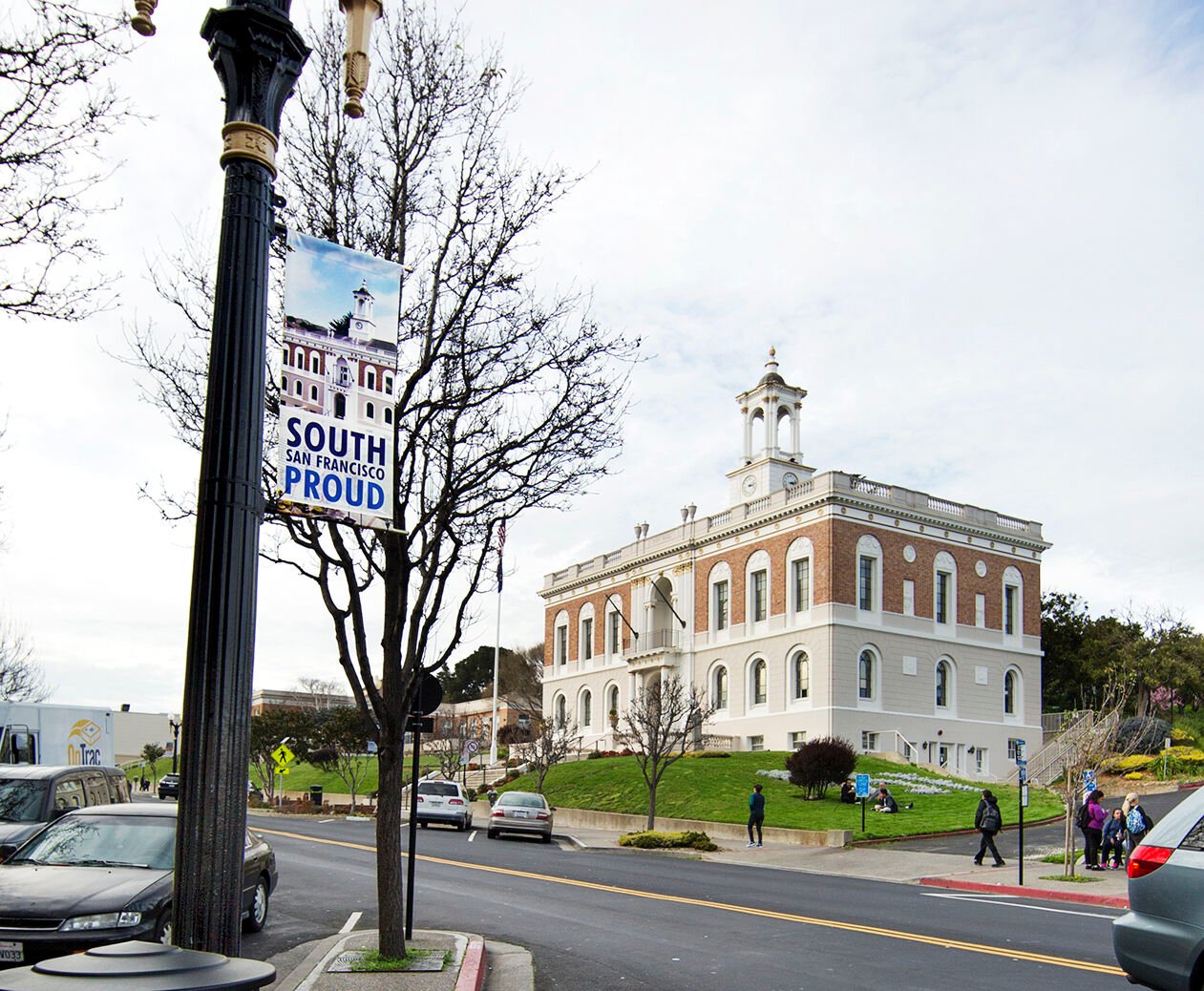
South San Francisco may scale down a ballot initiative headed to voters this November seeking to allow the city to own and operate its own housing developments.
Jurisdictions must obtain voter approval before acquiring or building low-income public housing, and the City Council earlier this year signaled intent to request permission to add the equivalent of 1% of its housing stock, roughly 225 units, yearly over the course of the next 30 years.
But amid concerns of lost property tax revenue and limited funding, city officials agreed to move forward with limiting the timeline to eight years — reducing the number of units the city could own by roughly 5,000. The council has until August to decide on a final measure.
“At the end of that 30 years, if we are a city that has 30% of its housing not participating in property tax, what’s the financial implication of that,” Councilmember Mark Addiego said. “More importantly, what happens with the school district that received three times as much money?”
Property tax, the city’s largest revenue stream, would not be collected from public housing.
The city has roughly 22,437 units of housing, according to the state Finance Department, and Addiego said the city already has roughly 1,000 units owned by nonprofit developers that similarly do not pay property tax.
“I’m not comfortable with 30 years, that seems like a stretch,” Mayor Mark Nagales said, who indicated his primary concern was with school district funding.
The city expects roughly $122 million to flow into its affordable housing fund over the next 15 years as fees are collected from commercial developers. City Manager Mike Futrell said $85 million of that is expected in the next four to five years. While the city could use some of that money for public housing, Nagales said, some of it should be saved for other uses, like acquiring land for apartment buildings with below-market rate rent.
Addiego estimated it would cost $700,000 per unit for the city to build housing; meaning the initial $85 million would build roughly 120 units.
“That’s not a prescription for success. It’s not enough bang for $85 million,” he said.
Traditionally, below-market rate housing in the city has been built by either nonprofit developers or included within larger market-rate projects, subsidized by for-profit developers as a result of the city’s inclusionary zoning rules. Nell Selander, Economic and Community Development director, said the most recent 456 affordable units built in the city had come at a taxpayer cost of $27,000 per unit.
In the case of city-owned housing, City Attorney Sky Woodruff said in addition to the city’s affordable housing fund, other public funding sources available to nonprofit affordable housing developers could be sought. The city, he said, could also ask voters to approve a new tax, which is how other cities have financed public housing. He emphasized that the proposal for November’s ballot would not increase taxes.
Recommended for you
Planning Commission Chair Sam Shihadeh, however, said the measure would indirectly cost other residents money either way.
“Let’s be realistic, no property taxes are going to be paid, somebody has to pay for those services that are going to be provided to the residents, so somehow someway residents are going to pay an increase,” he said.
As a potentially more cost-effective approach, the ballot measure would also allow the city to acquire privately held buildings to convert to public housing. The city could purchase “naturally affordable” buildings (those with low rents due to aging buildings or other reasons), and impose deed restrictions to preserve the low rents.
Deed restrictions that keep rents capped and units only available to low-income tenants often expire after 55 years. Councilmembers in the past have noted the need to preserve such units that could soon revert to market rate, displacing tenants.
“There are units down the road that will come up to market rate, and the majority of the people that live there are seniors living on fixed income,” Nagales said. “Having that finance ability to keep it as affordable, that’s a big piece of this as well.”
An eight-year cutoff would align with the city’s Regional Housing Needs Allocation, a state law that assigns housing production in eight-year cycles. The city’s next cycle begins in 2023, and per the law the city will need to permit 1,300 units of low-income housing by 2031.
The proposed timeline would allow the city to comfortably fulfill the allocation with public housing. The per-year allocation would roll over each year if unused, and the city could still build at the end of the eight years if a balance of allowable units remained.
Planning Commissioner Norm Faria said he expected a public housing program would take at least five years before a project could be developed. City planning staff previously mentioned the undertaking could necessitate a whole new city department.
San Francisco, Berkeley, Moorpark, Stockton and San Diego, in addition to Humboldt and Tuolumne county have all placed public housing initiatives on the ballot in recent years. South San Francisco would be the first to do so in San Mateo County.
(650) 344-5200, ext. 105





(0) comments
Welcome to the discussion.
Log In
Keep the discussion civilized. Absolutely NO personal attacks or insults directed toward writers, nor others who make comments.
Keep it clean. Please avoid obscene, vulgar, lewd, racist or sexually-oriented language.
Don't threaten. Threats of harming another person will not be tolerated.
Be truthful. Don't knowingly lie about anyone or anything.
Be proactive. Use the 'Report' link on each comment to let us know of abusive posts.
PLEASE TURN OFF YOUR CAPS LOCK.
Anyone violating these rules will be issued a warning. After the warning, comment privileges can be revoked.