

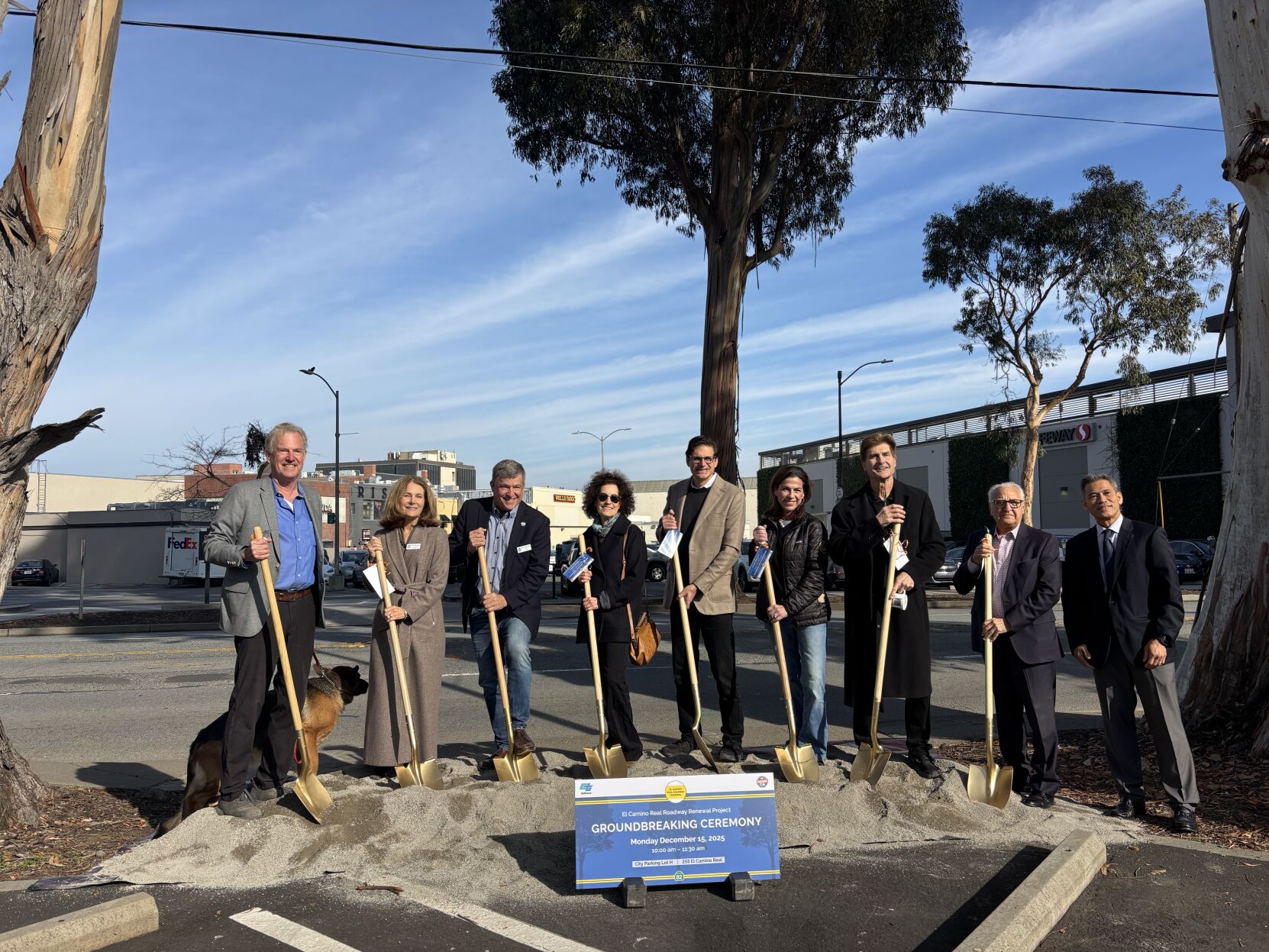
At the corner of El Camino Real and Burlingame Avenue, dozens of Caltrans employees in fluorescent vests waited to begin work on the El Camino Real Renewal Project.
They, like the bevy of local and state leaders who gathered on Monday, were there to celebrate the project’s long-awaited groundbreaking.
Then, they would get to work on the three-year renovation, which includes planned removal of 382 trees from the street, replanting of almost 460 trees, fixing failing sections of road and repairing sidewalks spanning from Millbrae to San Mateo, with a major focus on the Burlingame segment.
The massive renovation effort, which will necessitate major lane closures, has been decades in the making and at times controversial in the so-called city of trees.
With dedication and patience from transit agencies, city leaders and community members, the project has evolved into something the entire regional community can be proud of, Burlingame Vice Mayor Michael Brownrigg said to the assembled crowd.
“At the end of this project, there will be more trees on El Camino Real than there are right now. That’s incredible,” he said. “This project is a great example — you can preserve your past, preserve your history, but also build for the future.”
Bijan Sartipi, the retired Caltrans District 4 director who worked on the project for years, said the required removal of diseased eucalyptus and canopied trees came as a shock to residents when it was first proposed.
Over time and with cooperation — including insight from the Burlingame Historical Society and its president Jennifer Pfaff — a solution came together that could make all stakeholders proud.
“That was unacceptable, as a shock to the community, because they really value these trees,” he said. “There needs to be a project that brings in different species of the trees, takes down the ones that have to come down, and somehow protects the ones that cannot be taken down for different reasons. So it really took a collaboration between the state and the city and the community.”
Recommended for you
As a major state road, renovating El Camino Real can be a convoluted, complicated process. Finally breaking ground on the project is a testament to generations of dedicated leadership, Assemblymember Diane Papan, D-San Mateo, said.
“This is what happens when people are patient, when they get the stakeholders involved, and then they move the needle forward,” she said.
The project is one of the first major steps in the larger Grand Boulevard Initiative, a coordinated effort to revamp El Camino Real renewal efforts in 12 different San Mateo County cities. It will likely cost $750 million total and take up to a decade to fully complete.
From late December through May 2026, some road closures will take place on the northbound side of El Camino Real. The initial impact area will be from Dufferin to Rosedale avenues on the north end of the city. There will be tree removals on the northbound side of El Camino Real. Crews will also perform drainage work along the southbound side of the road. From May 2026 to summer 2027, work on pavement, sidewalks and tree replanting on the northbound side will necessitate closures of entire portions of the northbound side of the road, and one southbound lane will be open to northbound traffic. From summer 2027 to winter 2028, when that same work occurs on the southbound side, the traffic handling plan will be reversed.
During reconstruction and repavement of the middle lanes from winter 2028 to spring 2029, the inner lanes on both the northbound and southbound sides will be closed. Caltrans will also make improvements to the intersections during that time period.
Although traffic will flow both ways in at least one lane throughout the majority of the project, Caltrans is also planning to direct regional traffic away from El Camino Real and onto appropriate side streets. The agency will also have detour plans in place for when the road is closed entirely in one direction and will ensure residents and business owners on the street are always able to have access to homes and stores.
Separately, Pacific Gas and Electric will be undergrounding utilities on the road. That element of the project has been delayed until at least the second quarter of 2026.
As a vital transportation artery for the region, upgrading El Camino Real to make it safer for pedestrians, drivers and bikers alike while preserving the city’s character is no small feat, Burlingame Mayor Peter Stevenson said.
“Today’s groundbreaking of the El Camino Real Renewal Project represents far more than new pavement or infrastructure. It marks a shared commitment to transforming this historic corridor into a safer, smoother and more welcoming experience for everyone,” he said.





(1) comment
I hope that the new design is safer. Burlingame is not a safe place for pedestrians.
Welcome to the discussion.
Log In
Keep the discussion civilized. Absolutely NO personal attacks or insults directed toward writers, nor others who make comments.
Keep it clean. Please avoid obscene, vulgar, lewd, racist or sexually-oriented language.
Don't threaten. Threats of harming another person will not be tolerated.
Be truthful. Don't knowingly lie about anyone or anything.
Be proactive. Use the 'Report' link on each comment to let us know of abusive posts.
PLEASE TURN OFF YOUR CAPS LOCK.
Anyone violating these rules will be issued a warning. After the warning, comment privileges can be revoked.