

In their attempts to assure a sustainable future for coming generations, the seven candidates seeking election to the state Senate detailed their policies on environmental and education issues.
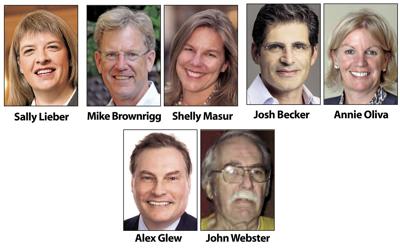
Five Democrats, one Republican and one Libertarian are running in the March election for 13th Senate District seat left vacant by state Sen. Jerry Hill, D-San Mateo, due to term limits: Former assemblywoman Sally Lieber; Burlingame Councilman Mike Brownrigg; Redwood City Vice Mayor Shelly Masur; nonprofit director Josh Becker; Millbrae Councilwoman Annie Oliva; Republican Alex Glew, an engineer who runs his own firm; and Libertarian John Webster.
In a series of endorsement interviews with the Daily Journal, each candidate explained their platforms on a variety of issues critical to the district spanning from Sunnyvale through a majority of San Mateo County. Our first article addressed candidates’ plans for unclogging traffic gridlock and combating the state’s housing crisis, and this article touches on climate change, education and other regional concerns.
Environmental policies
An experienced lawmaker, Lieber pointed to her long history of passing green legislation while in the Assembly in building her case as a champion for the environment.
“I feel like I got real stuff done,” said Lieber. During her term from 2002 to 2008, Lieber authored laws addressing incentives for electric and hybrid cars, air quality and protections for wetlands, among other initiatives.
Looking ahead, Lieber said her priority is aggressively limiting dependency on natural gas by transitioning to a focus on renewable power resources that can be locally generated and stored.
Masur also supported aggressive climate policy, and suggested the state should do more to assure it is a leader in implementing ambitious initiatives. To that end, she favored bumping up the deadline for California to be entirely powered by renewable energy from 2045.
“I think we need to have a greater sense of urgency,” said Masur.
To achieve such a goal, she said enhanced capacity for generation and storage of power generated from alternative sources is required. She suggested Sacramento could partner with local jurisdictions through enhanced investments or tax incentives.
Becker too favored collaboration, while pointing to connections in private industries that he can tap to help to help accelerate the process. As well, Becker highlighted green building opportunities that he believed would promote use of materials with a limited carbon footprint.
“I’m working on ideas that would incentivize green initiatives,” said Becker, whose past work through his capital fund focused on clean energy projects.
Becker also suggested phasing out two-stroke motors, or those commonly used in landscaping equipment, could be an effective fashion of limiting the state’s climate impact with a limited cost.
Glew supported simple efforts which could offer great benefits as well, such as reconfiguring home heating systems with more efficient components. An engineer with a background in lending his expertise to climate initiatives, Glew said he also backed efforts to limit reliance on natural gas.
To achieve that goal, one program he would not support is reach codes, or the movement to do away with gas appliances in new construction projects. Considering it a case of too much regulation, Glew said he would prefer to focus on smart energy usage incentives and policies.
“How do we get some quick results with minimal capital investments that pay for themselves?” said Glew, detailing a guiding principle he would pursue if elected.
Webster, meanwhile, suggested the climate change debate is blown out of proportion, but felt greater exposure should be given to those utilizing alternative forms of energy to illustrate potential benefits.
For her part, Oliva felt more attention should be paid to sea-level rise and credited the work taken on by county officials to address the issue along the Bayshore.
Noting she largely preferred to address environmental issues through efforts to improve housing opportunities and transportation policies, Oliva acknowledged she considered climate change a paramount concern.
“I don’t want to leave this to the next generation,” she said.
Brownrigg shared a similar perspective, considering environmental policy a foundation of his campaign. To that end, he favored establishment of a task force dedicated solely to addressing issues around climate change and the environment.
Considering the group’s work a top priority, Brownrigg also advocated for collaboration between local and state governments and well as private industry to identify more sustainable energy sources.
Such work would help California further establish its reputation as a pioneer on green initiatives, setting a pace for the rest of the nation to follow, he said.
“I think this is perhaps the most important issue to ask about because to do this will require political courage,” said Brownrigg,
Education policies
Regarding the need for bold action, Brownrigg too called for changes to the mechanism funding state schools.
Noting there is no consideration for the cost of living in allocations paid by Sacramento to wealthier parts of the state, Brownrigg said hardships are faced throughout the Bay Area in addressing inequality or paying teachers.
He said he would favor overhauling the Local Control Funding Formula in a fashion which would better address local needs, but that effort would require a dogged commitment from the next state senator.
“We just have to become more effective advocates,” he said.
Becker also said he could support amendments to the state funding formula, and would favor a split roll tax initiative which could lead to more financing for the state school system.
Recommended for you
“I would love to see if there are some modifications that can be made,” said Becker, regarding the state tax code and resulting school funding model.
With additional money, Becker said he would look to address staffing levels, teacher credential pipelines and resolving funding inequality, which is an issue he considers especially relevant in San Mateo County, where a sizable achievement gap lingers.
He said he would also like to see districts be offered greater capacity to pay off their unfunded pension liabilities, which he said presents a significant threat to the financial health of the state school system.
With a long history advocating for local schools during her time on the Redwood City Elementary School District Board of Trustees and other education initiatives, Masur too said the education budget is a top priority for the state.
“Funding will continue to be an issue,” she said.
Masur said she is hopeful some of the efforts to amend the financing structure will begin to pay dividends, but suggested the work will need to continue over the coming years to gain momentum.
Furthermore, nodding to her successes bringing together members of the local teachers unions as well as those from the charter school system in her work on education programs, Masur said she has the skills to build consensus among groups with divergent interests.
For his part, Webster said some of the system’s funding challenges might be addressed if schools charged tuition and those needing financial assistance to enroll could seek loans.
A graduate of local schools, Oliva framed much of her campaign around support for those with mental health issues in an attempt to prevent homelessness. Though she largely linked the issue to housing affordability, Oliva positioned herself as a champion for those in need of more care and support. She suggested additional resources paid toward preventative care programs could help enhance such an initiative.
Glew too favored similar programs, and said he would support initiatives freeing up public land to make way for supportive housing programs.
More specifically to education though, Glew said he would want more streamlined math and science requirements which simplify the way the core curriculum is taught. Suggesting Common Core standards have driven down the state’s test scores, he favored an overhaul modeling successes discovered in New York City.
“The education system isn’t teaching a lot of things very well,” he said.
For her part, Lieber said one of the most ambitious goals of her campaign is an effort to fully fund the state education system in the next decade.
She advocated for a wealth tax targeting billionaires and luxury services to finance an initiative she considered a moonshot. But without restructuring the state’s education financing mechanism, Lieber shared measured optimism that California would see precipitous changes to a system which most acknowledge is insufficient for such a large and wealthy state.
“My feeling is you get what you pay for in this life,” she said.
Other priorities, perspectives and programs
Regarding his perceived affiliation with technology companies and the deep pockets of Silicon Valley, Becker downplayed his corporate ties and positioned himself as a candidate free from partisanship.
“My goal is to be an independent, regional voice,” he said.
Oliva, meanwhile, leaned into her associated with the real estate industry, suggesting she has long worked hard to help countless locals achieve their dream of home ownership and appreciated the support from the San Mateo County Association of Realtors and similar advocacy groups.
“I’m very honored and humbled that they have noticed,” she said.
Webster said he favors doing away with punishment for victimless crimes, and opposed progressive policies that could lead to redistribution of wealth.
Brownrigg supported floating a bill requiring public agencies managing a moderate budget to record and broadcast all board meetings, then store the materials for a significant period after. He also supported an agriculture infrastructure initiative designed to restore water to aquifers in farming communities.
For her part, Masur said she would support legislation designed to address unintended consequences associated with Assembly Bill 5, which aimed to offer employment benefits to gig economy workers.
“There will need to be some fixes,” she said.
Criminal justice reforms should be a higher priority for state lawmakers, said Lieber, who opposed coordination between federal customs agents and local law enforcement agencies.
“The immigrant community is living in fear,” she said.
Glew said he would work to address issues around the state’s unfunded pension liabilities, which he considered the biggest threat to the state’s future.
“It’s a disaster, it’s the elephant in the room and it puts pressure on everything else,” he said.
(650) 344-5200 ext. 105







(0) comments
Welcome to the discussion.
Log In
Keep the discussion civilized. Absolutely NO personal attacks or insults directed toward writers, nor others who make comments.
Keep it clean. Please avoid obscene, vulgar, lewd, racist or sexually-oriented language.
Don't threaten. Threats of harming another person will not be tolerated.
Be truthful. Don't knowingly lie about anyone or anything.
Be proactive. Use the 'Report' link on each comment to let us know of abusive posts.
PLEASE TURN OFF YOUR CAPS LOCK.
Anyone violating these rules will be issued a warning. After the warning, comment privileges can be revoked.