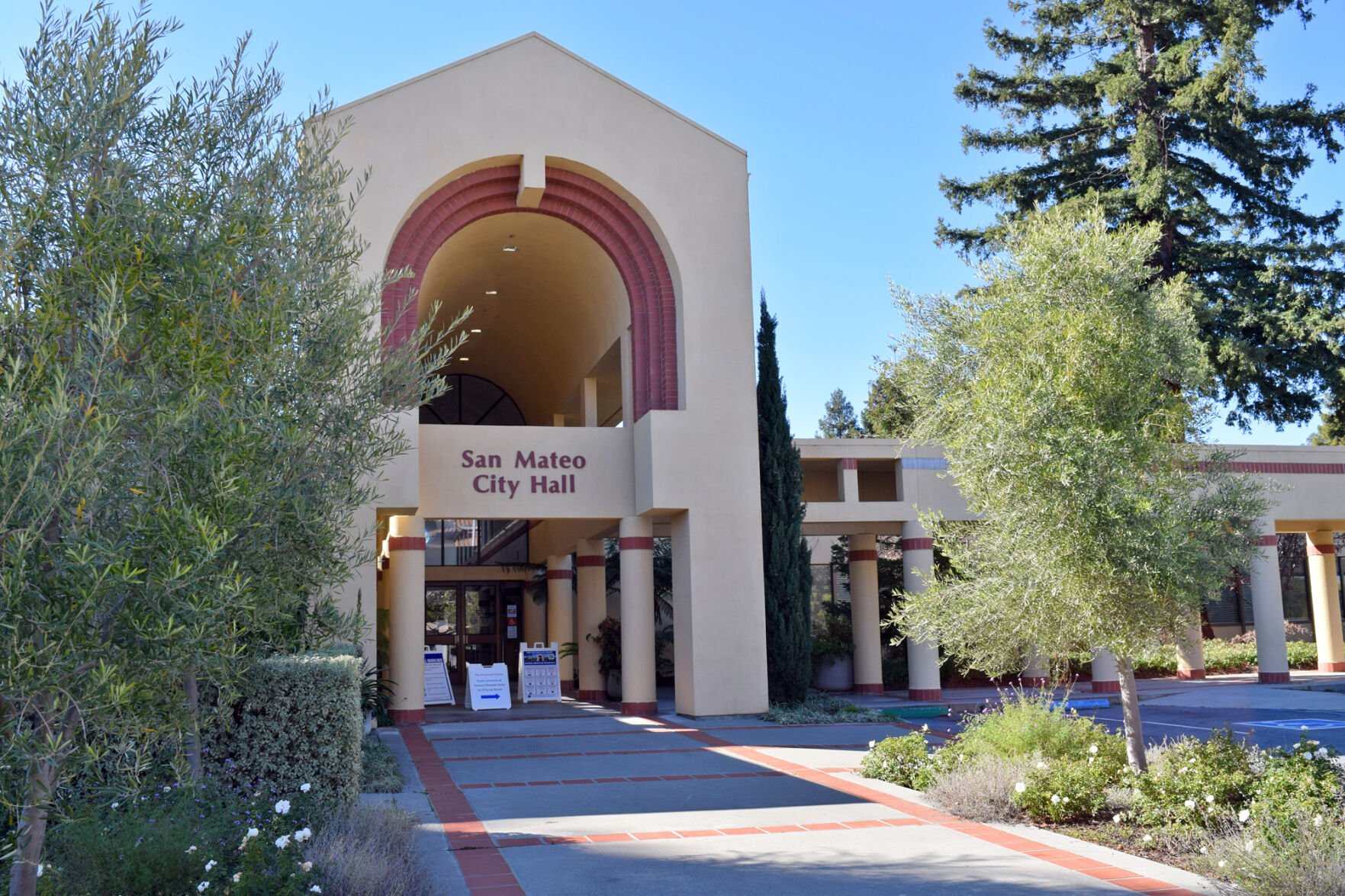
San Mateo councilmembers in an annual goal setting session this weekend identified a list of priorities for the year, among them increasing affordable housing and renter protections, bolstering sustainability initiatives and continuing to make road repairs and safety improvements.
Some priorities build on those identified by the council in previous years, others represent new ideas that will be further developed during future meetings. Mayor Rick Bonilla noted the potential need to limit the scope of the city’s work this year given uncertainty regarding staffing levels and funding as the pandemic continues.
“The city is looking at an overflowing plate full of activities and projects that we need to consider,” he said. “Right now we have a 5-pound bag with 30 pounds worth of stuff in it that we need to fund.”
Housing policies emerged as a key priority, with councilmembers agreeing to work to obtain external funding to subsidize below-market-rate homes, as well as to preserve the city’s current supply of affordable units. Boosting tenant protections — something that could entail creating a rental registry to track use of the city’s stock of rental units, was among the discussion.
Policy to allow for denser housing could also be part of efforts, with the council indicating it would like to explore adopting Senate Bill 10, a state law that would allow councils adopt an ordinance to zone any parcel to accommodate up to 10 units.
On the sustainability front, Bonilla introduced a goal to eliminate methane gas use in the city by 2030. An ordinance, if developed, would build on the law passed by the council in 2020 banning gas hookups in new residential and office construction, favoring the use of electric alternatives for appliances like stoves and heaters.
“This is an existential threat we’re talking about here, and it’s reached crisis levels already, climate change is overwhelming all of our systems,” Bonilla said of the proposal, which gained support from other councilmembers.
Other measures to be looked at include banning or restricting gas-powered leaf blowers, creating requirements for sustainable landscaping in home remodels and increasing the cities capacity to collect storm water.
Recommended for you
For road work, plans were set to continue the city’s effort to reconstruct failed streets, however, the date for completion was pushed from 2024 to 2026. City Manager Drew Corbett said the delay was partially due to funding, pointing to $29 million worth of upcoming projects currently being designed, but also a result of the impracticality of undertaking multiple large repairs at the same time given traffic impacts.
Councilmembers noted the need to balance reducing congestion with improving safety and limiting neighborhood cut-through traffic.
“We want to speed traffic up in places where there’s bottlenecks and slow traffic down in places where there are kids walking on the street and trying to enjoy their neighborhoods,” Councilmember Joe Goethals said.
Plans to facilitate that goal could include infrastructure and signs dissuading nonlocal traffic from traveling on neighborhood streets. Bonilla also emphasized the need to encourage modes of transportation other than single-occupancy vehicles, like public transit, carpooling, walking and cycling.
Among other goals, the council agreed to study rules to allow retail cannabis stores; adding a public restroom near the Caltrain station; expanding youth representation in city government; aiding small businesses in Americans with Disabilities Act compliance; campaign finance reform establishing expenditure limits; boosting transparency; and providing no-cost menstruation products.
Fear,fear, fear - natural gas and small combustion power tools. Real smart - eliminate an alternate source of energy when we have electrical brown outs. I agree small combustion engines are noisy and annoying. If the CO2 is that bad - the city should provide rebates to residents and property owners to replace gas combustible power tools.
Tarzantom – good points. Maybe the city should provide new “eco” power tools, along with at least a dozen battery packs, to folks who own gas combustible power tools. And maybe the city should inform folks about where the electricity to power all these new tools comes from (natural gas power plants from within the state and from outside the state). Meanwhile, we only get a goal of agreeing to aid small business in ADA compliance. So basically just more talking the talk, but not walking the walk. I guess it’s only businesses that are doing the walking, after closing down due to nuisance lawsuits.
Keep the discussion civilized. Absolutely NO
personal attacks or insults directed toward writers, nor others who
make comments. Keep it clean. Please avoid obscene, vulgar, lewd,
racist or sexually-oriented language. Don't threaten. Threats of harming another
person will not be tolerated. Be truthful. Don't knowingly lie about anyone
or anything. Be proactive. Use the 'Report' link on
each comment to let us know of abusive posts. PLEASE TURN OFF YOUR CAPS LOCK. Anyone violating these rules will be issued a
warning. After the warning, comment privileges can be
revoked.
Please purchase a Premium Subscription to continue reading.
To continue, please log in, or sign up for a new account.
We offer one free story view per month. If you register for an account, you will get two additional story views. After those three total views, we ask that you support us with a subscription.
A subscription to our digital content is so much more than just access to our valuable content. It means you’re helping to support a local community institution that has, from its very start, supported the betterment of our society. Thank you very much!







(2) comments
Fear,fear, fear - natural gas and small combustion power tools. Real smart - eliminate an alternate source of energy when we have electrical brown outs. I agree small combustion engines are noisy and annoying. If the CO2 is that bad - the city should provide rebates to residents and property owners to replace gas combustible power tools.
Tarzantom – good points. Maybe the city should provide new “eco” power tools, along with at least a dozen battery packs, to folks who own gas combustible power tools. And maybe the city should inform folks about where the electricity to power all these new tools comes from (natural gas power plants from within the state and from outside the state). Meanwhile, we only get a goal of agreeing to aid small business in ADA compliance. So basically just more talking the talk, but not walking the walk. I guess it’s only businesses that are doing the walking, after closing down due to nuisance lawsuits.
Welcome to the discussion.
Log In
Keep the discussion civilized. Absolutely NO personal attacks or insults directed toward writers, nor others who make comments.
Keep it clean. Please avoid obscene, vulgar, lewd, racist or sexually-oriented language.
Don't threaten. Threats of harming another person will not be tolerated.
Be truthful. Don't knowingly lie about anyone or anything.
Be proactive. Use the 'Report' link on each comment to let us know of abusive posts.
PLEASE TURN OFF YOUR CAPS LOCK.
Anyone violating these rules will be issued a warning. After the warning, comment privileges can be revoked.