

Redwood City’s ongoing construction boom is good news for some and excessive for others, and just about everyone agrees that a lack of affordable housing and projected budget deficits are two of the main challenges moving forward.
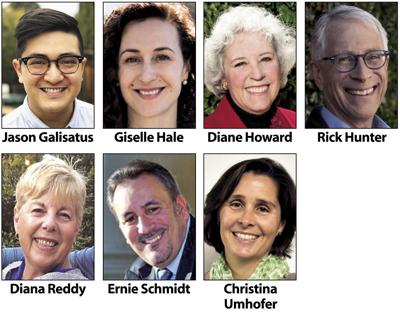
That is the backdrop for the City Council race, which features seven candidates competing for three open seats.
The candidates are Jason Galisatus, activist and member of the Complete Streets Advisory Committee; Planning Commissioner Giselle Hale, longtime Councilwoman Diane Howard; Rick Hunter, accountant and former planning commissioner; activist Diana Reddy, Planning Commissioner Ernie Schmidt and local businesswoman Christina Umhofer.
Each candidate supports the half-cent sales tax measure on the November ballot, but with varying degrees of enthusiasm. Galisatus, Reddy and Hale support the cannabis tax, also on the ballot, for bringing in a modest increase in revenue, and they also look forward to seeing those numbers grow with the legalization of retail commercial cannabis in the future.
“Cannabis is here to stay, we may as well benefit from it,” Reddy said.
Umhofer said cannabis research and development brings in more money than retail and is suggestively interested in seeing that industry have a greater presence in the city.
Schmidt and Howard, on the other hand, aren’t ready to greenlight dispensaries in Redwood City, at least for now. To boost revenue, both emphasized the need to retain and attract large car dealerships, one of the city’s biggest sales tax generators.
Reddy has suggested a head tax or square footage tax on the city’s large businesses. Howard said she’d be open to studying the head tax and Hale described such a tax as reasonable, adding that Mountain View is currently exploring one and appears to have the support of the Chamber of Commerce.
Hunter also appeared open to the aforementioned taxes and suggested renting out city facilities to increase revenue. Umhofer wants to build micro grids and then sell the power back to residents.
As for cutting costs, Hale favors administrative cuts and a greater reliance on technology to maximize the efficiency of government operations. She suggested the use of chatbots to answer residents’ questions rather than staff. She’s also interested, as is Hunter, in further pursuing shared services with other jurisdictions.
Hunter said no cuts should be made to programs that serve the underprivileged and if any cuts have to be made, there needs to be extensive community outreach first.
“I want to avoid making cuts for those who are least able to afford them,” he said.
Galisatus mentioned development as a path to boosting revenue.
“If we develop further that will add to our property tax base, but the question is how do we do it and where do we do it and we need to make sure we get thorough community input to make sure it’s done the right way,” he said. “I don’t support adding the housing we need at all costs. ... I don’t support filling in the Bay to accommodate our housing needs. We have plenty of space near transit corridors for housing.
“I disagree with the sentiment that housing is the problem, that market rate housing is the problem,” he continued. “Because they need somewhere to live and if they’re not living in the market rate units they’re going to be competing for more affordable units, driving those rents up and displacing those residents.”
Hunter said growth is inevitable and wants to see a slowdown of office development to close the jobs-to-housing imbalance, which he believes is the single biggest cause of the housing crisis.
Recommended for you
But Hale said Redwood City’s jobs-to-housing ratio is relatively low.
“It’s that we’ve been impacted by our neighbors,” she said.
Hale described the redevelopment agency as the city’s “most successful tool we had in the toolbox” for affordable housing development.
“We need to bring back [redevelopment agencies] and when Gov. Brown took it away, everything since then has been an attempt to replace that,” she said, adding she is interested in working with state legislators who would have to make it happen.
Schmidt stressed the importance of communication when it comes to past and present development.
“It takes community leaders to continually find ways to remind our community about what occurred and how we got here,” he said. “What I’m looking forward to doing is taking more time to involve the community more and if that means that if a project comes before us and we find that it’s a hot topic then instead of one study session you have two and you do that with all the other commissions and committees.”
Asked about her vision for the area east of Highway 101, Howard sees a “low-density lifestyle with recreational opportunities,” as the zoning permits, and not a “densely populated office space.” She also believes biotech companies would love to relocate there and hopes Google, which recently opened a new campus along the waterfront, will help make ferry service at the Port of Redwood City a reality.
“I still want to get that ferry service going in Redwood City so on the south side of Woodside Road I’d say let’s work with Google and others so we can build up their campus, make it a solid campus where they will invest in future ferry service and help us move forward creating a water transit in Redwood City.”
Hunter is worried about the loss of light industrial areas being rezoned for offices, and celebrated the city for buying waterfront property from building materials company CEMEX.
“I think we can have our own waterfront destination, like a river walk, and combined with a new park, which would be a trail on both sides of Redwood Creek from downtown to that area,” he said. “I think we could have a destination area of restaurants and recreational opportunities and entertainment all along our waterfront. That would be very exciting.”
Schmidt suggested development shouldn’t take place in that part of the city, at least not until the Woodside Road/Highway 101 interchange is complete.
“Can you even imagine the impact that the community of Redwood City is going to have if a large development is out there and we’re nowhere close to raising the funds for that interchange,” he said. “In the interim, I do agree as we continue to grow in Redwood City and hear concerns about rapid development, I think we owe it to the community to preserve open spaces.”
Reddy said she’s completely against offices and any large developments on the east side of Highway 101 in part because of concerns about sea level rise. She’d rather see light industrial uses there. Umhofer agreed that the area should remain zoned as is.
“Where I take my harder line is you already bought into an industrial restricted zone, build within those zonings,” she said, referencing the Harbor View proposal. “It’s very black and white for me as far as that zoning goes. ... You bought where you bought.”
The November ballot will also include half-cent sales tax increase, a cannabis business tax and a charter amendment, which would eliminate a residency requirement for the city manager and establish term limits for city boards.
(650) 344-5200 ext. 102









(4) comments
Odd that there was no mention of Ms. Reddy's goal of bringing rent control to Redwood City. Her local rent control agenda coupled with State Proposition 10 would be devastating for any Redwood City homeowner who would ever want to rent out their home.
But great to the new renter who can afford to spend more money at Redwood City businesses because they pay a more reasonable portion of their income in rent!
VOTE REDDY, UMHOFER! The only ones who can stop the overdevelopment, grentification of our town!
Redwood City voters passed Proposition 64 in November 2016 with 65% approval. So, it is refreshing to see a number of City Council Candidates supporting the Cannabis Tax. It demonstrates an acknowledgement of the will of the voters and a degree of rational thinking. Having a firm grip on reality is indeed a good trait for a City Council Member to possess.
Regardless of one’s opinion it is a fact that Redwood City has cannabis retail sales taking place everyday. Having leadership that understands this reality is important, especially in a time where facts and reality are blurred as fake and alternate. Supporting a tax along with good public policy means that cannabis businesses in Redwood City can be taxed, licensed and regulated to the high standards that Redwood City residents expect as with any business that wishes to come to their town.
Now, the reality is that retail (storefront and delivery) will generate the most tax revenue not cultivation or nurseries and the ancillary R&D that comes with these nurseries. Frankly, cultivation, nurseries and manufacturing are already locating or relocating to agricultural and manufacturing locales where land is cheap, labor readily available and the cost of housing affordable for its employees. Look to San Carlos which has permitted all aspects of the Cannabis Industry except retail and have collected zero dollars because not a single business has opted to open their doors in San Carlos.
Let’s assume a cultivation facility could find a hundred thousand square feet of available space in Redwood City at a reasonable rent (wishful thinking) a typical tax would be $1 or $2 per square foot or $100,000 to $200,000 a year in tax revenue. On the other hand, one retail storefront with delivery would require five to ten thousand square feet of retail space and would likely generate ten million in annual gross sales. At a conservative 5% gross receipts tax collected by the City that would be $500,000 in annual taxes collected. In the City of San Jose which has sixteen licensed taxed and regulated retail storefronts their combined annual sales for the last year were over One Hundred Million Dollars and the result was $10.5 million that went to the City of San Jose. This year they expect the numbers to be higher.
Without locally licensed, taxed, regulated cannabis retail storefronts and delivery Redwood City would be contributing to the survival of the black market for drug sales. To believe that cannabis sales are not happening in your neighborhood now is an alternate fact. Go online type in Redwood City in the location bar along with cannabis and look at the map, it’s everywhere and so is the associated crime and gangs that thrive in illegal markets.
Finally, it is my opinion that any taxes collected should not just go to the general fund but that organizations like Sequoia Hospital, the School District, First 5 San Mateo and the like should receive some portion of the taxes collected to deal with whatever adverse impact cannabis will bring. Everything has an adverse impact and putting our head in the sand won’t make it go away. Dealing with reality and facts to solve potential issues before they become unmanageable is what leaders are elected to do.
Post script – I would advise reading the following editorial article from Alexandra Gallardo-Rooker, Vice Chair of the California Democratic Party in the August 29, 2018 Sacramento Bee: https://www.sacbee.com/opinion/op-ed/soapbox/article217418345.html
Sincerely,
Sean Kali-rai, President & Founder of the Silicon Valley Cannabis Alliance
Welcome to the discussion.
Log In
Keep the discussion civilized. Absolutely NO personal attacks or insults directed toward writers, nor others who make comments.
Keep it clean. Please avoid obscene, vulgar, lewd, racist or sexually-oriented language.
Don't threaten. Threats of harming another person will not be tolerated.
Be truthful. Don't knowingly lie about anyone or anything.
Be proactive. Use the 'Report' link on each comment to let us know of abusive posts.
PLEASE TURN OFF YOUR CAPS LOCK.
Anyone violating these rules will be issued a warning. After the warning, comment privileges can be revoked.