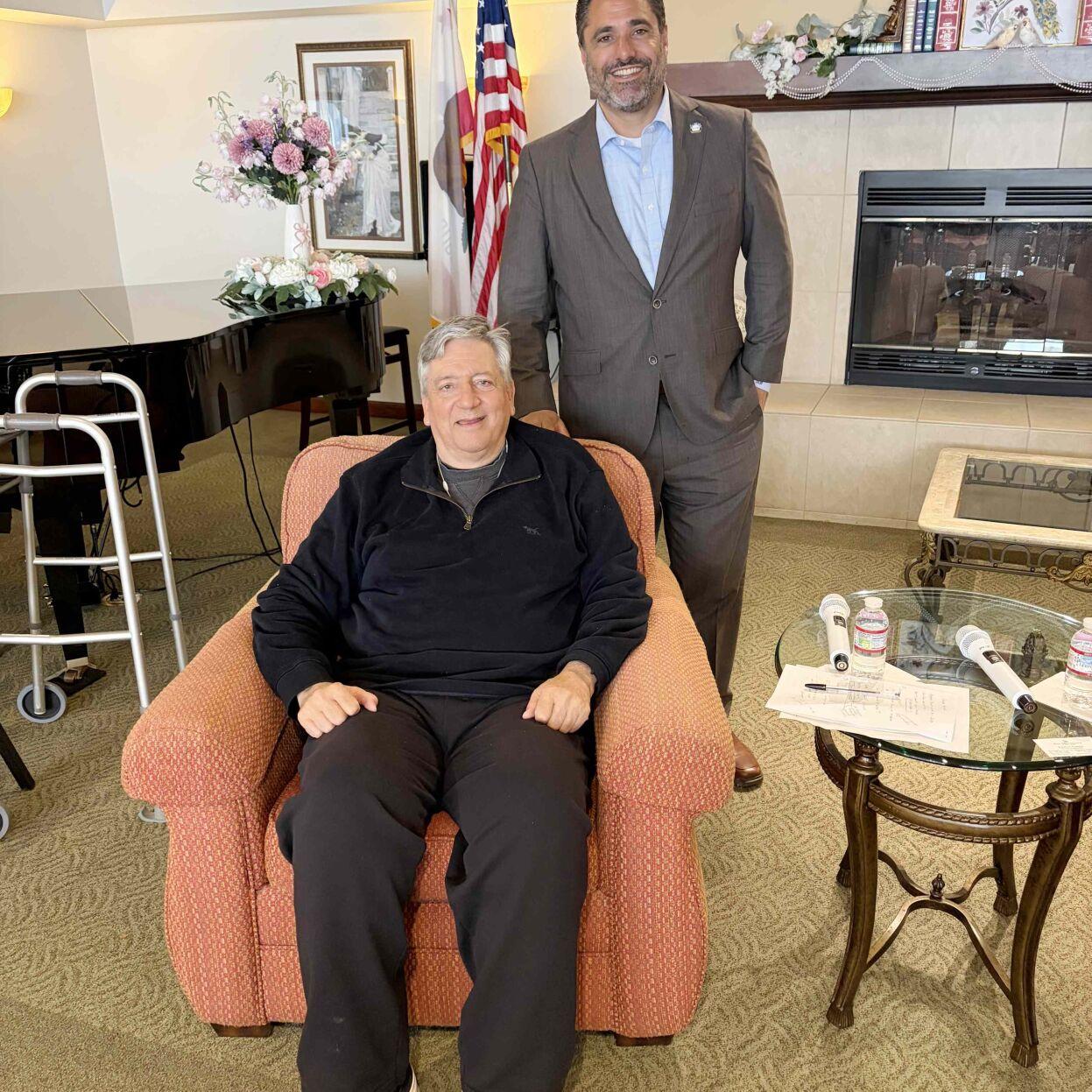
U.S. Rep. Kevin Mullin, D-South San Francisco, tours the San Bruno archives facility with National Archives at San Francisco Director Stephanie Bayless and San Francisco Federal Records Center Director Cynthia Mitchell.
Plans to shutter the National Archives facility in San Bruno are prompting concern for historical documents at the facility that tell the stories of generations of West Coast immigration and legacy.
An email from Jay Trainer, National Archives and Records Administration chief operating officer, told employees that two National Archives locations, one in San Bruno and another in Chicago, would be closed in the next few years and documents would be moved to other archival locations. The San Bruno facility is officially called the National Archives at San Francisco.
Temporary records would be moved to the Seattle Federal Records Center, Trainer’s email read, and that process could begin within the next few months.
Save Our National Archives, a group formed to stop a prior attempt to shut down the San Bruno archives location 28 years ago, is coming together once again to oppose the closure and start a letter-writing campaign against the decision.
“I’m the descendant of immigrants who have files at the national archives, and I’ve always been interested in accessibility to these documents,” SONA Co-Chair Grant Din said. “[This] would be a terrible blow for anyone researching their family history at the archives.”
Of the more than 750,000 records in San Bruno, many contain historical information about disenfranchised groups of Americans, including indigenous people and immigrants to Angel Island, a majority of whom were of Asian descent and were subjected to discriminatory immigration law.
U.S. Rep. Kevin Mullin, D-South San Francisco, expressed concerns around the two- to three-year closure timeline given by NARA in a statement and said the documents contained within the facility preserved unique documents and history. Mullin toured the facility earlier this year.
Recommended for you
“These aren’t just boxes of paper — it’s tangible and critical information for the public,” Mullin said in a statement. “Families whose ancestors immigrated through Angel Island can track their lineage, those whose loved ones served in the Navy and were stationed in the Pacific can learn about their legacy, and Native Americans whose history is documented over generations are all able to learn more because of this facility.”
There’s minimal information about the future of the records, San Bruno Mayor Rico Medina said, however, he highlighted the importance of them to the community.
“I have mixed feelings, because I don’t know what the government’s planning to do,” he said. “There’s a lot of public records and stuff folks have come to rely on. To have it unavailable … that would be concerning, and I think people would have some concerns.”
Although digitization and modernization of the records is a possibility, Din emphasized that many of the documents at the facility could not undergo that process. If they were to be moved to another facility, there’s a possibility they could only be accessed as scans, and not physical documents.
“They are not digitized, nor necessarily, can they be,” he said. “Many of the files are three dimensional objects, documents people brought over.”
The San Bruno and Chicago files can trace the history of many families who began their American journey on the West Coast, Din said. To separate them would be to separate present-day Americans from that history.
“A lot of the files that are in both San Bruno and Chicago are Asian immigrant files. To disperse them and make it difficult to research them makes it hard to show how your family became Americans,” he said. “By removing the ability to show our connections it makes it harder to show we’re American.”
Keep the discussion civilized. Absolutely NO
personal attacks or insults directed toward writers, nor others who
make comments. Keep it clean. Please avoid obscene, vulgar, lewd,
racist or sexually-oriented language. Don't threaten. Threats of harming another
person will not be tolerated. Be truthful. Don't knowingly lie about anyone
or anything. Be proactive. Use the 'Report' link on
each comment to let us know of abusive posts. PLEASE TURN OFF YOUR CAPS LOCK. Anyone violating these rules will be issued a
warning. After the warning, comment privileges can be
revoked.
Please purchase a Premium Subscription to continue reading.
To continue, please log in, or sign up for a new account.
We offer one free story view per month. If you register for an account, you will get two additional story views. After those three total views, we ask that you support us with a subscription.
A subscription to our digital content is so much more than just access to our valuable content. It means you’re helping to support a local community institution that has, from its very start, supported the betterment of our society. Thank you very much!







(0) comments
Welcome to the discussion.
Log In
Keep the discussion civilized. Absolutely NO personal attacks or insults directed toward writers, nor others who make comments.
Keep it clean. Please avoid obscene, vulgar, lewd, racist or sexually-oriented language.
Don't threaten. Threats of harming another person will not be tolerated.
Be truthful. Don't knowingly lie about anyone or anything.
Be proactive. Use the 'Report' link on each comment to let us know of abusive posts.
PLEASE TURN OFF YOUR CAPS LOCK.
Anyone violating these rules will be issued a warning. After the warning, comment privileges can be revoked.