

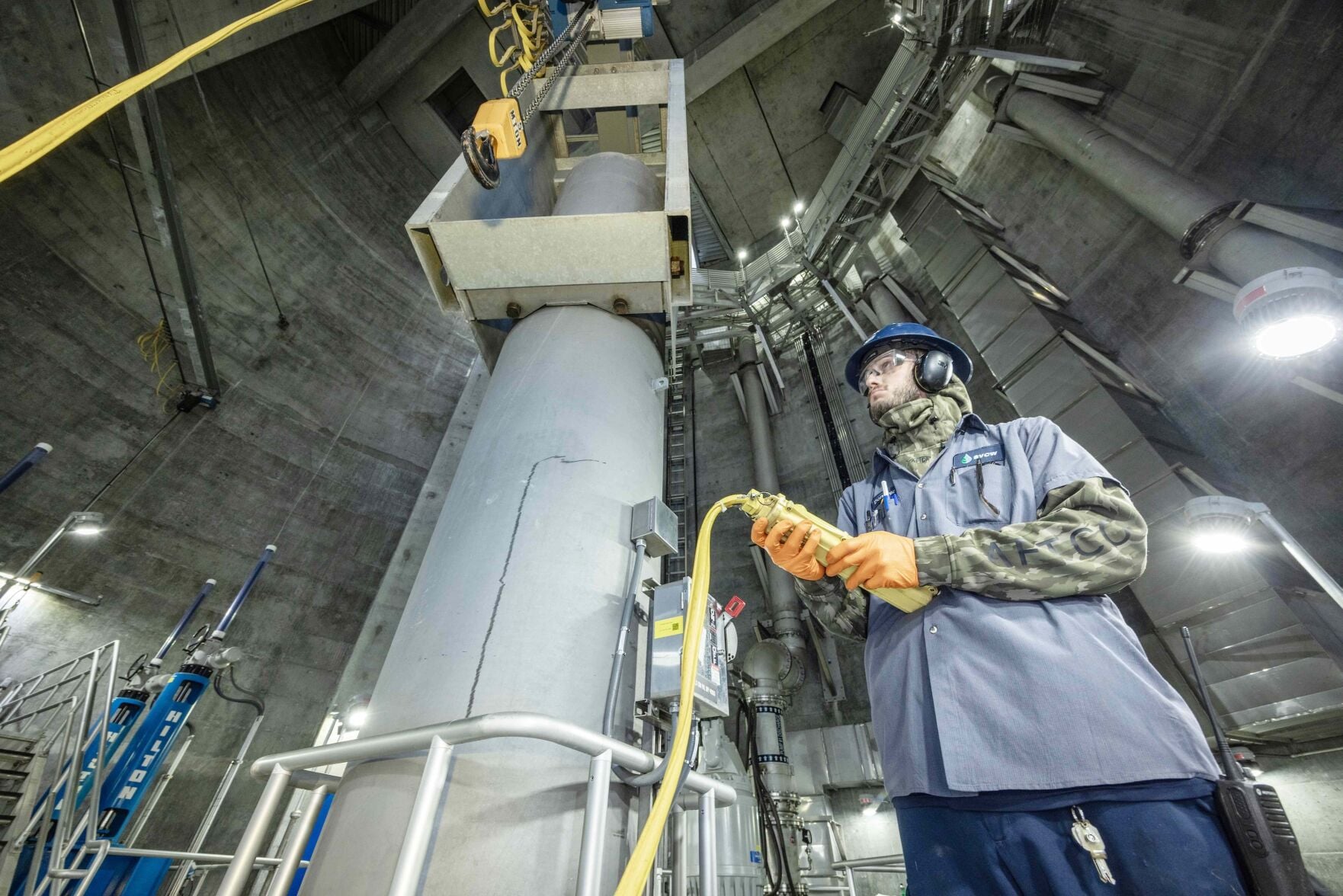
Silicon Valley Clean Water, a wastewater treatment agency in the mid-Peninsula, is inviting the public to have a close up view of how the advanced systems safeguard public health, the environment and the San Francisco Bay.
Guided tours invite residents to see the wastewater digesters, treatment processes and operations in action to gain a better understanding of the 24/7 system designed to handle a load of, well, you know.
When a resident flushes a toilet, it reaches the treatment center in less than half a day, treated and discharged in under 48 hours.
The tours hope to educate the community on a system that is incredibly vital and must operate at the highest efficiency, for the good of residents, Authority Manager Matt Zucca said.
"The purpose of the tours is to sort of have some association between something ‘you flush and forget’ and what happens to it,” Zucca said. “And, the fact that we’re able to swim in the Bay with this population density, because of what we do.”
While understanding how everyday systems work is part of the goal, it’s also impressive to see how an unassuming plant above ground reaches hundreds of feet below the surface and is built to treat millions of gallons of waste a day.
“The plant itself is deceiving,” Zucca said. “Until you walk into it you don’t expect how big it is.”
The plant collects about 15 million gallons a day during the dry, summer months, but peaks after a storm in the wintertime that amount skyrockets up to 80 million gallons a day, Zucca said. One of the six pumps that wastewater moves through in the plant can push “a hot tub a second,” Zucca said.
“We do really cool things from a sustainability point, but this part of the plant is really impressive from an infrastructure point too,” Zucca said. “We can’t turn the wastewater off, so we just have to be ready, 24/7.”
Tours start where wastewater comes into the plant and guides will share the highlights that differentiate SVCW from a conventional treatment center.
The organization is advancing its efforts to achieve energy neutrality, recycling treated wastewater and helping guard against future algae blooms in the San Francisco Bay. The treatment center works to reduce nitrogen discharge to protect the Bay’s water quality.
Anaerobic digesters at the plant are the only system on the Peninsula that utilizes food waste for co-digestion, to help transform methane into usable power for upwards of 70% of the facility’s needs. Eventually, the sustainable systems will be able to maintain 100% of the facility's electricity.
Recommended for you
One of the final stops on the tour — and for waste as it moves through the system — is a close look at how wastewater gets dehydrated before discharge.
Waste is about 5% solid and 95% water before it goes through a series of processes to dehydrate it to reach the goal portion of 80% solids, Zucca said.
The goal is to get as much water out, so alternative methods to remove water — even natural evaporation during the warm months — are used before transportation.
The majority of waste is discharged to agriculture as fertilizer because it is nutrient rich. The remaining small portion goes to rotary biodryers which use bacteria and heat to bring the waste from 20% solid to 80% solid — a unique initiative that the wastewater plant is hoping to make more common.
The biodryers essentially make charcoal, or biochar, which can be sold up to $700 a ton. The innovative material is used in concrete, durable black ink and other commercial products.
“Concrete is one of the most greenhouse gas-intensive processes, so by adding the biochar, it reduces the carbon footprint of concrete,” Zucca said. “It’d be great to turn what is otherwise waste and either going to a landfill or agriculture into a product that actually advances sustainability goals.”
Zucca said he hopes people take advantage of the new tours open to the public and feel more connected to the necessary work Silicon Valley Clean Water does.
“The tours are partly that shock and awe of seeing the facility, but then the opportunity to talk about why this is important and why it's worth the money,” Zucca said. “I don’t think people really appreciate that what we do is what allows them to have a San Francisco Bay.”
The organization provides wastewater treatment services to 300,000 residents in Belmont, San Carlos, Redwood City and the West Bay Sanitary District. Treated wastewater is discharged into the San Francisco Bay or transformed into valuable resources that support local and regional communities in their efforts to become more sustainable.
The treatment center is located at 1400 Radio Road in Redwood City. Tours are hosted every third Wednesday of the month, offered to residents, business owners, elected officials and educational groups.
Visit svcw.org/what-we-do/facilities/clean-water-tours to schedule a tour.





(0) comments
Welcome to the discussion.
Log In
Keep the discussion civilized. Absolutely NO personal attacks or insults directed toward writers, nor others who make comments.
Keep it clean. Please avoid obscene, vulgar, lewd, racist or sexually-oriented language.
Don't threaten. Threats of harming another person will not be tolerated.
Be truthful. Don't knowingly lie about anyone or anything.
Be proactive. Use the 'Report' link on each comment to let us know of abusive posts.
PLEASE TURN OFF YOUR CAPS LOCK.
Anyone violating these rules will be issued a warning. After the warning, comment privileges can be revoked.