In Caltrain’s transition from diesel to electric, the transit agency opened a new online store featuring a variety of branded merchandise. In addition to holiday sweaters and exclusive boxed models of the new electric train, a much larger commodity is up for sale: the “Caltrain EMD F40PH-2 Locomotive (Used).”
“These gently used, lovingly maintained 1985 F40 diesel locomotives could be yours,” the listing states. “The historic locomotives come with 40 years of service, and more than 1,000,000 miles traveled. Perfect for your model train set, train-themed diners, ornamental lawn decor or planter box, unconventional bed n breakfast or just to show up your overly gnomed neighbor’s lawn.”
When Caltrain completes its electrification project with full service Sept. 21, it will retire most of its diesel fleet. Almost 100 gallery cars will likely be sold to another operator, said Caltrain spokesman Dan Lieberman, and the locomotives are being split up by age.
Nine newer diesel locomotives will remain in use for the Gilroy service, which isn’t undergoing electrification because Caltrain doesn’t own that portion of the corridor. However, Caltrain has 20 diesel locomotives that have passed their expected retirement dates and will no longer be operational.
These older trains might be scrapped, Lieberman said, but first, Caltrain wanted to give rail fans the opportunity to bring them home and make something out of them.
The engine must be disabled and the buyer must cover the costs of storage and transportation, according to the listing. The locomotives will officially go up for auction in October.
A collector’s item?
Interested buyers may want to purchase the trains simply as collectors’ items, like self-proclaimed “trainiac” Pat Vanmunn did at first. Over the course of his life, he has amassed a boxcar, a locomotive and two cabooses on his property near Cupertino.
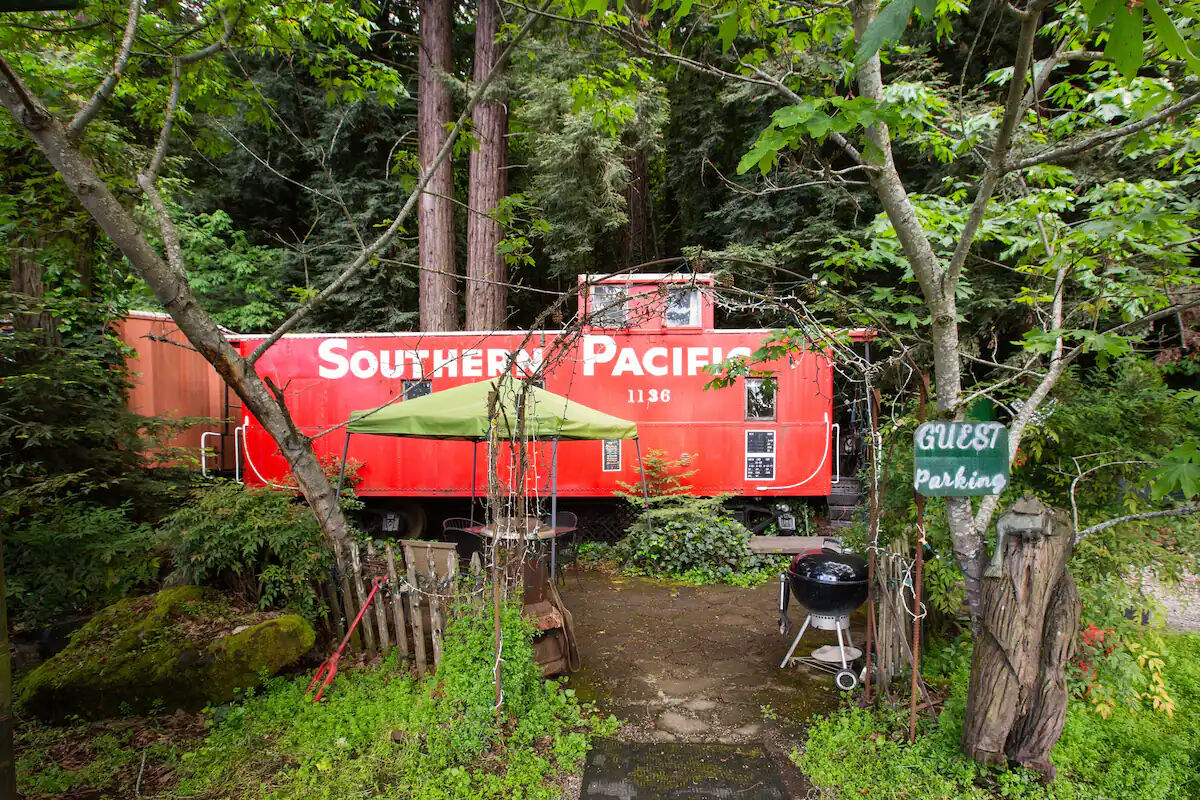
For a long time, the empty hulks of metal served as impromptu play space for his daughter, Vanmunn said. About 25 years ago, after she moved out, he renovated one of the cabooses for a friend who needed a place to stay.
The inside of Pat Vanmun’s red Southern Pacific caboose Airbnb.
Vanmunn and his son stripped, sandblasted, sealed and painted their red Southern Pacific caboose before adding furniture, hot water and heating. He listed the caboose on Airbnb seven years ago and, when it isn’t being rented, it’s a cozy guest house for friends and family, he said. He also renovated the other caboose for his mother-in-law and the boxcar for his daughter.
Vanmunn’s small switch locomotive has remained a play space: It’s where he and his neighbors “fire up a stove, drink cheap bourbon and bullshit together,” he said.
‘Just really, really cute’
Like the cars in Vanmunn’s collection, Jorg and Mimi Fleige bought their 1970s Muni Streetcar in the ’90s knowing it might one day become valuable. At the time, it was the cheapest way they could increase office space for their horticulture supply business in Richmond.
“We would have people come in and look at it. They go, ‘this is so art deco, this is great,’” Mimi Fleige said. “We had a black-and-white checkered floor and we kept the original Muni paint, the walls were turquoise. That sounds terrible, but it was just really, really cute.”
Over the past few years, the couple found the upkeep costly and decided to put their streetcar up for sale.
“Train cars, our Muni car, this stuff can only become historical if it’s preserved,” Mimi Fleige said. “I think it’s wonderful to extend the life of something. We had people literally outbidding each other, but we decided on a young couple who wanted it for an Airbnb,” Mimi Fleige said.
The car has been moved to Geyserville where the new owners are working on restoring it and turning it into a glamping site, much like Vanmunn’s.
Transforming train cars into housing can be more than a pet project: As an alternative to homeless shelters or encampments, a prominent architect in Washington, D.C., Arthur Cotton Moore, proposed repurposing WMATA’s decommissioned fleet as weather-safe apartments for homeless people. He mapped out the process in 2017, but the project was never carried out.
BART cars
Recommended for you
When Bay Area Rapid Transit announced the retirement of its legacy fleet in 2019, several press releases mentioned the possibility of using the old cars as housing for homeless people. However, no official proposals for the idea were submitted to BART’s call for proposals in 2021.
BART did not sell its old cars, which were officially retired in April. Most of the fleet was recycled, but eight were donated at no cost to BART, James Allison, the transit agency’s manager of media relations, said.
The Western Railroad Museum’s first BART car delivery on the back of a truck.
Joel DiGiorgio, owner of local restaurant chain Arthur Mac’s, was among the recipients of a BART car. Arthur Mac’s original location is across the street from the MacArthur BART station in Oakland, from where the name comes, DiGiorgio said.
DiGiorgio is opening a new location in Hayward and plans to turn his 75-foot BART car into an arcade full of retro games. The restaurant will utilize the car’s original lighting, signs and chairs, DiGiorgio said.
“Our vision for our upcycled BART train is to create a transportive experience, pun intended, where customers feel as though they’ve entered a time capsule from the 1990s,” DiGiorgio said.
Although the train car is becoming a side structure for the restaurant, some people choose to renovate train cars into restaurants themselves: Dad’s Luncheonette in Half Moon Bay and Gorilla BBQ in Pacifica are just two local examples.
DiGiorgio’s BART car will be delivered to Arthur Mac’s by truck when the restaurant is ready to receive it, he said.
This is a viable option for BART cars because they are made from aluminum, which is much lighter than steel, Bob Simon, the director of the Western Railway Museum, said. The museum is receiving three BART cars and will not be purchasing a Caltrain locomotive, Simon said.
A BART car shell is around 40,000 pounds, Simon said. The Caltrain locomotives are around 300,000 pounds, meaning they would probably have to be transported by rail rather than by truck. This would be much more expensive, Simon said.
Book it
While transporting a train is expensive, it could be a cost-effective way to open a small business, like Link Harjung did five years ago in rural Maine.
The former Bay Area local had previously worked at San Francisco’s Green Apple Books. He always dreamed of operating a used bookstore on his own.
“If I were to go through the conventional route and rent a brick-and-mortar, I would be struggling to pay rent every month. I could feel how the dream would become a nightmare for me,” Harjung said.
Link Harjung’s boxcar bookstore in rural Maine.
Someone he knew was using a 1960s Swedish boxcar as storage space and he thought it could be better used as a local bookstore. It had a midcentury design, nice wooden floors, bay doors and sliding windows, he said.
Harjung used to ride freight trains between Washington and West Oakland, where “most train hoppers first learn the art,” he said. Opening the store once dreamed of in a space he once frequented was only fitting.
Harjung is grateful he was able to take a piece of history and turn it into something new, he said.
Renovating one of Caltrain’s diesel locomotives might bring different challenges than boxcars, streetcars, subway cars and cabooses, but it could also bring unprecedented purposes.
“I know that every train car is going to offer different ideas of what makes sense to do with it,” Harjung said. “My boxcar lent itself to becoming a bookstore, but there are endless possibilities of what an old train can become.”
Keep the discussion civilized. Absolutely NO
personal attacks or insults directed toward writers, nor others who
make comments. Keep it clean. Please avoid obscene, vulgar, lewd,
racist or sexually-oriented language. Don't threaten. Threats of harming another
person will not be tolerated. Be truthful. Don't knowingly lie about anyone
or anything. Be proactive. Use the 'Report' link on
each comment to let us know of abusive posts. PLEASE TURN OFF YOUR CAPS LOCK. Anyone violating these rules will be issued a
warning. After the warning, comment privileges can be
revoked.
Please purchase a Premium Subscription to continue reading.
To continue, please log in, or sign up for a new account.
We offer one free story view per month. If you register for an account, you will get two additional story views. After those three total views, we ask that you support us with a subscription.
A subscription to our digital content is so much more than just access to our valuable content. It means you’re helping to support a local community institution that has, from its very start, supported the betterment of our society. Thank you very much!








(1) comment
Great
Welcome to the discussion.
Log In
Keep the discussion civilized. Absolutely NO personal attacks or insults directed toward writers, nor others who make comments.
Keep it clean. Please avoid obscene, vulgar, lewd, racist or sexually-oriented language.
Don't threaten. Threats of harming another person will not be tolerated.
Be truthful. Don't knowingly lie about anyone or anything.
Be proactive. Use the 'Report' link on each comment to let us know of abusive posts.
PLEASE TURN OFF YOUR CAPS LOCK.
Anyone violating these rules will be issued a warning. After the warning, comment privileges can be revoked.