

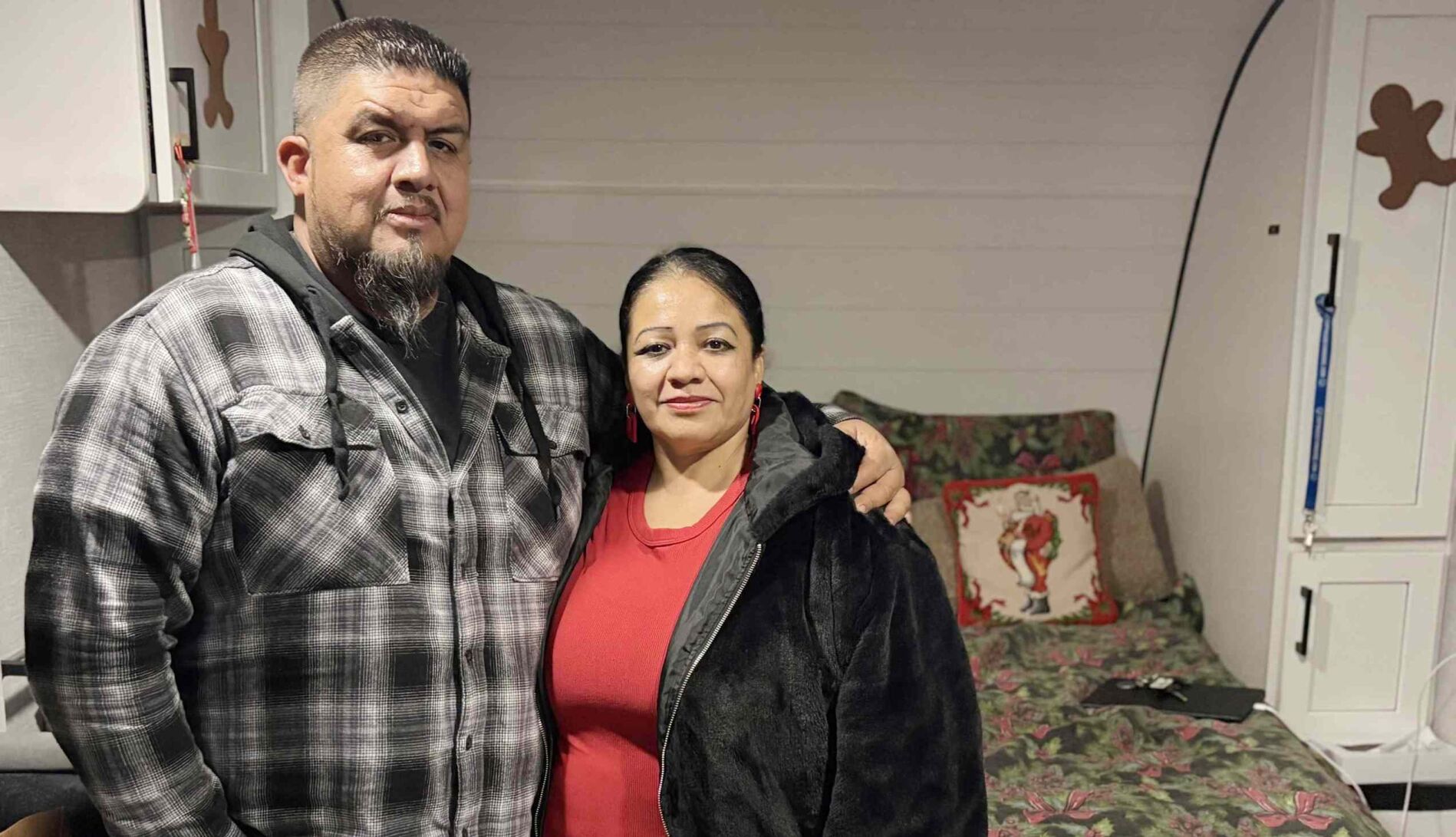
Jaime Prieto and Migdal Ibarra have moved multiple times over the last several years, from the Peninsula to Manteca, Newark and back to San Mateo County.
After living with their daughter and four grandchildren for a little while, they decided it was time to move back to get their own space and be closer to their jobs.
Prieto, who works at an auto body shop, and Ibarra, who works at Walmart and is also a cleaner, could no longer afford an apartment in the area, but the couple was lucky enough to secure a spot at a mobile home park in Redwood City.
But that’s when other problems started to arise. The couple settled on something within their budget, but unlike manufactured homes, RVs and trailers are often financed like car loans, yielding much higher interest rates than traditional home loans. Even with decent credit, the couple ended up with a 27% interest rate.
“When we went to the dealership, they were pushing us to sign,” Prieto said. “I think they do that when they know you want to live in it.”
They were hesitant but ultimately they knew they had little choice.
RVs and trailers are some of the most accessible housing options for lower-income households, especially in such an expensive area as San Mateo County, where the median house price is pushing $2 million. But the financing terms often negate the benefits.
“The interest rate could be from 15% all the way up to 30%, which is incredibly debilitating and can very quickly double the cost of what you’re paying,” said Alex Waggoner, program manager at Housing Endowment and Regional Trust, a county-based housing nonprofit. “Sometimes they don’t have the best credit history or sometimes they don't have any credit history, which is also part of why some of those interest rates end up so high.”
Pre-fabricated homes show promise again
The state has made significant strides to spike housing production, aimed at lowering the high cost of living. Over the last several years, the Legislature has passed a record number of bills meant to streamline housing development, from multi-family developments to accessory dwelling units.
The latter has seen some of the most success of any type of development. Less than 2,000 ADU permits were issued statewide in 2016 but, in 2022, that number rose to more than 20,000, according to data from California YIMBY and the Department of Housing and Community Development. That’s also in part the reason for stronger investment in pre-fabrication companies — an umbrella term for several types of factory-built housing — which tend to specialize in ADUs and small homes and can usually build them in a fraction of the time and for a much lower cost than traditional on-site construction. The industry has gone through some ups and downs, reaching a funding high around 2022, but there are signs it’s rebounding again.
The ADU market is starting to expand beyond just single-family homeowners who want an extra space for a family member. The Redwood City-based company Samara announced plans to build 50 new, small pre-fab homes on the same property as several large multi-family developments throughout the Peninsula, only possible due to recent state legislation.
Bigfoot Homes builds manufactured homes in Northern California, in rural areas and places like the Peninsula, ranging from 500 to 3,000 square feet and priced between $80,000 to $300,000. The firm was not only able to quickly deliver mobile homes in Paradise after its devastating 2018 fire, but it also installed 47 units of farmworker housing in Half Moon Bay in just a few months — something that would’ve likely taken at least a couple years and a lot more money if built with traditional construction.
For most of the homes, the average single or double wide takes about six weeks to manufacture and another 30 days to install, said Jason Tyler, co-founder and co-owner of Bigfoot Homes.
While the prices are usually higher than an RV, financing is usually more accessible. For those with decent credit, mobile home owners can secure financing with interest rates that are only 1% or 2% higher than traditional home loans, Tyler said.
“If you had a 650 score and you wanted to buy new or used, your rate could be around 7.5% and you could get about 25 years,” Tyler said. “The collateral is unique from a lender’s perspective, because they don’t have the land, and because they don't have the land, they just don't want to give a high amortization.”
Cities and counties are also trying to leverage the benefits. Most jurisdictions have some sort of fund set up for affordable housing development, but traditional builds cost up to $900,000 per unit to construct, not to mention a lengthy timeline, due to stronger regulatory requirements and complicated funding sources.
Recently, HEART, in partnership with the county, launched a low-interest pilot program meant to help families like the Prieto and Ibarra replace their trailers with modernized mobile homes. The program is funded with $2 million in Measure K funds — a countywide sales tax — and has so far provided 18 loans to low-income families who live in one of the seven mobile home parks in unincorporated San Mateo County.
“The initial allocation was for 20 loans for $100,000, and the hope is that once we start getting repayment, we can start expanding the program, and we can help out more people,” Waggoner said.
Interest rates range between 0.25% and 1%, and the loan payment doesn’t require them to pay more than one-third of their income on housing costs.
Recommended for you
The couple decided to apply as soon as they heard about it and got accepted within a few days.
“It was such a blessing,” Ibarra said in Spanish.
Their new home, which is expected to be completed in January, will have almost 50% more space — a loft with two bedrooms, a kitchen, laundry, dining room and living room. Including their mobile home park slot, which is the bulk of their monthly cost, they’ll pay a little under $1,600 in total for the new home, slightly less than what they’re paying now for the small trailer.
Declining access to mobile home parks
As affordable housing development fails to keep up with demand, more residents are living in RVs or small manufactured homes, but unfortunately, even living in a mobile home park has become inaccessible for many. The couple pays about $1,200 just for the space alone, not including any trailer-related payments.
And even though the demand for low-income housing has increased, the number of mobile home parks has declined over the years.
“There’s been almost zero mobile home park construction over the last 20 years,” Tyler said, attributing it to neighborhood pushback and developer incentives.
“If you’re building a new mobile home park, it's not going to be downtown because the land values are so high, so you're going to be in a more rural area and that has its own risks,” he said.
According to 2020 data from the California Department of Housing and Community Development, at least 4,800 mobile home lots have been lost statewide over the past decade and more than 400 parks have closed over the last 20 years.
Prieto said they were lucky to even get the slot in their mobile home park as quickly as they did.
Several cities throughout the county have struggled with the increase in RVs occupying neighborhoods and streets. While some jurisdictions already have policies prohibiting residents from living in vehicles, not all of them enforced it, recognizing the lack of affordable alternatives. But with the situation only getting worse, some cities, such as San Mateo, started to ramp up RV enforcement in response to growing concern from residents over new neighbors and subsequent public health risks, especially from dilapidated vehicles.
It’s unclear if mobile home park zoning will increase on the Peninsula in the future, but more manufactured homes — which, unlike other pre-fab homes, adheres to federal code — seem likely, especially as the U.S. Department of Housing and Urban Development has relatively recently approved two-story manufactured structures, and Chris Lippi, co-owner and co-founder of Bigfoot Homes, said the agency looks poised to approve three stories or higher in the near future.
“It trumps all state codes, so it's built to this code to make things really affordable and cut the waste,” Lippi said. “One of the problems with HUD code is that it’s national so it takes forever to update, but they finally did, so we can do two stories and multi-family.”
The prefab market still has its risks. Companies that build modular developments — where modules are factory built and then constructed on site — have come and gone over the last few years, including Silver Creek, which built the Redwood City Navigation Center, making it less incentivizing for developers to partner with such firms.
But the cheaper build and quick turnaround still makes it more compelling for both individual homebuyers and local governments that want to stretch their affordable housing dollars as much as possible.
“With the housing crunch and with manufacturing homes getting way nicer, it seems like we’re going to see more park construction,” Tyler said.
Unlike most new below-market-rate units on the Peninsula, mobile homes provide not just low-income housing but the possibility of home ownership. That’s also what made the couple’s recent purchase so significant.
“Finally, we have our own home, and it’s ours,” Prieto said. “That’s the exciting part.”
You can find more information on the HEART mobile home loan program at https://www.heartofsmc.org/mobile-home-loan-program-mhlp/




(0) comments
Welcome to the discussion.
Log In
Keep the discussion civilized. Absolutely NO personal attacks or insults directed toward writers, nor others who make comments.
Keep it clean. Please avoid obscene, vulgar, lewd, racist or sexually-oriented language.
Don't threaten. Threats of harming another person will not be tolerated.
Be truthful. Don't knowingly lie about anyone or anything.
Be proactive. Use the 'Report' link on each comment to let us know of abusive posts.
PLEASE TURN OFF YOUR CAPS LOCK.
Anyone violating these rules will be issued a warning. After the warning, comment privileges can be revoked.