

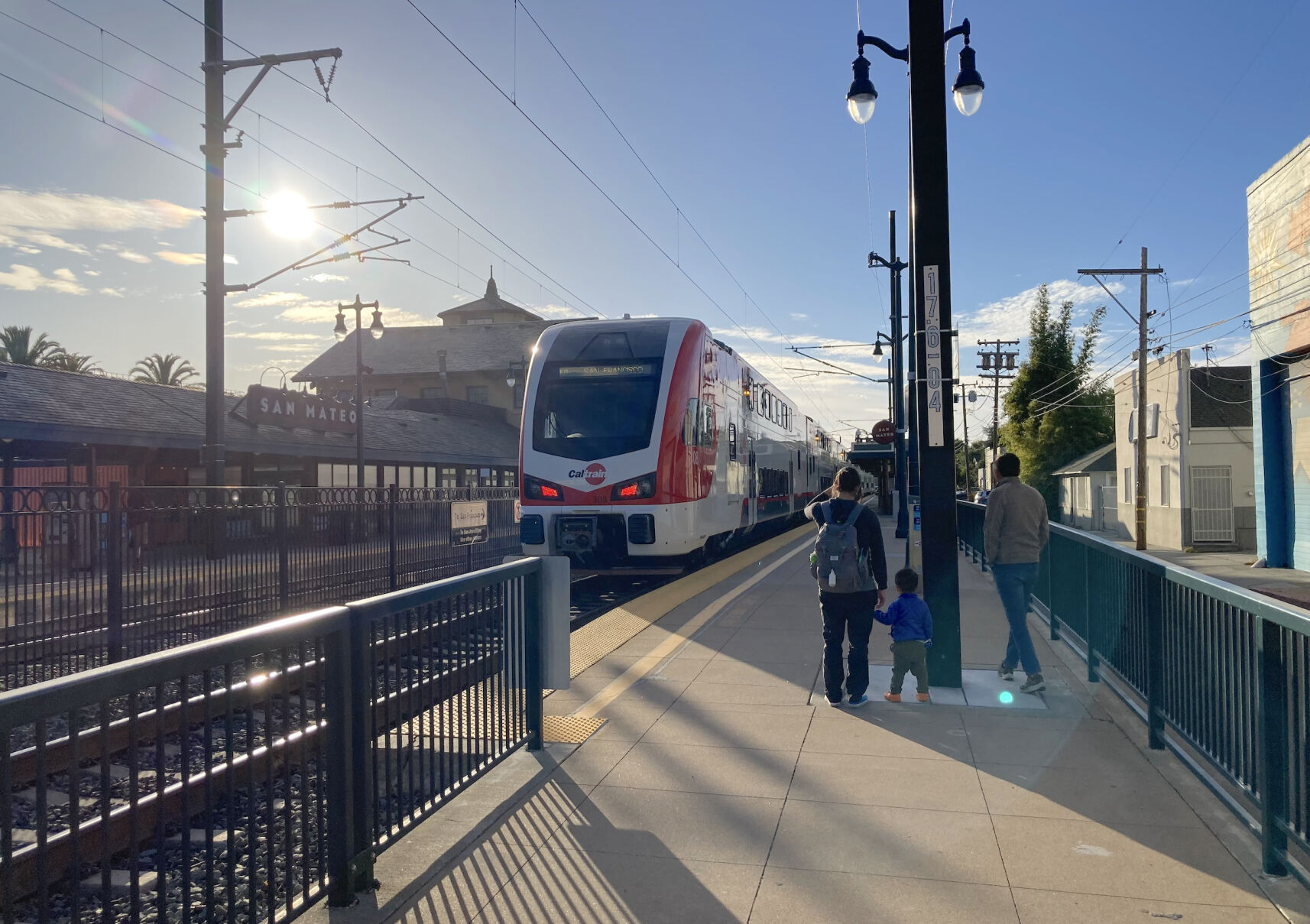
Debra Rosenfeld has lived in her San Mateo condominium for nearly 25 years and is intimately familiar with the surrounding noises in her neighborhood, both during the day and at night.
In all the years she has lived in her home, located near the intersection of Pacific Boulevard and South Delaware Street, Rosenfeld said she heard the horn noise every once in a blue moon, and it sounded distant.
But, like many residents, the new fleet and accompanying schedule that includes at least 20% more stops at each station has not been a welcome change. She has been meditating every day, anywhere from around 5-7 p.m., for nearly two years and is probably more familiar with ambient sounds than most.
“When you are meditating, you hear all the sounds. There was no train noise ever disturbing me between those hours,” she said. “We went from basically no noise to constant noise. I would say that it’s blowing 60 times an hour whenever they consider it rush hour … but I’m still hearing it as late as midnight.”
Rosenfeld isn’t the only one to notice the difference. Many of her neighbors, as well as other county residents, have made complaints to city officials and Caltrain, and post regularly on Nextdoor.
She said she has discovered that the noise she hears from her home starts near the Public Storage building and goes off even when there are no at-grade crossings or intersections nearby.
“I live a mile and a quarter from the closest four-way crossing at Ninth Avenue,” she said. “There is no reason for it.”
Despite the several filed complaints, she said neither she, nor any of her peers, have received much of an answer from anyone at the rail agency. In fact, city and Caltrain staff have provided differing responses as well, further stirring confusion. In an email exchange with one resident on Oct. 3, San Mateo Public Works Director Matt Fabry said that “Caltrain rail representatives indicated there were no changes to the decibel levels of the new trains based on [the] last 92 days of inspection.”
During an Oct. 3 Caltrain Board of Directors meeting, Executive Director Michelle Bouchard, however, said the agency recognized that some of the train horn noise levels were in fact set higher than the diesel trains and fixed them.
“We certainly have not had comments since we recognized and did that right away,” she said.
Recommended for you
Federal regulations mandate that train horn noise levels range from about 96 to 110 decibels, though the new electric train horns were set at the higher end initially. On Sept. 25, due to a high number of complaints, the agency OK’d a slightly lower horn noise level, more on par with the diesel trains, which were around 96 decibels.
About half the trains’ horn noises have been lowered since then, but it will still take until mid-October to update the entire fleet, Dan Lieberman, Caltrain spokesperson, said.
Train noise has long been an issue for many residents who live near the train tracks, even before electrification. While noise levels must adhere to specific federal standards, the San Mateo City Council has been discussing creating a quiet zone, which would allow for less horn noise, provided the city makes improvements at certain track crossings. At Villa Terrace, at the north end of the city, the proposed changes would create two cul-de-sacs on either side of the tracks, removing through traffic and access for pedestrians, cyclists and motorists. There are also several options to update the at-grade crossing near East Bellevue Avenue, however, the changes are in the early planning stages and likely wouldn’t be implemented until at least 2026, if not later.
But that still may not affect all neighborhoods, which have only recently started hearing more noise. And even the 96-decibel horn levels may still not provide much reprieve. While increased train service is beneficial for many commuters — and is expected to help boost Caltrain’s ridership levels — the higher frequency and placement of the train noise is still a big change for those residing within earshot.
San Mateo Deputy Mayor Rob Newsom, whose District 3 is in the heart of much of the Caltrain line, recently made a comment during the Caltrain Board of Directors meeting Oct. 3, highlighting the barrage of complaints he’s received about train noise since the rollout.
“Since the adoption of the electric trains, even though I heard in the report earlier today that the horn noise decibel level is within range, we’re getting inundated with complaints from our San Mateo city residents,” he said. “Specifically during rush hour, we’re seeing 59 blasts of the horn in a 60-minute period of time between stations where there shouldn’t even need to be horn blasts because they’re at elevated stations.”
Rosenfeld added that the location where they are sounding the horn is also a new occurrence.
“It’s ruining the quality of my life. I’m hearing a horn all day,” she said. “I heard it around midnight with earplugs and with the windows closed.”
Lieberman said there has been no change in locations of where the horns go off, attributing any differences to the decibel change or higher numbers of trains in the new schedule.


(0) comments
Welcome to the discussion.
Log In
Keep the discussion civilized. Absolutely NO personal attacks or insults directed toward writers, nor others who make comments.
Keep it clean. Please avoid obscene, vulgar, lewd, racist or sexually-oriented language.
Don't threaten. Threats of harming another person will not be tolerated.
Be truthful. Don't knowingly lie about anyone or anything.
Be proactive. Use the 'Report' link on each comment to let us know of abusive posts.
PLEASE TURN OFF YOUR CAPS LOCK.
Anyone violating these rules will be issued a warning. After the warning, comment privileges can be revoked.