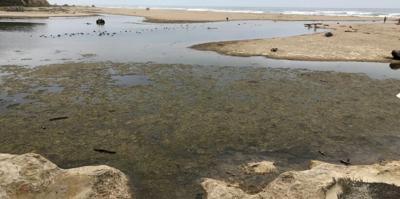
Water sampling at San Gregorio State Beach near Half Moon Bay has revealed the presence of toxic algae in San Gregorio Creek lagoon. In coordination with the San Francisco Bay Quality Control Board, San Mateo County's Environmental Health Services has posted notices in publicly accessible areas of the state beach, warning users not to enter the creek or allow children or pets to do so.
Harmful algal blooms produce toxins that are potentially fatal to people, pets and livestock. The compounds produced by bacteria in the algae can cause numerous health effects in humans and animals that range from stomach pain to nerve damage and, in some circumstances, death.
Testing in San Gregorio Creek lagoon revealed the presence of algal mats, which are a type of bloom that grows on bottom surfaces. These mats can be attached to the bottom or become detached and float in the water or on the surface and wash up on shore.
The waters and banks of San Gregorio State Beach lagoon and the creek upstream for a quarter mile should be avoided due to risks from the algae. While testing occurs regularly on beaches and adjacent bodies of water, with warnings posted, any standing or slow moving fresh or brackish water with visible signs of algae growth should be avoided this summer.
Adults and children should not touch, eat, or swallow any algal mats. Dogs should not eat algal mats or drink from the water (dogs are not permitted on San Gregorio State Beach). Call a doctor or veterinarian immediately if a person or pet becomes sick after coming into contact with or ingesting algae or water from San Gregorio Creek or elsewhere where algae is visible.
"Harmful algal blooms can be very dangerous," Heather Forshey, director of Environmental Health Services, said in a press release. "As families enjoy the water this summer, we urge everyone to be especially mindful of children and pets near any body of water where there is visible algae."
The next water sampling event for San Gregorio Creek lagoon is scheduled for mid-August, so users of the state beach should avoid the lagoon, creek, and nearby areas until the water is declared free of toxic algae and the posted notices are removed.
Keep the discussion civilized. Absolutely NO
personal attacks or insults directed toward writers, nor others who
make comments. Keep it clean. Please avoid obscene, vulgar, lewd,
racist or sexually-oriented language. Don't threaten. Threats of harming another
person will not be tolerated. Be truthful. Don't knowingly lie about anyone
or anything. Be proactive. Use the 'Report' link on
each comment to let us know of abusive posts. PLEASE TURN OFF YOUR CAPS LOCK. Anyone violating these rules will be issued a
warning. After the warning, comment privileges can be
revoked.
Please purchase a Premium Subscription to continue reading.
To continue, please log in, or sign up for a new account.
We offer one free story view per month. If you register for an account, you will get two additional story views. After those three total views, we ask that you support us with a subscription.
A subscription to our digital content is so much more than just access to our valuable content. It means you’re helping to support a local community institution that has, from its very start, supported the betterment of our society. Thank you very much!










(1) comment
How is this the same or different from the normal beach monitoring tests SMC does?
Welcome to the discussion.
Log In
Keep the discussion civilized. Absolutely NO personal attacks or insults directed toward writers, nor others who make comments.
Keep it clean. Please avoid obscene, vulgar, lewd, racist or sexually-oriented language.
Don't threaten. Threats of harming another person will not be tolerated.
Be truthful. Don't knowingly lie about anyone or anything.
Be proactive. Use the 'Report' link on each comment to let us know of abusive posts.
PLEASE TURN OFF YOUR CAPS LOCK.
Anyone violating these rules will be issued a warning. After the warning, comment privileges can be revoked.