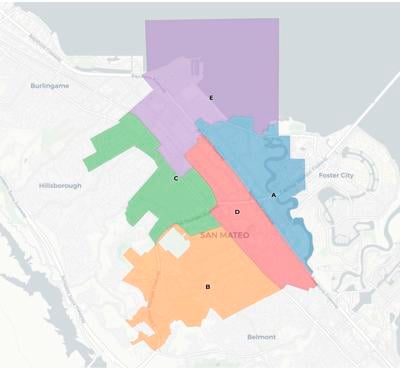
The San Mateo City Council reached a consensus this week on what districts will look like as the city converts from at-large elections to five separate districts to elect councilmembers.
The configuration decided on was determined to keep the most neighborhoods intact and best promote equitable representation by grouping together when possible communities with similar ethnicity, income, education level, housing renter or owner status and other factors, thereby empowering potentially underrepresented demographics to elect a candidate to meet their needs.
Under the new voting system, residents falling within each district will get a single vote with which to elect a councilmember who will also be required to live within the district. The title of mayor will rotate yearly between councilmembers, as it does now.
The map decided on is the result of extensive outreach conducted by the city over the past three months, including four public meetings, community workshops, pop-up events and mailers. At least 27 different map configurations were considered during the process.
“This is a staggering number of pieces of input,” Paul Mitchell, a redistricting expert hired by the city for the process, said. “I can say definitively that it’s the most that we’ve seen for any California Voting Rights Act conversion for an at-large to a district system.”
The switch from the city’s current at-large election system was spurred by the threat of a lawsuit in May alleging the city was in violation of the CVRA, a law designed to limit the “diluting” of votes from minority groups.
The city’s ethnic makeup is roughly half white, a quarter Asian and a quarter Latino. Just less than 2% of the population is Black and 2.5% is Pacific Islander, according to census figures. The agreed-upon map includes a 43% Latino district composed partially of the North Central and Shoreview neighborhoods (district E), as well as a nearly 60% white district made up of San Mateo Park, Baywood, Baywood Knolls, Aragon and Hayward Park (district C).
Other districts have ethnic makeups slightly closer to the city as a whole, but may share other similarities that could lead to common voting patterns. Per state law, the districts cannot deviate by more than 10% in population size, adding to the intricacy of the process.
Recommended for you
“It’s not going to be a perfect map, we already established that,” Mayor Eric Rodriguez said. “We’re going to have to be making some trade-offs.”
Some councilmembers, along with members of the public, expressed that the Hayward Park neighborhood, partially included in district C, should be moved to district D given its higher concentration of renters and overall lower income which fall more in line with district D’s demographics. Ultimately the shift was deemed not feasible because it would create population deviation greater than 10% between districts.
The districts, though currently labeled with letters, will next need to be numbered in accordance with state law. The numbering process is significant because it will determine election dates, with elections for councilmembers staggered every two years between even and odd numbers.
The next election will take place in November of 2022, and will elect councilmembers to serve the odd number districts. Even numbers will be up in 2024. For this reason it was noted districts where recently elected councilmembers reside should be labeled with even numbers.
Additionally, Mitchell pointed out, some consideration could be taken for aligning presidential elections with those for districts containing high percentages of people traditionally less likely to vote.
“If you feel like there’s a population maybe that hasn’t had a effectiveness in electing people to the City Council and now they have a district, maybe giving them a district and putting them in a low turnout election cycle doesn’t allow them to actually elect a candidate of choice,” Mitchell said.
The matter will be taken up during the city’s next districting meeting, scheduled for Nov. 1. Go to cityofsanmateo.org/4537/District-Elections for more information or to add your input.
Keep the discussion civilized. Absolutely NO
personal attacks or insults directed toward writers, nor others who
make comments. Keep it clean. Please avoid obscene, vulgar, lewd,
racist or sexually-oriented language. Don't threaten. Threats of harming another
person will not be tolerated. Be truthful. Don't knowingly lie about anyone
or anything. Be proactive. Use the 'Report' link on
each comment to let us know of abusive posts. PLEASE TURN OFF YOUR CAPS LOCK. Anyone violating these rules will be issued a
warning. After the warning, comment privileges can be
revoked.
Please purchase a Premium Subscription to continue reading.
To continue, please log in, or sign up for a new account.
We offer one free story view per month. If you register for an account, you will get two additional story views. After those three total views, we ask that you support us with a subscription.
A subscription to our digital content is so much more than just access to our valuable content. It means you’re helping to support a local community institution that has, from its very start, supported the betterment of our society. Thank you very much!









(0) comments
Welcome to the discussion.
Log In
Keep the discussion civilized. Absolutely NO personal attacks or insults directed toward writers, nor others who make comments.
Keep it clean. Please avoid obscene, vulgar, lewd, racist or sexually-oriented language.
Don't threaten. Threats of harming another person will not be tolerated.
Be truthful. Don't knowingly lie about anyone or anything.
Be proactive. Use the 'Report' link on each comment to let us know of abusive posts.
PLEASE TURN OFF YOUR CAPS LOCK.
Anyone violating these rules will be issued a warning. After the warning, comment privileges can be revoked.