

Since July, Maria Gabriela’s car has been broken into twice — both times from her San Mateo apartment complex parking lot. No valuables were visible, and the police still haven’t been able to find the suspects. Now she is always nervous to come home, but she has little choice. Even her neighbor recently got his car broken into soon after she did.
“I feel very violated and not safe in my own place,” she said.
After posting on Nextdoor, she started hearing anecdotes from other city residents who have also seen increases in theft and car break-ins, many of which go unresolved.
“They don’t get punished,” she said.

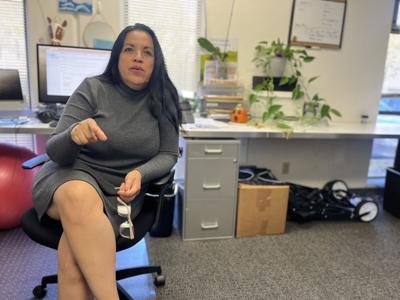
Evelia Chairez talks about the changes in the North Central neighborhood from her office.
Alyse DiNapoli/Daily JournalEvelia Chairez has lived in the North Central neighborhood of San Mateo for over 30 years and said crimes ranging from drug use to package theft and car break-ins have increased since the pandemic. Last year, her car was stolen, and when she was offered the footage from her neighbor’s outdoor camera, Chairez didn’t want to look.
“I refused to see the cameras, because I didn’t want to find out that I know one of them,” she said.
After living in the South Bay, Maria, who works as a babysitter and is originally from Brazil, moved to San Mateo only a few years ago, but after the latest incident, has been considering whether she wants to stay.
“People that have never been to Brazil are always saying it’s not safe there but I never had that happen in Brazil. There are some places that are not safe, but … we come to the United States, and we want a better life and not have our property broken, and it’s just happening everywhere,” she said.
Crime increases
Last year, San Mateo County saw the highest number of violent crimes in decades, with the increases largely coming from aggravated assaults and robberies, according to data from the California Department of Justice.
Retail theft arrests in the county’s largest cities have spiked in the last several years.
Daly City saw a 240% increase from 2019 to 2023, and based on the first few months of 2024, it is on pace to surpass last year’s figures. San Mateo has seen a roughly 75% increase in retail theft arrests since 2020, with the first few months of 2024 showing signs of a year-over-year increase.
Redwood City has also seen an increase in retail theft, and property crime arrests have increased by 70% between 2019 and 2023. Records show 2024 may have similar levels as last year.
Interestingly, while arrests have increased, county jail bookings have steadily decreased by about 20% between 2019 and 2023, with this year on pace to be slightly lower than last year.
That’s in part due to a higher issuance of cite-and-release tickets since 2020. Such citations technically count as an arrest but do not result in individuals being taken into custody but rather provided a citation with a court date. While it’s certainly helped decrease jail overcrowding, it also means the fail-to-appear rate has skyrocketed, District Attorney Steve Wagstaffe has said.
That’s led more residents to express frustration over what they see as rampant crime — often without consequences — during this election cycle. The tone is different from just four years ago, when widespread protests and calls for criminal justice reform were top of mind.
Many residents openly advocated for and held trainings on alternatives to calling the police, in light of what they said was the long history of racial prejudices held by law enforcement. Some cities and police departments did in fact heed increased community calls to incorporate more clinicians in situations where someone is having a mental health crisis or is dealing with domestic violence. Belmont created a police oversight subcommittee, and the Board of Supervisors approved a resolution in support of Black Lives Matter.
Two self-described Democratic Socialists beat incumbents to win a seat on their respective councils. Redwood City Vice Mayor Lisette Espinoza Garnica campaigned on a progressive platform calling for a reduction and reallocation of police funding, and South San Francisco Mayor James Coleman frequently cited the 2012 police killing of 15-year-old Derrick Gaines in his calls for racial justice and better law enforcement.
But, at least in the public sphere, the appetite for such a platform has since shrunk.
Chairez’s work involves pushing more residents in her Latino community to call the police more often, not because she wants more of her neighbors locked up, but because she feels it’s important to foster a healthy relationship with law enforcement. She understands why many are hesitant — language barriers, immigration status, neighbor retaliation or possibly a bad past experience with a cop — but said that crime will only proliferate if they don’t work together.
“They need to hear from us,” she said. “We as a community have the responsibility to report it and to make the call.”
It’s been particularly hard since the pandemic, when many longtime residents and community leaders moved out, largely due to financial burdens.
“Many different residents that were leaders in the eyes of the community needed to move out,” she said. “Before, we knew who was living next door, and now I feel that most people don’t know who’s living next door. They don’t want to make the connection.”
At the College of San Mateo, several students openly discuss how several crimes like theft have increased over the last few years.
Aiden Nightengale, a CSM student, said he’s seen more items locked up in stores and that there are fewer consequences for shoplifters. Hunter Dela Calzada, another CSM student who attended high school in San Francisco’s Tenderloin neighborhood, said he also saw rampant theft, as well as drug use, on his way to and from school.
“I used to see people go in there and steal all the time, very casually,” Dela Calzada said. “It’s just getting worse.”
Recommended for you
But, in a deeply blue county, residents are still trying to discern the ideal concoction of carrots and sticks to effectively reduce crime while maintaining the spirit of the 2020 criminal justice movements so many supported.
Complicated fixes
Young adults like Dela Calzada said they are familiar with controversial tough-on-crime and war-on-drugs policies of the past, which led to astronomical rates of incarceration. Drug addiction, often an underlying motivation in theft-related crimes, has become more widely accepted as a health condition that necessitates proper treatment, rather than a crime in and of itself.
Both Nightengale and Dela Calzada said crime is not the number one issue they’re thinking about this election, but they still feel there is room for more accountability and consequences.
“If you’re selling a drug that kills you, you should be able to punish the person for that. That is murder in my eyes. You shouldn’t be able to walk away scot-free,” Dela Calzada said.
Redwood City resident Paul Bocanegra — who has served time in prison and is co-founder of the nonprofit ReEvolution, which aims to combat recidivism — said he is in support of serial criminals serving jail time, but it’s not in anyone’s best interest if there are no opportunities during their sentence to positively turn their lives around.
“Youngsters will come in and share their experience. They’ll say, ‘I was able to get a vape pen before I could get counseling,’ or ‘I could kick it with my gang friends before I was arraigned,’” he said. “Now, if you do the crime, you got to do the time. But when you do that time, it should be done in a rehabilitative manner.”
In her community engagement work, Chairez works with incarcerated individuals at the county jails and said many were, and still are, completely unaware of programs and other resources available to them.
“When I’m in the jail, and I listen to all of them, I think, ‘you’re here because you missed opportunities. You didn’t realize there were opportunities outside,’” she said. “Yes, there should be punishment when they do something wrong, but there needs to be something else.”
Kalimah Salahuddin, who serves on the board of the Jefferson High School District and Housing Leadership Council, said, in addition to more expansive job training and educational programs, she would prefer to see cost-of-living decrease and crackdowns on online sellers.
“It’s extremely expensive to live here, and people are trying to find money. I think another issue is the ease in which you can resell things online,” she said. “If there was a way that you had to prove that you bought something before you sold it online, maybe that would detract people.”
Maurice Friera has been through the criminal justice system and was a heavy drug user for years before he entered a court-mandated treatment program, where he now works as a counselor in East Palo Alto and helps others during their recovery journeys. He said he is unconcerned over how clients enter treatment, whether it’s mandated or not, only that they continue showing up. He acknowledged that some are resistant to treatment, but simply being in a supportive environment still increases their chances of success compared to spending that time in jail.
“It’s not what gets them in the door. Having those court orders may be what keep them there initially … but what can we do while we have their attention to buy into this and give hope in their lives?” he said. “Are we trying to get people to live in prison or live in the community?”
Challenges to successful recovery
Expanding access to drug treatment is not necessarily an unpopular opinion, especially given alcohol and drug-related deaths throughout the county remain high. There were about 113 alcohol and drug-related deaths in the county last year — more than half of which were fentanyl-related — which is only slightly lower than 2020, though still much higher than the few years leading up to the pandemic.
But getting more people into rehabilitation centers can be complicated. Beyond the staffing and investment concerns, Wagstaffe, along with many other DAs and law enforcement officials, say the current incentive structures to encourage treatment are failing.
Currently, due to Proposition 47 — the 2014 ballot measure which reduced most drug possession charges to misdemeanors — almost no one in the county who is arrested only for possession spends more than a week in jail, if that. That means, when faced with the choice of attending a 30- to 90-day treatment program or spending a few days in jail, most choose the latter. Drug court participants in the county have since plummeted.
The new Proposition 36, which voters will decide on this November, would turn current misdemeanors, including drug possession and shoplifting, into felonies by the third conviction — unless, in some cases, if they successfully complete a treatment program. The measure is perhaps the strongest tough-on-crime state ballot initiative in more than a decade. The most consequential crime-related measures since 2016 have largely focused on expanding rights to nonviolent convicted felons, such as increased parole opportunities and restoring rights to vote, the latter of which passed in 2020.
Supporters of Proposition 36 say it will compel more people into treatment, as they will otherwise face up to three years in jail or state prison. Others are in favor of the measure due to its reinforcement of rules that allow drug dealers to be charged for murder if they sell to someone who overdoses or dies as a result.
But there is also a good chance jails and prison populations will increase as a result. That is concerning to Friera, who said long-term sobriety usually involves several failed recovery attempts. That’s also why Salahuddin is skeptical of the measure, as increasing the number of people with felonies will only increase “the amount of people who are now permanently denied access to a lot of those things that help them stop committing crime,” she said.
In 2020, people were forced to reflect and have tough conversations, she said, but now it’s easier to focus on individual, rather than collective, interests.
“When people are scared, they want quick solutions, and they go to the most simplistic solution, because it provides a feeling of safety,” Salahuddin said. “It’s hard to motivate people to turn away from that.”
Melissa Michelson, a political scientist at Menlo College, said Californians’ approach to crime and public safety constantly changes.
“If I’m zooming out and thinking long term, how have Californians thought about crime and safety and criminal justice? It’s like this seesaw of extremes,” she said.
California allows for several methods and types of citizen-initiated ballot measures. That can be a blessing and a curse, Michelson said, especially in a state with 40 million people, many of which have widely varied experiences, opinions and concerns. It also creates a system, she said, in which only the wealthiest special interest groups can afford to advertise on each measure’s behalf. Whether it’s a Three Strikes law or something like Proposition 47, she said voters are often operating on limited information, especially as state and national elections tend to capture more attention, rather than local races, where residents actually have the most control over their environments.
“[The ballot measure system] forces people to pay attention to issues and so it’s a great way to keep people involved in politics,” she said. “But on the other hand, people are making these decisions based on limited information and sometimes without a true understanding of the consequences.”





(5) comments
Vote TRUMP-VANCE-KENNEDY- Make America Safe Again
Great job with the comprehensive article, Alyse DiNapoli. To me, the solution is clear: enforcing the laws on the books. And holding those for doing so responsible for their actions or inactions. Remember, you get the government you deserve so as long you keep electing folks who will not enforce law and order or who will not keep offenders in prison, you get what we have now. So think carefully now and in the near future about who you want in office. Unless you’re okay with the status quo. Maybe just leave your car doors unlocked?
We get what we vote for. We voted for catch and release, and now we're surprised that crime has spiked.
Correction “we the people” got what democrats and ignorant people voted for. This result was easy to predict
Its very simple - decriminalize self defense with firearms. In Commiefornia - Criminals have more rights than we do - they can legit break into your house and kick your cat in the head - and you still cant shoot them. The cops are NOT here to protect us - we are tasked with protecting our own selves and families - cops are just here to investigate after the fact. Until these criminal scumbags fear the regular citizens again - crime will continue to go up. And when we don't deport illegal aliens with this "sanctuary" BS nonsense - what does anybody expect? Illegals have to do crime to survive because they do not belong here - they are here to be parasites. You liberal goofballs got exactly what you voted for.
Welcome to the discussion.
Log In
Keep the discussion civilized. Absolutely NO personal attacks or insults directed toward writers, nor others who make comments.
Keep it clean. Please avoid obscene, vulgar, lewd, racist or sexually-oriented language.
Don't threaten. Threats of harming another person will not be tolerated.
Be truthful. Don't knowingly lie about anyone or anything.
Be proactive. Use the 'Report' link on each comment to let us know of abusive posts.
PLEASE TURN OFF YOUR CAPS LOCK.
Anyone violating these rules will be issued a warning. After the warning, comment privileges can be revoked.