I love maps. I love to try and puzzle out why odd-looking boundaries are the way they are, and I love to discover new and interesting ways to get from one point to another. Even in areas I’m intimately familiar with — like Redwood City, where I’ve lived for more than 35 years — maps remain useful.
I regularly walk around Redwood City, gathering information for my columns and blog posts. Often, I just wander, but other times I follow a carefully preplanned route. For instance, one day I followed the path of Redwood Creek from near its origins (the closest I could get was up against the Menlo Country Club fence, along Alameda de las Pulgas) to where it flows beneath Highway 101 and out toward the Bay. Given that Redwood Creek flows underground in spots, and between private parcels in others (where it is inaccessible to me), I marked the creek’s route on a paper map and then identified all of the places where I could meet up with it. I then drew a zig-zag route to all of the points where the creek passes beneath either a public street, a public park or a school playground; and to the few places where I could walk alongside the creek in an open-topped channel.
I did something similar when I decided to follow the path of the mostly underground Hetch Hetchy pipeline from where it passes beneath Edgewood Road all the way through Redwood City, North Fair Oaks, Menlo Park and East Palo Alto (that walk took multiple days). And maps proved critical when I decided to explore and then write individual blog posts about each of Redwood City’s 17 defined neighborhoods. Without a map, I wouldn’t have known exactly where one neighborhood ended and another began.
Having grown up well before the age of the internet — and before electronic maps and GPS were in the public consciousness — I learned early on to use paper maps. Beginning with the folding paper maps that once occupied most automobile glove compartments, I then graduated to the wonders of the Thomas Guide. Each Thomas Guide was a thoroughly indexed book of highly detailed paper maps for one of our country’s major metropolitan areas. Given an address, the index directed you to the map page, and to the marked row and column on that page, where that address was located. It was left to you to work out a route to that address — using the many maps in the book, of course.
Electronic maps have a number of advantages over the old paper ones. For one, they are almost always up-to-date. Photographic satellite and street views augment the simple lines and shapes found on a map, and greatly help relate a map to reality. And then there is automatic routing. Particularly when it takes into account speed limits and near-real-time traffic loads, automatic routing can be a godsend for unfamiliar destinations or when you are in a hurry. But electronic maps, for all their advantages, aren’t ideal in all cases, and thus I still find myself resorting to paper from time-to-time.
One of the biggest drawbacks to an electronic map is the size of the screen on which it is being displayed. Cellphone screens are especially limiting, but even on a large tablet or even a desktop computer display, the screens can only show so much. Yes, you can scroll and you can zoom in and out, but neither is as effective as a large paper map. Paper maps can show a large area while still retaining detail, a combination you cannot get with an electronic map. I’m in the middle of planning a trip to the East Coast and, armed with a handful of destinations, I find the best way to plan out the trip is with a large paper map showing the entire area — multiple states, in this case — spread out on my dining table.
Having worked out the rough sequence of places to visit, electronic routing can serve as a good starting point for a path incorporating them all. But while on vacation I rarely find myself wanting to get from point A to point B as quickly as possible. Rather, I often want to visit nearby points of interest or scenic viewpoints that require an alternative routing. And to discover those points and create that routing, nothing seems better than a good old paper map.
I spend more time these days with electronic maps than with paper ones, but both have their uses. And paper maps make great keepsakes. I still cherish the paper TripTik the AAA travel planner put together for the honeymoon I planned for my wife and me; that bound set of small maps detailing the precise route we took after our wedding gives us a unique way to reminisce about that very special trip.
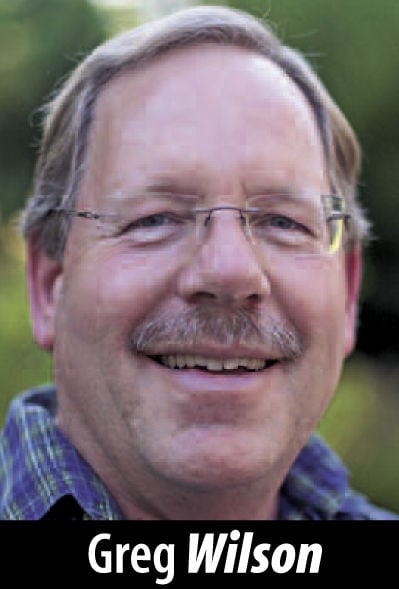
Greg Wilson is the creator of Walking Redwood City, a blog inspired by his walks throughout Redwood City and adjacent communities. He can be reached at greg@walkingRedwoodCity.com. Follow Greg on Twitter @walkingRWC.
I used to love buying the Ordinance Survey (OS) maps in the UK for biking and hiking. They were remarkable and highly informative as well as very artistic. You could fold them up and out to carry in a pocket. In fact, I'm likely to write a column soon about maps as art, because they certainly are.
Keep the discussion civilized. Absolutely NO
personal attacks or insults directed toward writers, nor others who
make comments. Keep it clean. Please avoid obscene, vulgar, lewd,
racist or sexually-oriented language. Don't threaten. Threats of harming another
person will not be tolerated. Be truthful. Don't knowingly lie about anyone
or anything. Be proactive. Use the 'Report' link on
each comment to let us know of abusive posts. PLEASE TURN OFF YOUR CAPS LOCK. Anyone violating these rules will be issued a
warning. After the warning, comment privileges can be
revoked.
Please purchase a Premium Subscription to continue reading.
To continue, please log in, or sign up for a new account.
We offer one free story view per month. If you register for an account, you will get two additional story views. After those three total views, we ask that you support us with a subscription.
A subscription to our digital content is so much more than just access to our valuable content. It means you’re helping to support a local community institution that has, from its very start, supported the betterment of our society. Thank you very much!







(1) comment
I used to love buying the Ordinance Survey (OS) maps in the UK for biking and hiking. They were remarkable and highly informative as well as very artistic. You could fold them up and out to carry in a pocket. In fact, I'm likely to write a column soon about maps as art, because they certainly are.
Welcome to the discussion.
Log In
Keep the discussion civilized. Absolutely NO personal attacks or insults directed toward writers, nor others who make comments.
Keep it clean. Please avoid obscene, vulgar, lewd, racist or sexually-oriented language.
Don't threaten. Threats of harming another person will not be tolerated.
Be truthful. Don't knowingly lie about anyone or anything.
Be proactive. Use the 'Report' link on each comment to let us know of abusive posts.
PLEASE TURN OFF YOUR CAPS LOCK.
Anyone violating these rules will be issued a warning. After the warning, comment privileges can be revoked.