When World War II broke out, there were less than 400,000 service men ready to defend the United States. The population of the United States was 132,164,469, however most of this population was on the West and East coasts. The Americans were able to muster up six fighter planes when the Japanese attacked and they began engaging in dogfights, but were shot down almost immediately. Most of the airplanes never got off of the ground and were destroyed by the Japanese. There were new B-17s arriving from San Diego and they were immediately attacked. The B-17s were not armed and most were destroyed almost immediately. Most of the remaining B-17s we had were destroyed in the Philippines in their first engagement of the war. Airplanes and manpower were needed immediately ... and just about everything else to fight a war for which we were not prepared.
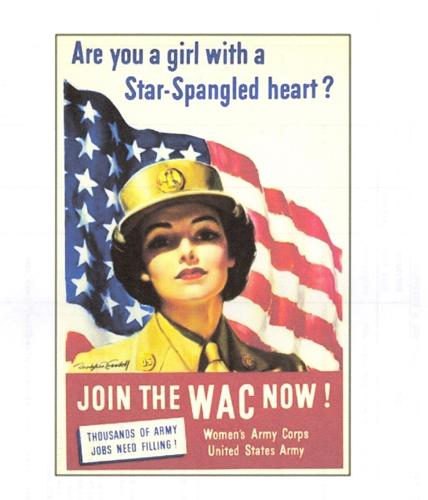
Luckily, Congresswoman Edith Nurse Rogers had introduced a bill in Congress in May of 1941 that allowed creation of an all-volunteer woman’s corps in the Army (The Air Force was still under the control of the Army). It wasn’t, however, until May of 1942 that Congress approved a bill creating the Women’s Army Auxiliary Corps. It wasn’t until that this bill had transformed the WAAC to the Women’s Army Corps that the women attained Army military status. They enlisted “for the duration and six months.”
In 1940, Nancy Harkness Love (a test pilot) and Jacqueline Cochran had made separate proposals to the Army Air Force to begin a women’s program utilized for ferrying aircraft from factories to airports, pull drones and aerial targets to relieve male pilots from this duty as they were needed at the front. They were both refused at first but on Sept. 10, 1942, Love’s proposal was accepted. Jackie Cochran was outraged at this pick and, on Sept. 15, 1942, her plan was also put into motion. It wasn’t until July 1943 that the two plans were merged and the Women Airforce Service Pilots was formed.
Each WASP had a pilot’s license and had about 1,400 flying hours. They were immediately retrained in the “Army way” during 30 days of orientation and then were assigned to various ferrying commands. The women were not trained for combat but their course of instruction was almost the same as that used for aviation cadets. The WASPs were considered civil service and did not receive military benefits. On June 21, 1944, a House bill to give WASP military status was narrowly defeated. Immediately, they began ferrying light aircraft and primary trainers such as Stearmans and PT-19 Fairchilds. They quickly rose to check out larger aircraft including pursuit planes such as the P-38 and P-51.
Dec. 20, 1944, marked the end of the WASP program. At the conclusion of the WASP program, 915 women pilots were on duty with the AAF: 620 assigned to the Training Command, 141 to the Air Transport Command, 133 to the numbered air forces in the continental United States, 11 to the Weather Wing, nine to the technical commands and one to the Troop Carrier Command. The G.I. Improvement Act of 1977, signed by President Jimmy Carter, gave the WASP corps full military status for their service. In 1984, each WASP was awarded the World War II Victory Medal. Those who served for more than one year were also awarded American Theater Ribbon/American Campaign Metal for their service during the war. On July 1, 2009, President Barack Obama and U.S. Congress awarded the WASP the Congressional Gold Medal.
Recommended for you
After the WAACs were formed in May of 1942, the women service for the Navy was organized — The Women Accepted for Volunteer Emergency Service. The women Air Force service WASP was formed in September 1942. The Marines got on board in 1944 without a nickname. The Marine commandant said none was needed. Being a Marine says it all.
Because of all of the hassle related to women being allowed into the services, President Harry S. Truman signed the Women’s Armed Services Integration Act in 1948, allowing women to serve directly in the military. On Oct. 15, 1948, the first eight women were commissioned in the regular Navy.
During the war, almost 400,000 women served in the armed forces. By the end of the war, there were few noncombatant jobs in which women did not serve. The attitude of women serving “over my dead body” that was accepted before 1941 quickly dissolved when the women of the United States proved they could serve our country as well as males.
Rediscovering the Peninsula runs every weekend. It is compiled through our archives created by Jim Clifford and the late Darold Fredricks.
Keep the discussion civilized. Absolutely NO
personal attacks or insults directed toward writers, nor others who
make comments. Keep it clean. Please avoid obscene, vulgar, lewd,
racist or sexually-oriented language. Don't threaten. Threats of harming another
person will not be tolerated. Be truthful. Don't knowingly lie about anyone
or anything. Be proactive. Use the 'Report' link on
each comment to let us know of abusive posts. PLEASE TURN OFF YOUR CAPS LOCK. Anyone violating these rules will be issued a
warning. After the warning, comment privileges can be
revoked.
Please purchase a Premium Subscription to continue reading.
To continue, please log in, or sign up for a new account.
We offer one free story view per month. If you register for an account, you will get two additional story views. After those three total views, we ask that you support us with a subscription.
A subscription to our digital content is so much more than just access to our valuable content. It means you’re helping to support a local community institution that has, from its very start, supported the betterment of our society. Thank you very much!






(0) comments
Welcome to the discussion.
Log In
Keep the discussion civilized. Absolutely NO personal attacks or insults directed toward writers, nor others who make comments.
Keep it clean. Please avoid obscene, vulgar, lewd, racist or sexually-oriented language.
Don't threaten. Threats of harming another person will not be tolerated.
Be truthful. Don't knowingly lie about anyone or anything.
Be proactive. Use the 'Report' link on each comment to let us know of abusive posts.
PLEASE TURN OFF YOUR CAPS LOCK.
Anyone violating these rules will be issued a warning. After the warning, comment privileges can be revoked.