Attorneys Mark Massara, left, Joe Cotchett, Eric Buescher and surfer Rob Caughlan gather for a press conference after Cotchett and Buescher presented closing arguments in the Martins Beach case at the County Center.
Coastal access advocates may have won a hard-fought battle in their ongoing effort to reopen Martins Beach to the public, but the war against privatizing California’s coast will undoubtedly rage on.
This week marked a victory for the nonprofit Surfrider Foundation as three state appellate judges ruled against the billionaire property owner who has sought to close access to the secluded beach just south of Half Moon Bay.
“The case represents one of the most important issues of our day — can wealthy private individuals buy up our beautiful coastal beaches for their own use and close them to the public? It’s as simple as that,” said attorney Joe Cotchett, whose firm represents Surfrider.
In their unanimous 50-page opinion filed Wednesday, the judges gave broad credence to the California Coastal Act and the Legislature’s intent of preserving access to the beach. The ruling could have sweeping effects on how the 1976 law is interpreted.
The appeals court agreed with Surfrider that deterring the public from visiting the property — which under prior ownership was open for nearly a century — constituted coastal development. The judges also upheld a ruling issued last year in a San Mateo County courtroom that the beach be immediately reopened to the public as it had been in years past.
“They have to open that gate tomorrow,” Cotchett said Thursday.
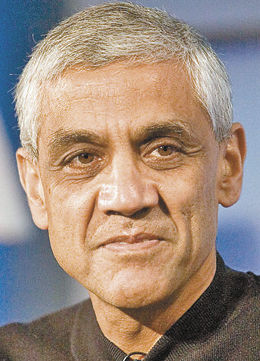
Vinod Khosla
But it’s left to be seen whether venture capitalist Vinod Khosla, a staunch advocate for private property rights, will actually do so. Khosla filed a federal lawsuit against the state and San Mateo County alleging his constitutional rights would be violated should he be forced to allow the public to visit the beachfront property he purchased in 2008 for $32.5 million.
While his attorneys did not return a request for comment about the appeals court decision, they’ve previously indicated Khosla won’t back down. Attorney Jeffrey Essner has described his client as a philanthropist and environmentalist who’s pledged to one day give half his wealth to charity. But Khosla is also a man of principle with strong convictions, Essner told the State Lands Commission in late 2016.
“Mr. Khosla is unwilling to be coerced into giving up a vested constitutional property right,” Essner said at the time.
A storied battle
Khosla, a co-founder of Sun Microsystems, closed the gate in 2009 sparking four lawsuits. Not all have sided in firm favor of public access.
In a case filed by the Friends of Martins Beach, a San Mateo County Superior Court judge cited an 1800s Mexican land grant as rationale for the public not having an inherent right to access this particular property. The state appeals court partly reversed that decision, sending the case back to county court.
Legislative efforts have also ensued, with Gov. Jerry Brown signing a law authored by state Sen. Jerry Hill, D-San Mateo, requiring the State Lands Commission negotiate for public access. But that movement ultimately stalled after the SLC offered $360,000 for a 6.4-acre easement Khosla contended was worth $30 million.
Surfrider, a nonprofit dedicated to preserving the world’s beaches, dove into the fight by filing its suit in county court.
The case hinged on what constitutes development under the Coastal Act. Surfrider argued painting over a welcome sign, closing the gate to the sole access road and hiring security guards to deter visitors ultimately altered the land’s use. The county court, and now the state appeals court, agreed.
In their ruling, the judges wrote what was important in this case is the owner’s “conduct indisputably resulted in a significant decrease in access to Martins Beach.”
Recommended for you
Permitting the public
Attorney Eric Buescher, who also represents Surfrider with the firm Cotchett, Pitre & McCarthy, said the judges’ ruling was an important victory in the ongoing efforts.
“It’s a critical decision vindicating the public’s right to use and access the 1,100 miles of California coastline that are a public resource. It reaffirms the principle that Surfrider has advocated this entire time — that the Coastal Act requires maximization of public recreational opportunities on the coast. And that applies to everybody in the state, not just those with enough resources to purchase the land adjacent to the beach,” Buescher said.
A linchpin in the ruling was that Khosla should have first sought a permit from San Mateo County or the Coastal Commission before cutting access to the beach. Although Khosla contends forcing him to welcome strangers onto his private property violate his rights, the judges disagreed, noting he must simply seek a permit to change the land’s use.
Applying for a permit would trigger a series of public hearings, and the community has been nothing short of vocal about reopening Martins Beach. In their ruling, the judges noted providing public opportunity to weigh in is of the utmost importance, and Buescher emphasized that decision as this “lawsuit was always brought and prosecuted on behalf of the public.”
“That’s one of the most important pieces of the Coastal Act that’s now existed for 45 years in this state, is that the public is the first line of defense in attempts to privatize or take away access to the beach,” Buescher said.
Informing next steps
The state appeals court ruling could also set precedent in the federal case in which Khosla is suing San Mateo County, the Coastal Commission and the SLC. The government agencies have filed a motion to dismiss the case and a federal judge has said he first wants to review the appeals court’s ruling before making a decision. Now, the county is hopeful as this week’s ruling essentially concurred with arguments that requiring a permit doesn’t constitute taking away owners’ private property rights.
“We are pleased that the court continues to stand with the public and to protect the Coastal Acts’ basic premise: the coast belongs to all Californians,” John Claussen, chair of Surfrider’s San Mateo County Chapter, said in an email.
But with the bitter battle dragging on, Cotchett said he doesn’t anticipate Khosla to settle until it’s weighed at the highest level.
“This is going all the way to the U.S. Supreme Court,” Cotchett said. “It’s a wild fight. He’s got an army of lawyers.”
While legal costs don’t seem to be a deterrent, Khosla will have a few bills to pay. As part of their ruling, the appeals judges awarded Surfrider its legal costs both from the county court case — which amounted to about $465,000 — as well as the appellate court costs expected to cost another few hundred thousand dollars.
But many know this week’s decision favoring the spirit of the voter-approved California Coastal Act, is just a step — albeit an important one.
“There’s still a long road ahead but we are encouraged by this decision,” Jack Ainsworth, executive director of the Coastal Commission, said in an email. “We are hopeful that the day will come when the locks are cut off the gates and the public can once again walk across the sand at Martins Beach and go for a swim.”
Keep the discussion civilized. Absolutely NO
personal attacks or insults directed toward writers, nor others who
make comments. Keep it clean. Please avoid obscene, vulgar, lewd,
racist or sexually-oriented language. Don't threaten. Threats of harming another
person will not be tolerated. Be truthful. Don't knowingly lie about anyone
or anything. Be proactive. Use the 'Report' link on
each comment to let us know of abusive posts. PLEASE TURN OFF YOUR CAPS LOCK. Anyone violating these rules will be issued a
warning. After the warning, comment privileges can be
revoked.
Please purchase a Premium Subscription to continue reading.
To continue, please log in, or sign up for a new account.
We offer one free story view per month. If you register for an account, you will get two additional story views. After those three total views, we ask that you support us with a subscription.
A subscription to our digital content is so much more than just access to our valuable content. It means you’re helping to support a local community institution that has, from its very start, supported the betterment of our society. Thank you very much!







(3) comments
The case is very far from over. Ultimately, parts of the CCA may be ruled unconstitutional.
If this does get overturned, I hope San Mateo County will simply invoke eminent domain and seize the property.
I agree. I think thats what they are planning on.
Welcome to the discussion.
Log In
Keep the discussion civilized. Absolutely NO personal attacks or insults directed toward writers, nor others who make comments.
Keep it clean. Please avoid obscene, vulgar, lewd, racist or sexually-oriented language.
Don't threaten. Threats of harming another person will not be tolerated.
Be truthful. Don't knowingly lie about anyone or anything.
Be proactive. Use the 'Report' link on each comment to let us know of abusive posts.
PLEASE TURN OFF YOUR CAPS LOCK.
Anyone violating these rules will be issued a warning. After the warning, comment privileges can be revoked.