
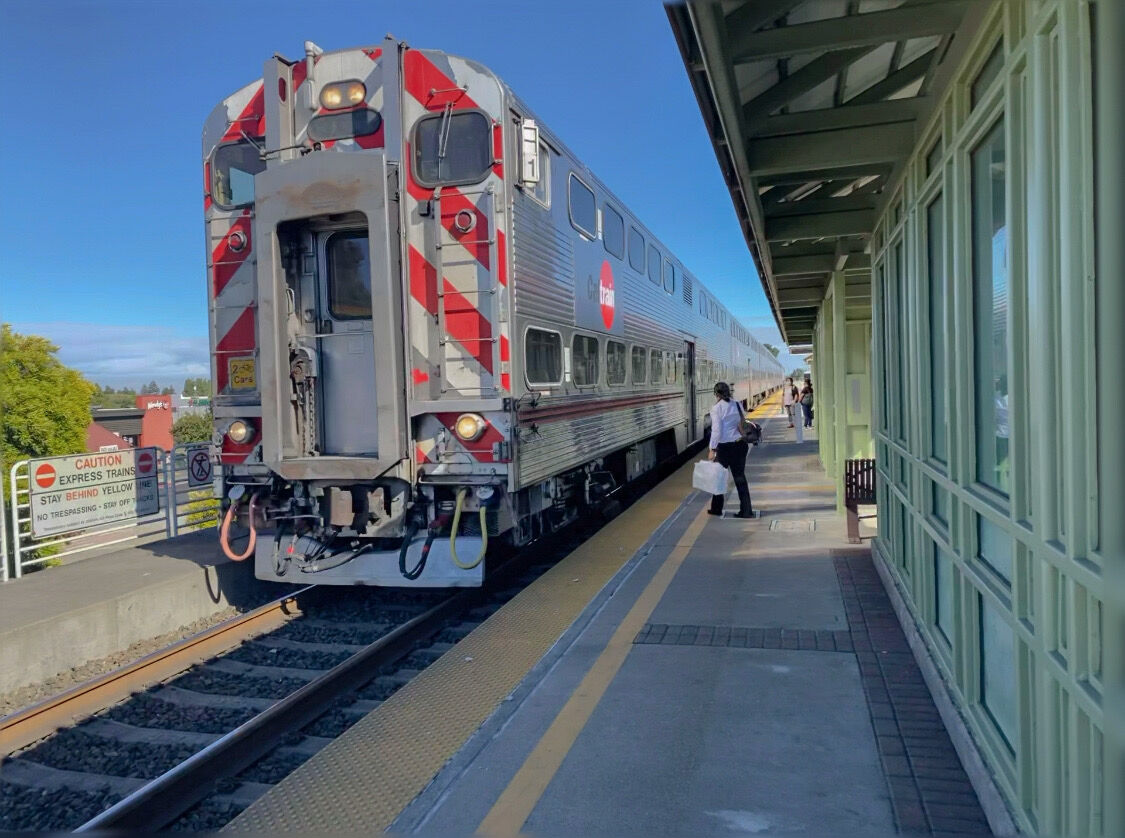
Dana L. remembers her daily commute to work being a hectic affair.
Every morning, she’d trudge into a packed Caltrain carriage and sit shoulder to shoulder next to other groggy office workers. On especially busy days, she’d often find herself standing in the crowded hallway, bracing for the shuttle’s lurching stops while scouting for open seats.
But now, she typically shares the entire carriage with just one or two other riders.
“It was very disconcerting. It’s like a ghost train,” said Dana L., a longtime Peninsula resident and Caltrain rider who didn’t want to give her full last name. “You’re staring around, remembering a year ago when people were all sitting there ready to go to Friday night happy hour.”
Caltrain ridership plummeted by more than 95% during the height of the pandemic, Caltrain spokesperson Dan Lieberman said. More than a year later, ridership still only remains at 7% of prepandemic levels.
Despite enhanced sanitation measures and widened vaccine eligibility, the numbers show that riders are still hesitant to return to public transit.
“If I were to be jumping on Caltrain, I’d be putting myself at risk of becoming a carrier of [COVID-19] and bringing it home to my family and putting my dad at risk,” Joseph Suarez, a local Realtor and lifelong Burlingame resident, said before California’s official reopening June 15.
Suarez lives with his father, who is in his 60s, and also helps care for his elderly grandmother. He said he only took Caltrain once since the pandemic started out of an abundance of caution for his family.
It’s a concern echoed by many Caltrain riders. A summer survey conducted for Caltrain and SamTrans revealed that two primary causes of lower ridership are concerns about social distancing and cleanliness.
In response, Caltrain adopted the Bay Area Healthy Transit Plan during the onset of the pandemic. The plan enforces mask wearing, physical distancing, contactless payment methods, increased sanitation and maximization of air filtration on board.
Caltrain is an open air system that already features hospital-grade filters in all passenger cars, so no extra equipment installation was necessary. Vehicles continue to be sanitized between uses with special attention to high-touch areas, and spray foggers are used on all cars overnight and midday.
But for cautious riders like Suarez, the single deciding factor to possibly returning to public transit was getting fully vaccinated. And while vaccination rates are increasing — 87.3% of San Mateo County residents over 16 are vaccinated as of June 23 — giving up old habits is easier said than done.
Suarez said he still felt uncomfortable with the idea of taking public transit with his high-risk family members, even though they’ve been fully vaccinated. His father and grandmother often see other high-risk individuals, and the possibility of the two contracting COVID-19 and spreading it to friends who haven’t been vaccinated remains a concern.
“A year of relative isolation has affected how all of us think about large crowds in enclosed spaces, and that’s a challenge we will have to face,” Lieberman said in an email.
Recommended for you
The rise of remote work was another major source of lower ridership, but not all Peninsula workers had the luxury of working from home or choosing not to take public transit.
Caltrain saw a major shift in the demographics of its riders during the height of the pandemic. According to the agency’s fall Pandemic Rider Survey, the average annual household income of 2020 Caltrain riders fell from $158,000 to $95,000.
Higher income workers are more likely to be concentrated in industries that allow remote work, leading to a larger percentage of essential workers using the service. Additionally, the number of Latino and Black riders on board has doubled, with the former increasing from 12% to 26% and the latter from 4% to 8%.
That led to a shift in the agency’s business strategies, mostly notably with the unveiling of Caltrain’s first Framework for Equity, Connectivity, Recovery and Growth. The framework envisions preserving the pandemic-era 50% discount on fares for low-income workers and supporting increased off-peak hours and weekend service.
“Our Equity Framework was designed to help us better serve people who are less likely to work a standard 9-5, and if we effectively meet their needs, that has the potential to build new markets for our services and offset potential losses associated with increased working from home,” Lieberman said.
For riders who do feel comfortable taking public transit, the unpredictability of the pandemic still leaves health concerns on the table.
Dana L. felt extremely safe riding Caltrain during the pandemic, and even more so now that she’s getting fully vaccinated. Carriages are usually empty and allow for more than adequate social distancing, and she’s had positive experiences with mask policy compliance.
“Honestly, Caltrain’s probably safer than airplanes at this point. I know people who have gone on airplanes now, and they’ll be shoulder to shoulder, maybe one space apart from other people,” Dana L. said. “You probably have more risk of catching [COVID-19] from a relative or friend.”
Still, she’s monitoring the development of COVID-19 closely and said that she’d hesitate to use the service if a concerning mutation of the disease emerges.
The agency expects more riders to return around midsummer and early fall as offices open, schools restart in-person instruction, recreational activities resume and vaccinations become even more widespread. But a year’s worth of drastically reduced revenue has done its damage, leading to a budget shortfall of $18.5 million in 2020.
“Caltrain is very dependent on fares and the effect on the budget has been substantial,” Lieberman said. “The passage of Measure RR is a real lifeline for the railroad and will reduce some of the pressure on Caltrain, but we will face real constraints and deficits until its ridership returns.”
Measure RR, which passed in early November, allows for a eighth-cent sales tax increase in San Francisco, San Mateo and Santa Clara counties as a source of dedicated funding for Caltrain. The measure is expected to raise an estimated $108 million annually for 30 years.
The agency will begin collecting funds on the new tax on July 1. For now, Caltrain has lowered the price of its monthly pass by 20% through September to encourage people to start riding again.
“We will continue to do all that we can to make sure our service is even better than it was when you were last on board,” Lieberman said, “and we look forward to seeing all of our riders again soon.”





(0) comments
Welcome to the discussion.
Log In
Keep the discussion civilized. Absolutely NO personal attacks or insults directed toward writers, nor others who make comments.
Keep it clean. Please avoid obscene, vulgar, lewd, racist or sexually-oriented language.
Don't threaten. Threats of harming another person will not be tolerated.
Be truthful. Don't knowingly lie about anyone or anything.
Be proactive. Use the 'Report' link on each comment to let us know of abusive posts.
PLEASE TURN OFF YOUR CAPS LOCK.
Anyone violating these rules will be issued a warning. After the warning, comment privileges can be revoked.