
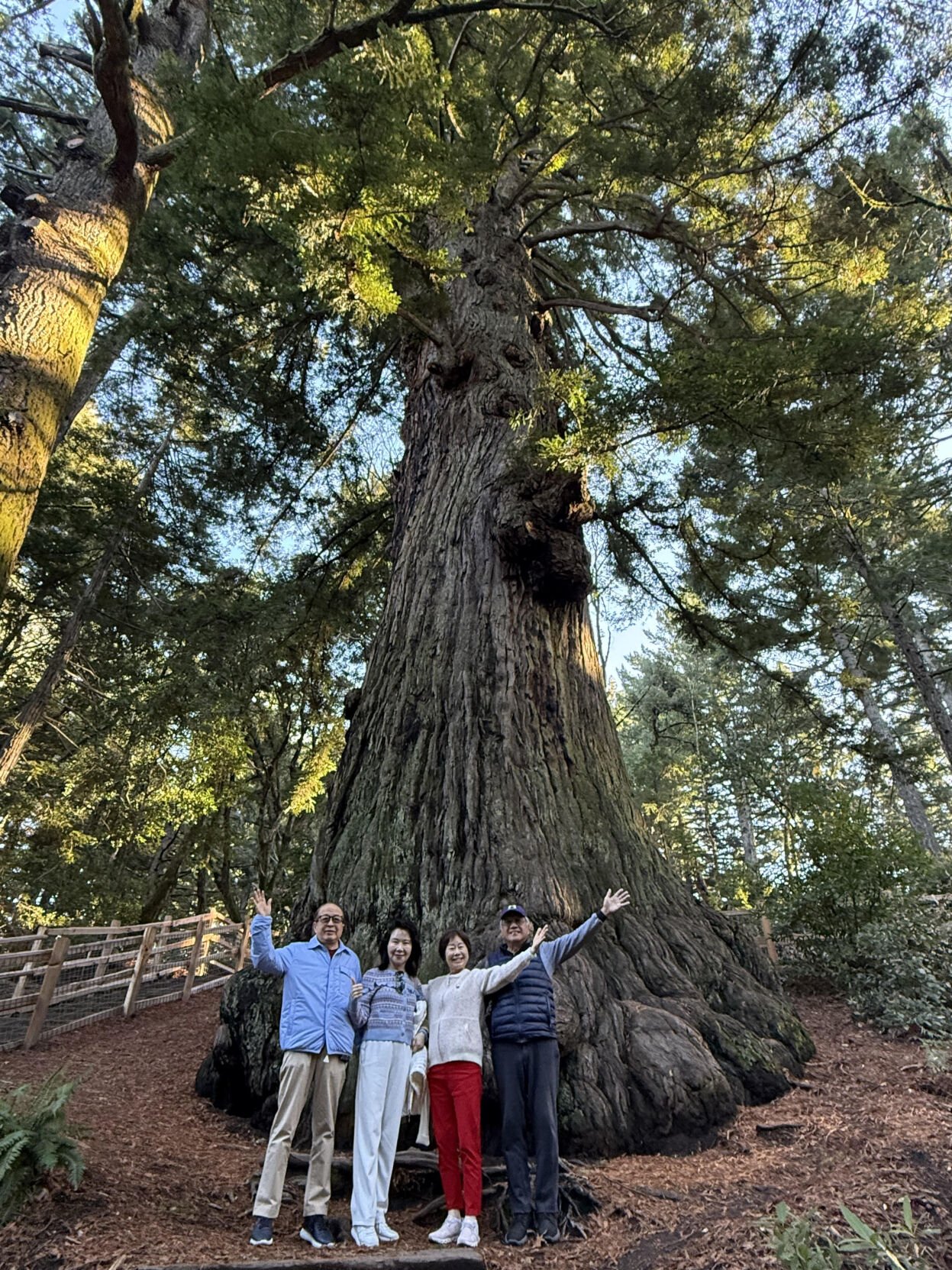
Before the World Wars, the Declaration of Independence, Columbus’ voyage to America, the Magna Carta and the First Crusade, there was Methuselah.
An old-growth redwood sprouting circa 217 A.D., Methuselah is a natural landmark that predates the split of Rome.
Named after the Biblical grandfather of Noah, who reportedly lived to be 969 years old and had the longest life ever, the tree has nearly doubled its namesake’s age at more than 1,800 years old.
To visit this ancient being, you’ll drive down a beautiful winding road by horse corrals and multimillion-dollar homes, with day trippers and joy-riding motorcyclists weaving by roadside hikers and cyclists. While it is hidden in the forested surroundings just off Skyline Boulevard, once you arrive, there is an undeniable presence to Methuselah.
Marked by a simple, metal sign and a fenced path, with a 14-foot diameter and 44-foot circumference, Methuselah is the largest and oldest tree in the Santa Cruz Mountains outside of Big Basin Redwoods State Park.
First time visitor Qing Yao of Foster City, taken by the scale of Methuselah, said, “the size is just overwhelming,” and that the tree “should be protected.”
Brandon Shumate, visiting from San Francisco, agreed. He pointed out how Methuselah is so large that single, off-shoot branches could be their own tree.
Methuselah hasn’t lived this long, or grown to such a stature, for no reason. Redwoods, with their thick bark, are built to withstand natural wildfires and other acts of God or man.
Yet the tree’s heartiness and luck has been tested multiple times in its relatively recent history.
When the Peninsula and Bay were being settled in the mid to late 19th century, most of the area was logged for the construction of the surrounding communities. Water-powered sawmills were introduced and the lumber industry grew to meet the demand brought on by western expansion. Yet Methuselah avoided the sawyer’s blade.
Methuselah’s survival of the logging industry is due to perceived flaws in the tree; particularly large burls and knobs deemed the prospective lumber to be faulty and difficult to mill; these “flaws” spared the tree while the rest of the area was harvested.
By the interwar years Methuselah virtually stood alone, the neighboring trees leveled. A 1938 picture shows the tree towering over the Douglas Fir saplings around it.
Recommended for you
Methuselah’s luck and solo battle for survival would eventually be eased by California Water Service’s 1936 acquisition of the land in which it is rooted.
Bear Gulch Watershed, named after the local creek, is a 1,200-acre plot of land dedicated to the collection of drinking water.
Diverting Bear Gulch Creek via two dams, the area taking its name from a purported grizzly bear mauling in 1850, water is carried by 3 miles of pipe to the local Bear Gulch Reservoir.
Storing and treating up to 215 million gallons of drinking water, the reservoir provides utilities for more than 55,000 people in the greater Atherton area.
Despite its organized stewardship, Methuselah’s tale continued to grow.
In 1954, the tree was struck by lightning. As the entrance sign indicates, this bolt from the sky blasted Methuselah’s crown, reducing its height from 225 feet to 137 feet.
However, the tree persisted and continues to do so, having regrown its crown and new sprouts.
With the help of California Water Service and an on-team arborist, Methuselah has been maintained and preserved for the public to appreciate its epic history.
Felix Sung and Teresa Chung, visiting from Taiwan, were brought by their friends Tina Wu and Jimmy Chen of Saratoga, to experience Methuselah for the first time.
Wu, thinking of the stories the tree could tell from its long life, said, “It is just amazing.”
The newly added fence around the tree was put in place to stop trespassers from the surrounding watershed while still allowing public access to view the grandeur of Methuselah. While originally fully encompassing the tree, two openings have been added to grant visitors the ability to physically connect with the tree.
Parking and respectful access can be found near the Molder Trailhead on Skyline Boulevard.





(0) comments
Welcome to the discussion.
Log In
Keep the discussion civilized. Absolutely NO personal attacks or insults directed toward writers, nor others who make comments.
Keep it clean. Please avoid obscene, vulgar, lewd, racist or sexually-oriented language.
Don't threaten. Threats of harming another person will not be tolerated.
Be truthful. Don't knowingly lie about anyone or anything.
Be proactive. Use the 'Report' link on each comment to let us know of abusive posts.
PLEASE TURN OFF YOUR CAPS LOCK.
Anyone violating these rules will be issued a warning. After the warning, comment privileges can be revoked.