
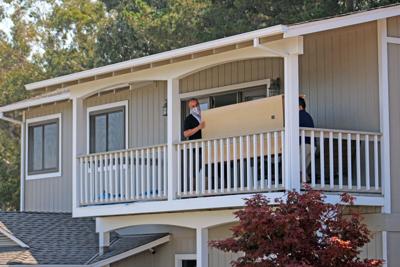
The Peninsula is packing up and pushing off for greener pastures, according to moving professionals who claim the pandemic is fueling the relocation business at an unprecedented rate.
Remote work arrangements yielding freedom from the office, locals fleeing from the traditionally high cost of living and rising unemployment due to a disrupted economy are all contributing factors to the rise in activity, said movers.
“Everyone is moving out of the Bay Area,” said Ben Matte of College Movers USA, a San Mateo company accommodating both residents and businesses looking for a new place to call home.
Data from The UniGroup Companies, which includes national moving brands such as United Van Lines and Mayflower Transit, supported that sentiment.
From May through July, interest in moving out of the Bay Area increased by 31% from the year prior — a greater spike than almost any metropolitan area in the nation other than New York City, said the group’s spokeswoman Eily Cummings in an email.
More specifically, there was a 46% rise in June among those looking to move from the Bay Area over the same time last year, said Cummings. Additionally, the group is seeing more small move shipments, considered two bedrooms or fewer, out of the state than any other area in the U.S., said Cummings.
The most common destinations for residents relocating in California are south to Los Angeles and surrounding communities or east from Sacramento to the Central Valley, said Matte.
Seattle, Dallas, Boston, Chicago, Denver, Phoenix, Portland, Atlanta and Austin, Texas are among the most popular national markets for those leaving the San Francisco metropolitan region, said Cummings.
Affordability is a key factor in the decision for many, said Matte, whose company is finishing many moves from local apartment units to new homes acquired in less expensive locales.
Also, Matte said businesses shuttered by the pandemic are seeking movers to haul the equipment no longer needed.
“Companies are shutting down and getting rid of their stuff,” he said.
Jose Mendoza, of Dynamic Movers, agreed that economic disruption is a huge contributing factor to his recent spike in business.
Whether it is moving out companies that closed, helping businesses set up shop elsewhere or relocating workers seizing on sudden flexibility granted by remote work arrangements, he said his crews have been on the road steadily since spring.
“At this point, it’s busier than ever,” said Mendoza.
Similar to Matte, Mendoza said most of his trips have been from the Peninsula down the state to Southern California or east to Modesto and Las Vegas for residents exhausted with the cost of living in San Mateo County.
“It’s too expensive to live in the Bay Area,” said Mendoza, fresh off a moving trip to Colorado. He added many employees of local businesses are moving back to their hometowns now that proximity to an office is not required.
Recommended for you
Summer is traditionally a busy time for movers, as people often seek new destinations when the weather is warm, the real estate industry heats up and students head off to college.
But with COVID-19 upending normal travel patterns, movers said the start of their season stumbled out of the gate because the shelter-in-place yielded great uncertainty regarding what, if any, activity was allowed.
With restrictions loosened recently, Alex Rodina of California Movers said there has been a sizable uptick in activity.
“It’s been very busy because I think some people wanted to move in April but they couldn’t,” she said.
Matte said moving anxieties still linger though, specifically for those fearful that the virus conditions may worsen with the cold weather on the horizon - potentially leading to another shutdown.
“Lately we’ve been really busy because everyone is anticipating a bigger shutdown than the last one,” said Matte.
In the interim though, Matte said his team is focused on completing their many jobs in the safest fashion possible.
Ramped up sanitation policies, greater reliance on single-use materials, social distancing and mandated face coverings are among the safety standards all must observe, he said, noting his company has gone as far as requiring workers to change clothes between jobs.
Mendoza agreed, saying that his company has been extra cautious because potential virus exposure could threaten his business and the livelihood of his employees as well.
For his part, Matte said the safety standards are relatively easy to implement as a common sense approach to preserving the health of workers and customers.
“We just have to take all protocols and precautions to make sure we don’t spread anything that can be avoided,” he said.
The extra measures can make the job more difficult though, said Matte, nodding to the challenges associated with lugging heavy items up and down flights of stairs in the summer heat while wearing a mask.
“We don’t get considered as essential workers, but we do all the hard stuff,” he said. “We do all the heavy lifting in heated environments. And we don’t get the credit that we deserve.”
(650) 344-5200 ext. 105


(4) comments
Not a good trend for those stacked housing advocates who are pushing for higher taxes and less regulations in building codes.
Selective Data selection can make all the difference.
Same trends from pre-covid 2019. Proper data on this MUST include international migration statistics for San Mateo County. Are we seeing people from other countries returning?
https://www.uhaul.com/Articles/About/19966/U-Haul-Migration-Trends-Top-25-Growth-Cities-Of-2019/
This just shows how the push for more dense apartment living is not supported by the market in San Mateo County. And the Pandemic also showed how density fueled the outbreak. Scott Wiener and his attempted SB50 giveaway to developers is totally unnecessary and designed not to fit a need, but purely to line the pockets of the small group of rich developers, union reps and politicians who would benefit. Please, let's not turn San Mateo County into San Francisco.
Totally agree! Stop all of this insane overbuilding in San Mateo. We will be left with a bunch of empty apartments where current residents will need grocery stores and other retail in the not so distant future. Take note, Passages.
Welcome to the discussion.
Log In
Keep the discussion civilized. Absolutely NO personal attacks or insults directed toward writers, nor others who make comments.
Keep it clean. Please avoid obscene, vulgar, lewd, racist or sexually-oriented language.
Don't threaten. Threats of harming another person will not be tolerated.
Be truthful. Don't knowingly lie about anyone or anything.
Be proactive. Use the 'Report' link on each comment to let us know of abusive posts.
PLEASE TURN OFF YOUR CAPS LOCK.
Anyone violating these rules will be issued a warning. After the warning, comment privileges can be revoked.