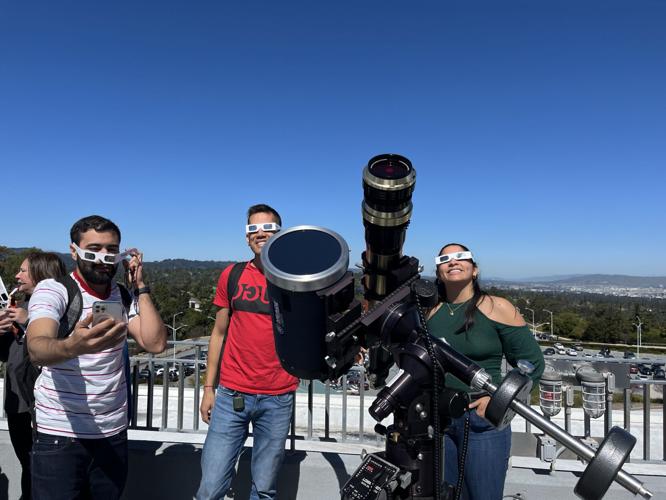
Felipe Aguado, Alejandro Caro and Catalina use telescopes and glasses to catch a glimpse of a rare solar eclipse at the College of San Mateo observatory.
San Mateo County residents caught a glimpse of a rare solar eclipse on Monday, using special glasses and telescopes to witness the moon covering a portion of the sun.
Join The Associated Press on April 8 at 10:00 a.m. EDT for a total solar eclipse watch party live from Texas with livestreams from Mexico, Arkansas, Illinois, Ohio and New York.
In some locations across the United States, the moon covered the sun in totality, casting a dark shadow onto the swath of planet below. At the College of San Mateo observatory, where onlookers gathered to watch the phenomenon, around 34% of the sun was covered at the eclipse’s peak, professor Mohsen Janatpour said.
“People get really excited about it, because it’s a big, cosmic event,” Janatpour, who coordinates the astronomy program at CSM, said. “In fact, in terms of the solar system, this is the biggest event that we can observe.”
On the rooftop of CSM’s observatory, adults and children alike donned eclipse glasses to look safely at the red-crescent sun, with Janatpour estimating more than 300 visitors throughout the 10:30-11:30 a.m. period of visibility.
Janatpour and the astronomy team put out sun-spotters — an advanced version of a pinhole camera to view the eclipse’s shadow — as well as two different solar telescopes with filters.
Ivana Hansen attended the eclipse after previously taking Janatpour’s CSM astronomy class. Janatpour’s excitement for the solar system and planetary functions was contagious, she said, and something she’s passed along to her own students as a teacher herself.
Felipe Aguado, Alejandro Caro and Catalina use telescopes and glasses to catch a glimpse of a rare solar eclipse at the College of San Mateo observatory.
Holly Rusch/Daily Journal
“I love to be able to see things that are happening in the solar system and I get really excited for it. I’ve been tracking this eclipse for a while,” she said.
The simultaneous eclipse-viewing going on throughout the nation also stirs broader emotions for Hansen.
“It makes you think about life in general, and the bigger purpose and how small we are in comparison,” she said. “It’s actually an event that just brings everyone together as well.”
Recommended for you
Solar eclipses have created strong feelings spanning centuries, Janatpour said, particularly when scientific explanations did not yet exist. In ancient China, for example, it was a commonly held belief that solar eclipses were a celestial dragon devouring the sun.
“That’s an event that has a big historical background. Eclipses, people thought at one point, were a sign of bad, bad things [happening],” he said. “In different cultures, we have been observing glimpses that we know of recorded eclipses from about 1200 years BC.”
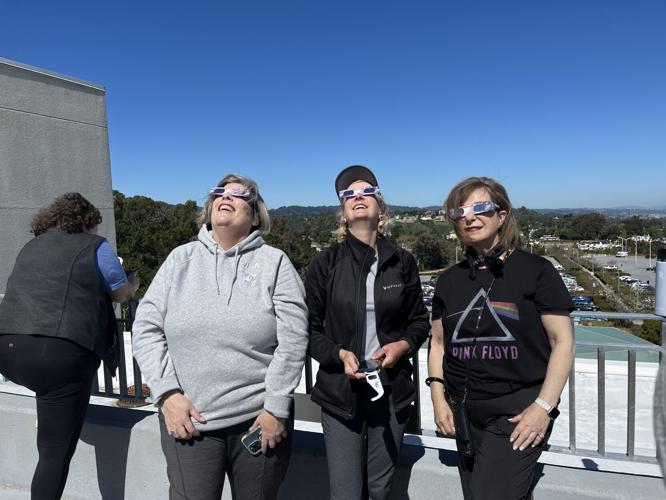
Jan McDonald, who attended the eclipse viewing at the observatory alongside two friends — after viewing the 2017 eclipse at the same location — had similar thoughts on the perspective watching an eclipse brings viewers.
Barrie Howard, Margaret Reed and Jan McDonald use eclipse glasses to enjoy the astronomical phenomenon.
Holly Rusch/Daily Journal
“I think that’s the bigger picture of what’s really happening in our lives,” she said. “We should focus more on this type of science, instead of some of the things that we get caught up in daily.”
Others, like McDonald’s friend Barrie Howard, appreciated the multigenerational excitement that solar eclipse viewing offers.
“I’m excited for the young kids that are here. It’s special for them,” she said.
CSM students Maige Brody and Aidan Pechnik took a more measured approach to the astronomical event, stopping by the observatory viewing to check out the crowd and view the phenomenon.
“We saw some people on the roof and were like ‘oh, this is a party,’” Pechnik said.
Janatpour said Monday’s solar eclipse was unique because another total eclipse won’t occur in the United States until 20 years from now, in 2044. But he emphasized that eclipses are more common than one might think — if you know where to look.
Solar eclipses happen every six to seven months and total eclipses occur every one to three years, but often over the ocean or other locations that make it challenging to view, he said.
Keep the discussion civilized. Absolutely NO
personal attacks or insults directed toward writers, nor others who
make comments. Keep it clean. Please avoid obscene, vulgar, lewd,
racist or sexually-oriented language. Don't threaten. Threats of harming another
person will not be tolerated. Be truthful. Don't knowingly lie about anyone
or anything. Be proactive. Use the 'Report' link on
each comment to let us know of abusive posts. PLEASE TURN OFF YOUR CAPS LOCK. Anyone violating these rules will be issued a
warning. After the warning, comment privileges can be
revoked.
Please purchase a Premium Subscription to continue reading.
To continue, please log in, or sign up for a new account.
We offer one free story view per month. If you register for an account, you will get two additional story views. After those three total views, we ask that you support us with a subscription.
A subscription to our digital content is so much more than just access to our valuable content. It means you’re helping to support a local community institution that has, from its very start, supported the betterment of our society. Thank you very much!






(0) comments
Welcome to the discussion.
Log In
Keep the discussion civilized. Absolutely NO personal attacks or insults directed toward writers, nor others who make comments.
Keep it clean. Please avoid obscene, vulgar, lewd, racist or sexually-oriented language.
Don't threaten. Threats of harming another person will not be tolerated.
Be truthful. Don't knowingly lie about anyone or anything.
Be proactive. Use the 'Report' link on each comment to let us know of abusive posts.
PLEASE TURN OFF YOUR CAPS LOCK.
Anyone violating these rules will be issued a warning. After the warning, comment privileges can be revoked.