
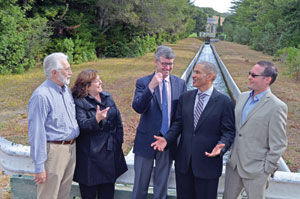
As part of a multi-billion dollar seismic upgrade and a truly incredible feat, the first tunnel to ever be drilled underneath the Bay began to convey drinking water Tuesday morning from the Hetch Hetchy reservoir to Crystal Springs.
Marked by a stark drought, the San Francisco Public Utilities Commission’s tunnel replaces failing pipes that had leaked millions of gallons of water into the Bay.
The culmination of the $288 million Bay Tunnel Project marks the 80th anniversary of when the first Hetch Hetchy water entered the San Mateo County reservoir at the historic Pulgas Water Temple off Cañada Road.
As the Loma Prieta earthquake shook the area exactly 25 years ago this Friday, the new tunnel is an massive seismic upgrade to the backbone of the conveyance system that serves 2.6 million customers in San Francisco, San Mateo, Santa Clara and Alameda counties.
“Where we’re standing right now (near Pulgas Water Temple) 80 years ago we began delivering precious resource to the customers that we serve. On this very location also coincidentally 25 years ago, we had one of the biggest earthquakes in modern times and that’s just simply a reminder how important this infrastructure is,” SFPUC President Vince Courtney said.
An incredible example of modern engineering, the tunnel was dug with a 15-foot diameter earth pressure balance tunnel boring machine, according to the SFPUC.
The 5-mile long, 9-foot diameter pipe runs about 75 feet to 110 feet underneath the sand and silt of the Bay between Newark and East Palo Alto, according to the SFPUC.
The new tunnel resolves a failing pipe’s waste of about 25 gallons of fresh water per minute that had been leaking into the Bay since the SFPUC first became aware of the problem at least four to five years ago. The aged pipe, located just south of the Dumbarton Bridge immediately offshore from East Palo Alto, has wasted between 52.5 million and 65.7 million gallons of fresh water, according to SFPUC estimates.
Despite the drought, the SFPUC opted not to make costly and potentially dangerous repairs to the pipe as the new Bay Tunnel was set to abandon the nearly 80-year-old pipes.
“[The Bay Tunnel is] very significant because we always want to conserve water. It’s doubly significant because we’re in a drought. So the fact that we’re putting the new Bay Tunnel in service means the conveyance system is seismically reliable, but we’re also saving water at the same time,” SFPUC spokesman Charles Sheehan said.
The entire Hetch Hetchy system carries more than 250 million gallons of water per day and, depending on flow, the new tunnel can transport the resource from Newark into Crystal Springs in six hours, according to the SFPUC.
Recommended for you
Construction of the project began in 2010 and was initially anticipated to take until spring 2015. The project not only benefits consumers, it generated jobs as well, Courtney said. While preparations kicked off in 2008 during the recession, about 60 percent of the more than 500,000 construction hours on the project were performed by Bay Area residents and 50 percent of the apprenticeship hours were fulfilled by San Mateo County residents, Courtney said.
The project funded entirely by ratepayers also came in $25 million under budget, said Nicole Sandkulla, CEO of the Bay Area Water Supply Conservation Agency. BAWSCA represents the interests of 24 cities and water districts as well as two public utility companies along the Peninsula that purchase wholesale water from the SFPUC.
Although the new tunnel was costly, it was well worth it to ensure reliable water supplies to millions of residents, Sandkulla said.
Work still remains in the SFPUC’s $4.6 billion Water System Improvement Program such as replacing the Calaveras Dam and the Regional Groundwater Storage and Recovery project that will assist with drought preparations by holding a year’s worth of water, Sandkulla said.
Dave Pine, president of the San Mateo County Board of Supervisors, said the seismic improvements were vital as the U.S. Geological Survey is noting geographical movement indicating another large earthquake could come soon.
“This work was done ahead of that and it’s not often that government can get ahead of a problem. It could have very easily seen an earthquake and had a loss of water supply. But thanks to the foresight of the SFPUC, the generosity of the ratepayers, the investments have been made to strengthen that system so when the earthquake occurs, we’ll be much better off,” Pine said.
SFPUC General Manager Harlan Kelly said there are 83 projects outlined in the improvement program and constructing the first ever tunnel to run underneath the bottom of the Bay is an amazing accomplishment that benefits consumers.
“The one thing that people don’t recognize is when we talk about water infrastructure it’s always buried, it’s invisible,” Kelly said. “My job as general manager is to remind everyone that we’re investing this money in our infrastructure, may be invisible, but it’s vital to deliver you water, which is the source of everyone’s existence.”
(650) 344-5200 ext. 106











(0) comments
Welcome to the discussion.
Log In
Keep the discussion civilized. Absolutely NO personal attacks or insults directed toward writers, nor others who make comments.
Keep it clean. Please avoid obscene, vulgar, lewd, racist or sexually-oriented language.
Don't threaten. Threats of harming another person will not be tolerated.
Be truthful. Don't knowingly lie about anyone or anything.
Be proactive. Use the 'Report' link on each comment to let us know of abusive posts.
PLEASE TURN OFF YOUR CAPS LOCK.
Anyone violating these rules will be issued a warning. After the warning, comment privileges can be revoked.