
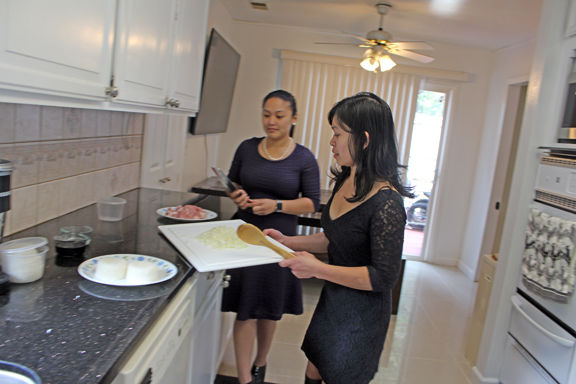
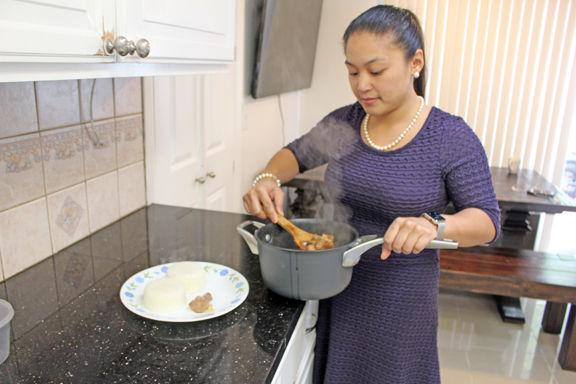
Having cooked daily meals for a seven-person household for years, San Bruno resident Maya Mendoza knows well what it’s like to feed a crowd.
Whether it’s pork adobo or a dish prepared for those on a healthy diet, Mendoza is used making enough food for neighbors and friends of her family to take part in the meals she cooks at home.
So when county officials voted in January to begin crafting a permit allowing eligible residents to cook and sell up to 60 meals a week, Mendoza was among those who took note. Having watched as a state bill aimed at legalizing small-scale food operations received overwhelming support from state legislators last year, Mendoza viewed the new law as bringing her one step closer to opening her own business.
“I see myself opening maybe a food truck or a restaurant in the future,” she said. “It’s a really great stepping stone between cooking for the fun of it and actually making it tangible business.”
As a mom of high school students playing volleyball, Mendoza said she started cooking large batches of meals for athletes and parents to enjoy at tournaments. She said she hadn’t given much thought to selling extra meals until she learned in late 2017 of the startup Josephine, which offered an online platform where home chefs could post meals they are planning to cook for the day so others could purchase them.
Mendoza said she met neighbors and students at nearby Skyline College through Josephine, and also saw the benefits the arrangement could offer to those who didn’t have time to cook their own meals. She said Josephine guided her through the process for obtaining a California Food Handlers Card, completing a virtual inspection of her kitchen and securing insurance for her operation. Though the startup closed its operations last year, Mendoza said she planned to build on the experience she gained through Josephine and start her own operation under the new law.
“I would never have thought about selling my food,” she said. “It was such a great idea.”
As a cofounder and CEO of the Oakland-based startup, Matt Jorgensen said Josephine was launched in 2015 with the goal of helping home chefs prepare their meals safely and build a business around their operations. Though he had known the startup would face regulatory changes, Jorgensen said he realized after advocating for home chefs with local governments that changes to state law would be needed to create a path for home chefs to legally and safely sell their food.
Recommended for you
Jorgensen said a coalition of nonprofits and cooks with a variety of backgrounds met with state environmental health officials to begin crafting Assembly Bill 626, which then Gov. Jerry Brown signed into law in September. Though Jorgensen opted to wind down Josephine’s operations in early 2018, he has remained focused on opening opportunities for underserved communities to formalize food-centric businesses through the nonprofit C.O.O.K. Alliance.
Though he has seen how small-scale food operations can provided an avenue for immigrant or low-income communities to participate in their local economies, Jorgensen also acknowledged the social benefits of getting to know one’s neighbors through food.
“The amazing thing about food is that it’s such an easy common denominator for people to share culture,” he said. “Just knowing a few cooks in your community can really make it feel like your neighborhood.”
In proposing county officials take a step toward crafting permits for home chefs, San Mateo County Supervisor David Canepa hoped to both create economic opportunities for residents and offer a path for those currently selling food to do so legally and safely. He said he and Supervisor Don Horsley will serve on a subcommittee focused on figuring out what a permit that would be issued by County Health’s Environmental Health Services Division would look like and cost as well as how the rules will be enforced.
Canepa noted the up to $50,000 in gross annual income an individual can make under the new law can serve as substantial ancillary income for a family. He emphasized their efforts are not meant to subvert the professional food industry or evade health and safety codes but rather will help residents who might not otherwise have the capital to start their own business to take steps toward becoming business owners.
“We’re giving people an opportunity to ramp up,” he said. “For people who don’t have that wealth on hand … it gives them the opportunity to build capital and move forward with the business.”
(650) 344-5200 ext. 106





(0) comments
Welcome to the discussion.
Log In
Keep the discussion civilized. Absolutely NO personal attacks or insults directed toward writers, nor others who make comments.
Keep it clean. Please avoid obscene, vulgar, lewd, racist or sexually-oriented language.
Don't threaten. Threats of harming another person will not be tolerated.
Be truthful. Don't knowingly lie about anyone or anything.
Be proactive. Use the 'Report' link on each comment to let us know of abusive posts.
PLEASE TURN OFF YOUR CAPS LOCK.
Anyone violating these rules will be issued a warning. After the warning, comment privileges can be revoked.