

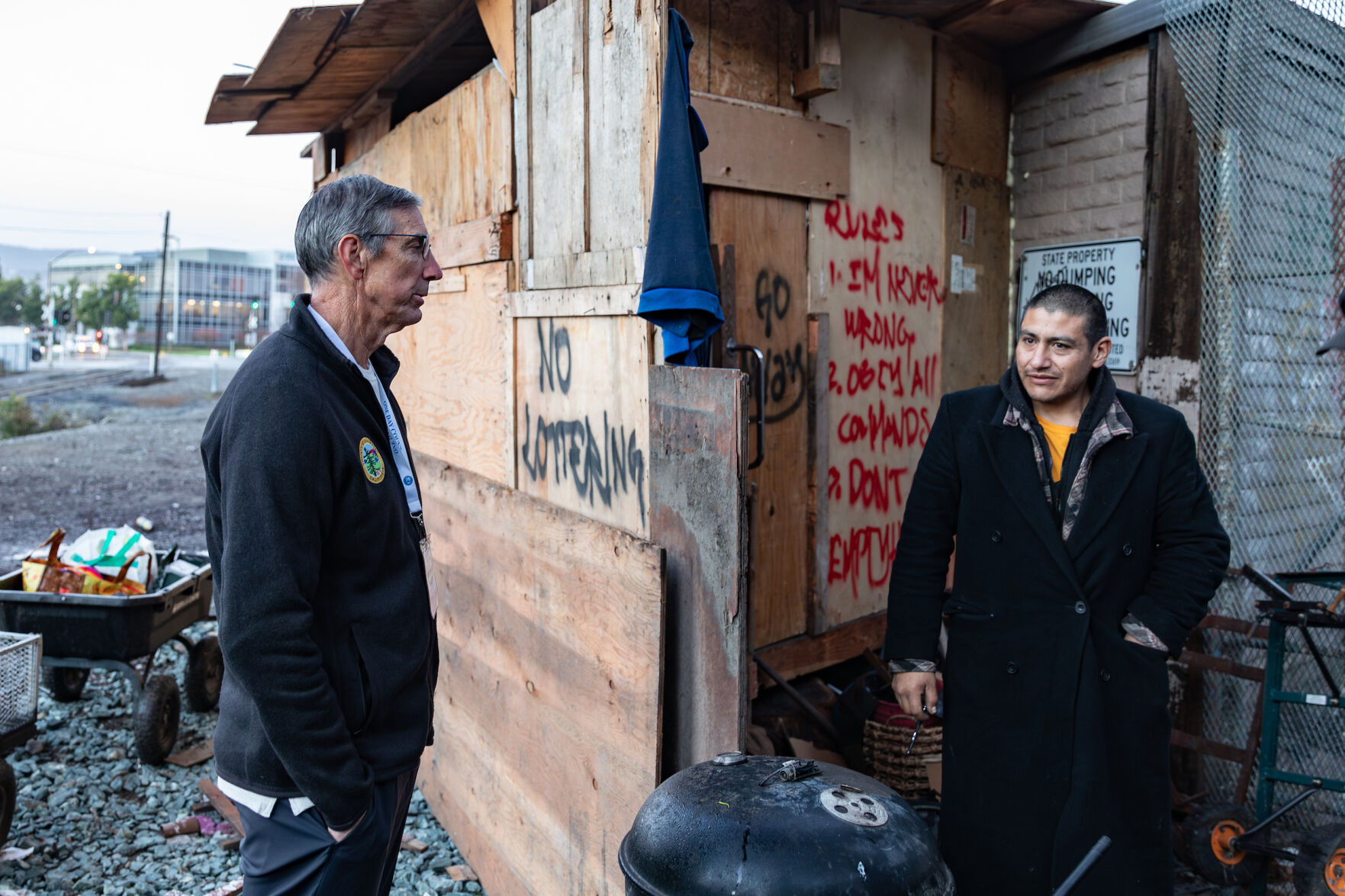
A new executive order from Gov. Gavin Newsom mandating state officials remove homeless encampments and encouraging local municipalities to do the same won’t have any impact on San Mateo County’s own guidelines, Assistant County Executive Iliana Rodriguez said.
That’s because the San Mateo County Board of Supervisors passed an ordinance in January that’s consistent with what the state government is now imposing on its departments, Rodriguez said.
Under the regulation — which only affects unincorporated areas of the county — anyone contacted for illegally camping on public property in the areas could be charged, but those charged would be eligible for diversion programs.
“Our ordinance lays out guideposts on how you humanely deal with the clearance of encampments,” Rodriguez said. “We never attempt to clear anything without offering a shelter bed.”
An encampment cannot be dismantled unless the county has shelter available for each person living there. The county isn’t required under state law to have a bed for all homeless individuals in the county before pursuing other measures meant to compel someone into shelter.
San Mateo County’s ordinance also already adheres to guidelines laid out in the executive order, like giving individuals advance notice of encampment clearing whenever possible and storing individuals’ belongings for up to 90 days.
Ultimately, cities have responsibility over managing their unhoused populations, Rodriguez said, with the county providing health and social services.
It remains to be seen whether local cities will adopt new ordinances as a result of the executive order, which was in response to a recent U.S. Supreme Court ruling that gave governments greater ability to clear encampments.
Organizations like Samaritan House, a nonprofit that runs three adult shelters as well as the county’s coordinated entry system for shelter and services, are prepared to serve greater numbers of unhoused clients if need arises, CEO Laura Bent said.
Recommended for you
“San Mateo County has been preparing for this since the ordinances went into place. I think we’re positioned well in terms of having availability of shelter beds for folks who may be displaced from the encampments,” she said. “Samaritan House stands ready for what could be an increased number of unsheltered clients.”
The county is focused and prepared to provide wraparound services — like shelter beds, mental health and behavioral treatment, workforce development, food security and financial management — that are necessary to make encampment-clearing a successful tool, Bent said.
“As a standalone solution, the likelihood [of success] is minimal. If you have all the resources, which our county does, you have a much better chance,” she said.
The county has eight encampments in its jurisdiction — which are not large, typically containing one to two individuals — seven of which are vehicular in nature, Rodriguez said. Encampments have been cleared in the past, but the county ordinance applies only to public property, not the public right-of-way, meaning limited jurisdiction over vehicles.
“We try to approach with compassion and understanding after we tried numerous months, if not years, to get an individual off the street and into shelter,” she said.
Newsom’s executive order has drawn mixed reactions, with some, like Reform California chairman and Republican state Assembly candidate Carl DeMaio dismissing the action as another example of the inadequate homelessness policy that created a statewide emergency.
“I urge the media and the public to carefully read the actual text of Newsom’s executive order — because if they do, they will find it is nothing but bureaucratic nonsense masquerading as bold action and policy change,” he said in a statement. “Gavin Newsom still backs “Housing First” policies that expressly prohibit local government and nonprofits from using drug treatment and mental health mandates to get to the root cause of homelessness.
Others, like Jim Wunderman, Bay Area Council president and CEO, lauded the decision.
“Getting our many thousands of unhoused residents indoors and out of unsafe, unhealthy and inhumane outdoor encampments is critical to ending California’s homelessness crisis,” he said in a statement. “California cities must now rise to meet this moment, to grab this opportunity and provide the shelter and housing that can end our long homelessness nightmare.”





(0) comments
Welcome to the discussion.
Log In
Keep the discussion civilized. Absolutely NO personal attacks or insults directed toward writers, nor others who make comments.
Keep it clean. Please avoid obscene, vulgar, lewd, racist or sexually-oriented language.
Don't threaten. Threats of harming another person will not be tolerated.
Be truthful. Don't knowingly lie about anyone or anything.
Be proactive. Use the 'Report' link on each comment to let us know of abusive posts.
PLEASE TURN OFF YOUR CAPS LOCK.
Anyone violating these rules will be issued a warning. After the warning, comment privileges can be revoked.