Partly cloudy skies during the evening will give way to considerable cloudiness and fog after midnight. Low 56F. W winds at 10 to 20 mph, decreasing to less than 5 mph..
Tonight
Partly cloudy skies during the evening will give way to considerable cloudiness and fog after midnight. Low 56F. W winds at 10 to 20 mph, decreasing to less than 5 mph.
Starting at 5 a.m. Jan. 29, more than 300 volunteers combed through San Mateo County to conduct a biennial count of unsheltered individuals in the region, with hopes that the county’s latest initiatives — like encampment crackdowns and a new homeless shelter — have stopped the steady increase in homelessness since 2017.
The event takes place every two years and involves groups of volunteers walking and driving through neighborhoods, tracking the number of unsheltered individuals in the area. The count is required for certain types of federal funding, but it’s also a gauge for regional leaders on how effective their recent efforts have been to reduce homelessness. The number of unsheltered individuals in San Mateo County, according to the last few point-in-time counts, has gradually increased from 1,253 in 2017 to 2,130 in 2024.
While 2026 results won’t be finalized until at least springtime, leaders and community members are hoping the cities’ and the county’s initiatives in the last couple years show some reductions. Since the last count in 2024, the county opened a new homeless shelter in Redwood City, known as the Navigation Center, a 240-bed facility that offers case management services and job training, among other amenities. More supportive facilities like Cordilleras and affordable housing developments such as Kiku Crossing have opened as well.
The state has also encouraged ramping up enforcement on encampment ordinances — in part motivated by the City of Grants Pass v. Johnson Supreme Court case — which has led to some jurisdictions throughout the Bay Area implementing their own crackdowns. Redwood City and Millbrae both passed anti-camping ordinances last year, which could lead to a misdemeanor and jail time for those who continue to live in encampments and refuse shelter. Two years ago, the San Mateo County Board of Supervisors passed a policy that could lead to a misdemeanor charge if available shelter is refused.
“It is a tool to encourage folks that are resistant to receiving services to get those services, but it’s always better to offer a carrot than the stick,” Noelia Corzo, president of the San Mateo County Board of Supervisors, said.
It’s not quite clear how effective the policies have been, as neither the county nor Redwood City have issued any citations for the ordinances. Millbrae has issued two citations since its went into effect.
“There have been places that would be eligible or subject to [the illegal camping ordinance], but the teams have made repeated efforts, and they’ve been successful. If we’re not citing, then the efforts are successful and they’re making their way to services and resources,” county spokesperson Effie Verducci said.
City of San Mateo efforts
San Mateo has taken a carrot and stick approach as well. Last June, the City Council voted to start enforcing its current policies that prohibit individuals from living in their vehicles, including recreational vehicles. The city has issued about 22 citations — most related to parking and registration violations — since the crackdown went into effect, according to data provided to the City Council by Police Chief Ed Barberini during a December meeting.
At the end of 2022, the city started its own homeless outreach team within the Police Department. The duo, David Johnson, a retired police officer, and Victoria Asfour, approach unhoused individuals not to issue tickets but offer services, such as treatment, shelter or even food. Unlike many larger programs, they have the flexibility to quickly pivot and provide resources to someone in need or drive someone to a program or the Department of Motor Vehicles on the spot.
“We are the gap fillers. There are so many small areas where people can fall through the cracks,” Johnson said. We started taking them when they need to go to court. We’ve been to the Social Security office many times waiting in line because they are just not able to do it on their own, and there is no one else that is going to do it.”
Recommended for you
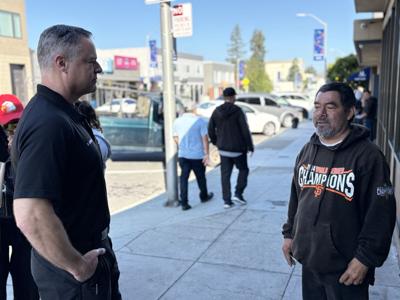
David Johson, left, and Juan Carlos Ramirez have a conversation in downtown San Mateo.
Alyse DiNapoli/Daily Journal
One longtime San Mateo resident, Juan Carlos Ramirez, said his housing struggles began after getting divorced several years ago. He often gets food from St. Vincent de Paul’s downtown outlet and sleeps in a friend’s truck or sometimes at his brother’s house. He’s tried staying at shelters but said he doesn’t like the rigid rules and doesn’t always get along with others who stay there.
“There were people I’ve had beef with in the past … so I didn’t want to be there,” he said. “I’d rather be outdoors.”
Johnson said many residents he and Asfour interact with aren’t ready to accept services, but it’s the outreach team’s job to continue trying, even if the person is uncooperative or they have a busy caseworker who’s unable to prioritize them.
“Everything is voluntary, so if you go repeatedly to somebody and they refuse to take services, how many times are you going to keep asking?” Johnson said. “We’re the unit that will keep going to them even when they say no. It may take 15 times before they finally let us give them a snack bag or even their last name, but we don’t pressure them.”
From counting to action
The point-in-time volunteers don’t count people staying in shelters, meaning the total number of individuals without adequate housing is much higher. Just two of the county’s shelters — the Navigation Center and Safe Harbor, for instance — served an average of 270 and 364 clients per quarter last year, respectively, operating at about 90% capacity. Corzo said there are also many families, including undocumented immigrants, living in overcrowded homes and apartments.
“To me, that’s a significantly undercounted form of homelessness, and it’s almost impossible to get a full picture of,” she said.
Despite the additional outreach initiatives and stricter ordinances in place, however, the county is also starting to brace for impending federal funding cuts to major social safety net programs, such as Medi-Cal — which covers drug treatment and other medical care for low-income individuals — and CalFresh, putting those in tenuous housing situations at higher risk. Community Development Block Grant funds, which in some cases, provide rental and housing assistance, are also in jeopardy due to new restrictions imposed by the Department of Housing and Urban Development.
An estimated 36,000 to 53,700 individuals — about 20% to 30% of those on Medi-Cal in the county — could soon lose medical coverage due to a mix of factors as a result of the legislation, including immigration status. Already starting Jan. 1, undocumented immigrants aren’t able to newly enroll in Medi-Cal, while many of those currently enrolled will have their coverage restricted. That means the county, and potentially state, will have to fill in the gaps in care.
“Tough decisions will have to be made,” Corzo said.
Despite the sacrifices, she added that the county remains luckier than most.
“This county has a lot more access than many others,” she said. “We’re a pretty wealthy county, and that shows in the additional programs and services we’re able to offer.”
Keep the discussion civilized. Absolutely NO
personal attacks or insults directed toward writers, nor others who
make comments. Keep it clean. Please avoid obscene, vulgar, lewd,
racist or sexually-oriented language. Don't threaten. Threats of harming another
person will not be tolerated. Be truthful. Don't knowingly lie about anyone
or anything. Be proactive. Use the 'Report' link on
each comment to let us know of abusive posts. PLEASE TURN OFF YOUR CAPS LOCK. Anyone violating these rules will be issued a
warning. After the warning, comment privileges can be
revoked.
Please purchase a Premium Subscription to continue reading.
To continue, please log in, or sign up for a new account.
We offer one free story view per month. If you register for an account, you will get two additional story views. After those three total views, we ask that you support us with a subscription.
A subscription to our digital content is so much more than just access to our valuable content. It means you’re helping to support a local community institution that has, from its very start, supported the betterment of our society. Thank you very much!






(0) comments
Welcome to the discussion.
Log In
Keep the discussion civilized. Absolutely NO personal attacks or insults directed toward writers, nor others who make comments.
Keep it clean. Please avoid obscene, vulgar, lewd, racist or sexually-oriented language.
Don't threaten. Threats of harming another person will not be tolerated.
Be truthful. Don't knowingly lie about anyone or anything.
Be proactive. Use the 'Report' link on each comment to let us know of abusive posts.
PLEASE TURN OFF YOUR CAPS LOCK.
Anyone violating these rules will be issued a warning. After the warning, comment privileges can be revoked.