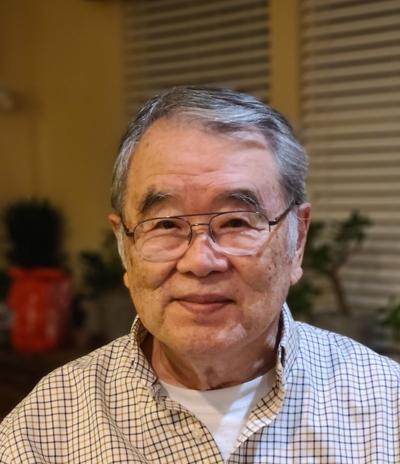
Yukio Shimomura was 8 years old when he and his family were sent to an internment camp in Utah from their home in San Francisco following the attack on Pearl Harbor, forcing him to spend two years as a prisoner in his own country.
Shimomura, now 88, will be at the San Carlos library Tuesday, May 23, teaching younger generations about a time of rising tensions and hate when he, his family and more than 100,000 people of Japanese descent were incarcerated and had their civil liberties taken away during World War II.
“It’s an opportunity to share a piece of history that a lot of people may not be aware of,” Shimomura said. “What I try to communicate is what the Japanese families went through, so it illuminates the ironies of the war.”
Life before the camps was good, and Shimomura recalls growing up in San Francisco as Nisei, which refers to the second generation of Japanese Americans whose parents were immigrants from Japan. His father worked as a traveling salesman throughout the United States, and his mother was a seamstress and an organist in a church. His parents came over for economic reasons, following a large earthquake in Japan, and were sponsored by his aunt and uncle. His brothers were in the Boy Scouts while living near Bush Street in San Francisco.
“We were enjoying what I would call a peaceful life until this tragedy happened,” Shimomura said of Pearl Harbor.
In the aftermath, President Franklin Roosevelt signed Executive Order 9066 on Feb. 19, 1942, two months after the attack on Pearl Harbor, which gave the political approval for the government to remove Japanese Americans from areas deemed military areas in the western part of the United States to other parts of the country. As the orders were carried out, many people got a few days to register with authorities and report to an assembly center before internment, forcing many to abandon businesses, property and lives. Many internment camps were in harsh, remote locations. Shimomura and his family were sent to Topaz, Utah, about two hours southwest of Salt Lake City. Much of his life then became being told what to do, when to do it and how, surrounded by guards with loaded weapons and by barbed wire. He and his family lived in a barrack made of wood covered by tarp paper, with no insulation during the harsh winters. A lack of privacy around the bathroom and other facilities made it a challenging environment in the years he was there.
Loyalty questionnaire
Shimomura’s parents were stoic and had little answers about where the family was going and for how long, with responses often, “I don’t know.” Authorities first sent his family to Tanforan Race Track in San Bruno because it was an assembly staging center before traveling by train to internment camps. Shimomura said many families had to stay in horse stalls at Tanforan, with a significant odor lingering, a lack of sinks and toilets and long lines for meals.
“I think it was very traumatic not only for my parents but also for my brothers and grandmother who was with us,” Shimomura said.
Recommended for you
Authorities also gave a loyalty questionnaire at the camp, with two controversial questions about if the individual would serve in combat when ordered and if they would declare loyalty to the United States. Shimomura said some men questioned why their constitutional rights were violated and wondered why they should show loyalty when the country treated them as disloyal. His brother was drafted into the military, and he and his other brother volunteered for service in the Army. His oldest brother served in Japan not long after the end of World War II, while his other brother served during the Korean War and was a prisoner of war for six months. Shimomura served in Korea only a short time after the Korean War ended.
“I guess that’s our family’s way of showing our loyalty to the United States,” Shimomura said.
Speaking publicly
His father and his family were allowed to leave the camps before the end of the war when his father got a job as a shipping clerk in Ogden, Utah, and they decided to stay in Utah after the war. Shimomura lived and briefly attended school in Los Angeles before moving back to Utah to go to Utah State University to study engineering. He then moved to the Bay Area for work and is now retired and living in Morgan Hill. In the decades since the camps, he had a significant chip on his shoulder because of how his family was treated but, over the years, he has mellowed out to the point where he can talk about it without getting angry.
“I can get emotional, but I don’t get angry because it’s all history. I just want to pass on the history of what we as a group of people went through,” Shimomura said. “To communicate that your constitutional rights can be violated, and groups have to speak up to defend themselves so they don’t have to go through what we went through.”
Despite the injustices he has faced, he still loves America and wishes it to live up to its ideals of liberty and justice for all. He didn’t talk about his experiences publicly until 2014, when he spoke at Weber State University because the school wanted students to hear a first-person account of the camps. After consideration, he jumped at the chance to share his family’s experiences and has since spoken at colleges, churches, rotary clubs and private homes. He recently spoke in Foster City and wants to talk in San Mateo and other parts of the county.
“If somebody is asking, I respond and say, let’s go for it,” Shimomura said.
The event, called My Two and a Half Years Behind Barbed Wire in the U.S. During WWII, will be on Tuesday from 6-7 p.m. at the San Carlos library on 610 Elm St.
Keep the discussion civilized. Absolutely NO
personal attacks or insults directed toward writers, nor others who
make comments. Keep it clean. Please avoid obscene, vulgar, lewd,
racist or sexually-oriented language. Don't threaten. Threats of harming another
person will not be tolerated. Be truthful. Don't knowingly lie about anyone
or anything. Be proactive. Use the 'Report' link on
each comment to let us know of abusive posts. PLEASE TURN OFF YOUR CAPS LOCK. Anyone violating these rules will be issued a
warning. After the warning, comment privileges can be
revoked.
Please purchase a Premium Subscription to continue reading.
To continue, please log in, or sign up for a new account.
We offer one free story view per month. If you register for an account, you will get two additional story views. After those three total views, we ask that you support us with a subscription.
A subscription to our digital content is so much more than just access to our valuable content. It means you’re helping to support a local community institution that has, from its very start, supported the betterment of our society. Thank you very much!







(0) comments
Welcome to the discussion.
Log In
Keep the discussion civilized. Absolutely NO personal attacks or insults directed toward writers, nor others who make comments.
Keep it clean. Please avoid obscene, vulgar, lewd, racist or sexually-oriented language.
Don't threaten. Threats of harming another person will not be tolerated.
Be truthful. Don't knowingly lie about anyone or anything.
Be proactive. Use the 'Report' link on each comment to let us know of abusive posts.
PLEASE TURN OFF YOUR CAPS LOCK.
Anyone violating these rules will be issued a warning. After the warning, comment privileges can be revoked.