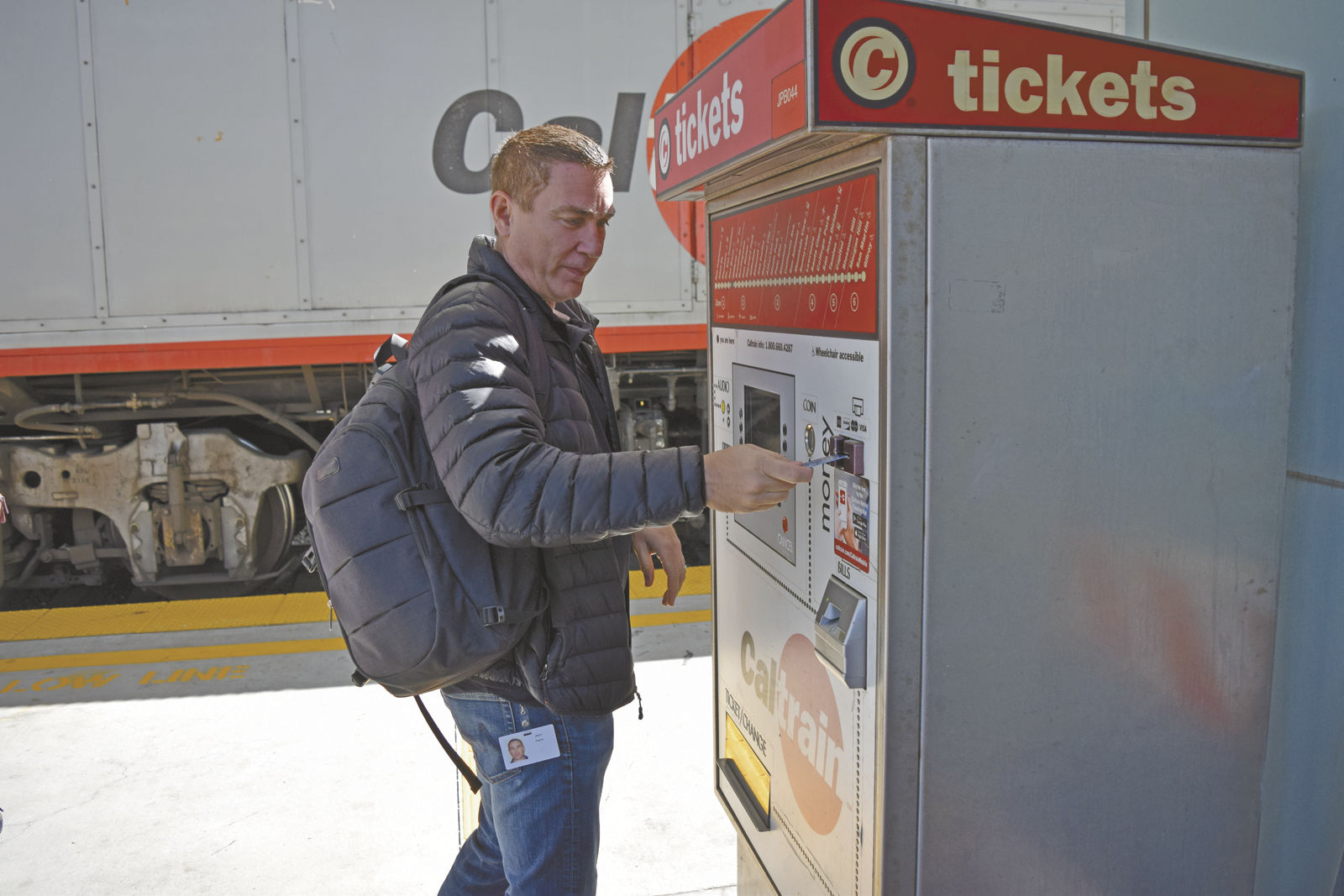
Citing the absence of a dedicated revenue source for Caltrain, railroad officials are set to approve a package of fare increases that some riders have described as unfair and especially burdensome to low-income riders.
The proposals include a 50 cent increase to the base fare by July 2020, a 25 cent increase to the zone fare by July 2022 and another 50 cent increase to base fare in July 2024. Those changes would apply to the one-way pass, day pass and monthly pass.
Staff is also proposing to raise the price of the Go Pass by 20%, effective Jan. 1, 2020, followed by a 5% increase every two years on Jan. 1, starting in 2022. The Go Pass program allows companies, educational institutions and housing complexes to purchase annual unlimited-ride passes for all eligible employees, residents or students. It currently costs either $285 per eligible user or $23,940 — whichever is greater.
Caltrain’s Chief Finance Officer Derek Hansel said the new Go Pass prices adequately address long-standing concerns that the program has historically been underpriced.
“We think on a revenue per passenger mile basis we’ve gotten pretty close to equity relative to our other products,” he said.
Hansel doesn’t anticipate the one-time 20% price increase to lead to a “huge decrease” in revenue. He said there was some customer attrition after the price of the Go Pass increased by 25% in January of 2018, but after the price went up by the same amount in January of 2019, Caltrain sold more Go Passes than it ever had before.
Finally, staff is proposing to either remove the 55-cent Clipper discounts for one-way fares or lower that discount to 25 cents.
The proposals aren’t sitting well with some riders.
“These are steep fare increases,” Caltrain rider Roan Kattouw said at a meeting Thursday. “Higher fares reduce ridership. [The board] should be avoiding these fare increases.”
San Jose resident Andrew Boone echoed those concerns.
Recommended for you
“The fare increases are unfair and Caltrain already costs too much,” he said before reprimanding the board for plans to fund Caltrain via a sales tax. “Everything’s being paid for on the backs of the poor.”
Boone said it costs him $21 to commute round-trip from San Jose to San Francisco and with the proposed changes he’ll be paying $25.
Board members acknowledged those concerns and some described the fare hikes as an unfortunate necessity given Caltrain’s financial constraints.
“I don’t want fares raised, I want the train to be free, that’s my vision. It’s rapidly becoming a train for the wealthy only, but as long as there’s no dedicated source of funding we have to,” said Board Member Charles Stone, also a Belmont councilman.
Stone and his colleagues point to Caltrain’s participation in Metropolitan Transportation Commission pilot program as a source of relief for low-income riders. Starting this fall, those earning less than 200% of the federal poverty level would be eligible for a 20% discount off single-ride adult Clipper card fares. Board members could opt for a higher discount in the future.
Hansel said if the board approves the above fare changes and opts to just lower rather than remove the Clipper discount, then Caltrain will see small operating surpluses in fiscal year 2020 and 2021, which would be used to cover a deficit expected by fiscal year 2022.
The board will vote on the proposed fare changes in its regular September meeting.
Not sure how this is equitable a tech work making a 6 figure income pay $285 (most likely the employer is paying) per year. While the janitor commuting from San Jose pay $5,280 (using the $25 figure used in the article discounted 20% or $20 avg 22 working days per month times 12 months)
Why not pass a $285 per year per housing unit tax. San Mateo County 275,109 housing units would result in $78M+. All three counties have 1,323,894 housing units would be just above $377M, more than 3 times the current budgeted revenue.
Keep the discussion civilized. Absolutely NO
personal attacks or insults directed toward writers, nor others who
make comments. Keep it clean. Please avoid obscene, vulgar, lewd,
racist or sexually-oriented language. Don't threaten. Threats of harming another
person will not be tolerated. Be truthful. Don't knowingly lie about anyone
or anything. Be proactive. Use the 'Report' link on
each comment to let us know of abusive posts. PLEASE TURN OFF YOUR CAPS LOCK. Anyone violating these rules will be issued a
warning. After the warning, comment privileges can be
revoked.
Please purchase a Premium Subscription to continue reading.
To continue, please log in, or sign up for a new account.
We offer one free story view per month. If you register for an account, you will get two additional story views. After those three total views, we ask that you support us with a subscription.
A subscription to our digital content is so much more than just access to our valuable content. It means you’re helping to support a local community institution that has, from its very start, supported the betterment of our society. Thank you very much!






(1) comment
Not sure how this is equitable a tech work making a 6 figure income pay $285 (most likely the employer is paying) per year. While the janitor commuting from San Jose pay $5,280 (using the $25 figure used in the article discounted 20% or $20 avg 22 working days per month times 12 months)
Why not pass a $285 per year per housing unit tax. San Mateo County 275,109 housing units would result in $78M+. All three counties have 1,323,894 housing units would be just above $377M, more than 3 times the current budgeted revenue.
Welcome to the discussion.
Log In
Keep the discussion civilized. Absolutely NO personal attacks or insults directed toward writers, nor others who make comments.
Keep it clean. Please avoid obscene, vulgar, lewd, racist or sexually-oriented language.
Don't threaten. Threats of harming another person will not be tolerated.
Be truthful. Don't knowingly lie about anyone or anything.
Be proactive. Use the 'Report' link on each comment to let us know of abusive posts.
PLEASE TURN OFF YOUR CAPS LOCK.
Anyone violating these rules will be issued a warning. After the warning, comment privileges can be revoked.