

The 2024 football season is upon us. At the high school level, games will be played in San Mateo County this week. The sport has been a staple of the area’s fall landscape for well over a century. “Friday Night Lights” have become a suburban ritual.
As the Peninsula’s population boomed in the decades after the conclusion of World War II, high school athletics began to take on even more importance in the heavily youth-oriented, family-friendly culture of the area’s growing suburbs. One particular post-war county prep team did its part to put an exclamation point — and some positive historical perspective — on that busy period.
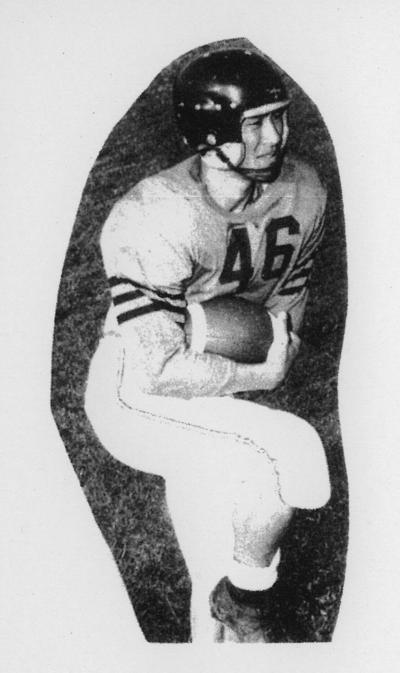
The 1954 San Mateo High School varsity football team won a share of the Peninsula Athletic League championship and it did so with a special ingredient: The inclusion and considerable contributions provided by three Japanese-American teens.
That might not be particularly noteworthy today. But 70 years ago, that was significant because the boys had spent most of the war years in internment camps. Those players — Wayne Fujito, Kent Ikeda and Oliver Semba — were among tens of thousands of U.S. residents of Japanese descent who were ordered into the camps for much of the duration of the bitter conflict.
In the wake of the empire of Japan’s air and naval attack on the U.S. Pacific naval base at Pearl Harbor and other vital installations in Hawaii in early December of 1941, President Franklin D. Roosevelt signed the interment order in February of 1942 and it went into effect two months later. War fears were rife in California and all along the West Coast. Interestingly, the draconian order did not include those of Japanese heritage living and working in Hawaii.
The future San Mateo football trio, like tens of thousands of their ethnic brethren, were separated from their friends, neighbors and schoolmates for an extended period. But, for the most part, they later said they were welcomed back to their community and, later, the high school, after the devastating war had ended during the late summer of 1945.
Prep football became a welcome part of that transition. Decades later, San Mateo’s quarterback Bucky Kahler, a 1954 all-PAL star and Peninsula Sports Hall of Famer, explained in a published 2004 interview, “There were no problems at all. We got along well.”
San Mateo’s coach, Frank Collin, agreed: “There was no resentment. They never talked about their experiences. Maybe they were too young. Maybe they kept any bitterness inside. We had kids from a number of different races on that team. It was a good group.”
Ikeda, a fast, durable 138-pound halfback who was a 1954 San Mateo co-captain along with the multi-talented Kahler, noted that, “We never felt discrimination. We came back (from the camps) together and the community had missed us.”
Semba, a lineman, pointed out that, “We knew everyone. It was kind of a small town back then.”
True that. Neither Hillsdale nor Aragon highs had opened yet. And Serra High School was still a relatively small parochial operation at its original location off Crystal Springs Road. San Mateo, which won a California Interscholastic Federation state football championship in 1926, dominated the public school landscape in the city at that time.
For high school kids in the 1950s, football was a very big deal. Rich Bortolin, a junior at San Mateo during the 1954 season, said large crowds were routine.
Recommended for you
“The school spirit was amazing,” he offered not long ago in a phone call. “When we played San Jose teams on the road, the school chartered 12 rooters’ buses so our students could attend those games. Our quarterback (Kahler) said he was stunned when we all started to show up during a game.”
A 1960 published history of San Mateo High noted that the buses became “an institution for all games away from home.”
San Mateo’s Japanese-American football threesome was not alone in FDR’s roundup. In all, according to historians, an estimated 120,000 Japanese-Americans were rounded up and sent away to internment camps as fears of betrayal, sabotage and espionage were rampant along the West Coast following the attacks in Hawaii. Of those internees, 891 were listed from San Mateo County.
A San Bruno sports facility, the Tanforan Race Track, located along what was then the Southern Pacific Railroad line, was used as an assembly center and transit point for many of the internees prior to their forced move to the far-flung camps located in relatively isolated parts of the U.S.
The race track is gone now, replaced by a shopping center after the track burned down in the 1960s.
In a nine-week season, the 1954 San Mateo team finished with an 8-1 record — including four shutouts. The sole defeat coming at the hands of upset-minded Capuchino by a razor-thin, 7-0 margin.
The loss meant that the Bearcats ended up tied with Menlo-Atherton for the PAL championship. The PAL, at that time, embraced 12 public schools from Daly City south to San Jose, a distance of some 45 miles.
The league calendar was a cumbersome arrangement, forcing an unbalanced schedule that year. The PAL was not split into divisions as it is now. As a result, San Mateo and M-A did not play each other in 1954. There were no playoffs. A prep football season in those days typically was completed by the end of November.
Nowadays, for some teams advancing in the CIF playoffs, a season can run all the way into early December.
The Bearcats weren’t the only prep football team from the city of San Mateo that made an impressive Bay Area mark in 1954. Serra wound up unbeaten at 9-0 as well, defeated Bellarmine Prep of San Jose for the first time and won what was then the Catholic Athletic League title. Both Serra, which played some of its home games on the Bearcats’ field, and San Mateo concluded the season ranked among the region’s best teams.
This is an updated and expanded version of a story included in John Horgan’s 2023 book, “Cradle of Champions, A Selected History of San Mateo County Sports.” Written and produced under the auspices of the county’s Historical Association, the book is available at the association’s museum bookstore in downtown Redwood City. All proceeds benefit the work of the association.
Email: johnhorganmedia@gmail.com







(1) comment
Good story. Need more history lessons. Will get the book
Welcome to the discussion.
Log In
Keep the discussion civilized. Absolutely NO personal attacks or insults directed toward writers, nor others who make comments.
Keep it clean. Please avoid obscene, vulgar, lewd, racist or sexually-oriented language.
Don't threaten. Threats of harming another person will not be tolerated.
Be truthful. Don't knowingly lie about anyone or anything.
Be proactive. Use the 'Report' link on each comment to let us know of abusive posts.
PLEASE TURN OFF YOUR CAPS LOCK.
Anyone violating these rules will be issued a warning. After the warning, comment privileges can be revoked.