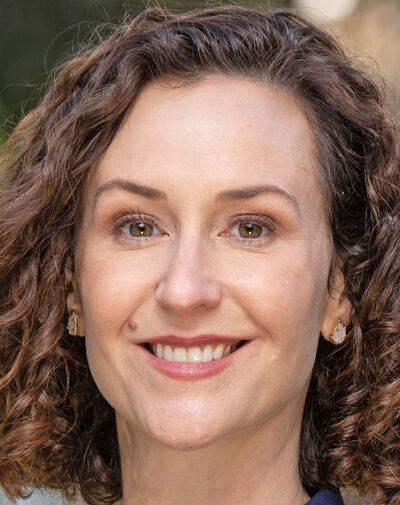
Giselle Hale
Last week, I had the opportunity to experience something my husband and daughters do daily — learning while dyslexic.
It started with a question I asked my 9-year-old a few months ago: How can I be a better mom?

Giselle Hale
Last week, I had the opportunity to experience something my husband and daughters do daily — learning while dyslexic.
It started with a question I asked my 9-year-old a few months ago: How can I be a better mom?
She paused and said thoughtfully, “Mom, I don’t think you understand how hard it is for me to read.”
Gulp. She was right, I didn’t.
Since both of my children were diagnosed with dyslexia and other related learning differences, my head was wrapped around the data and science of remediation. Still, my heart couldn’t fully empathize with the experience.
The desire to understand led me to co-sponsor a “Dyslexia Experience” with the Redwood City Library and Decoding Dyslexia California, facilitated by the International Dyslexia Association.
Dyslexia is common, more common than you think. One in 5 people fall somewhere on the dyslexia spectrum, or roughly 21,000 children and youth under the age of 18 in San Mateo County today.
If it’s so common, why don’t you know many dyslexics? Many don’t know themselves.
The cost of independent testing by a qualified educational psychologist in our region is roughly $5,000 and is often paid out of pocket. While dyslexia is considered a disability under the federal Individuals with Educational Disabilities Act, testing and treatment aren’t covered by insurance.
So, it goes unnoticed, especially in families who cannot afford expensive evaluations. And the longer it is to uncover, the harder it is to overcome.
The best way to get screened for dyslexia, until now, was to be an inmate in a federal prison, which has mandated screening since 2018. Inmates have an alarming 50% rate of dyslexia, far greater than the general population, and 80% are functionally illiterate. Studies have shown similar rates among homeless populations.
Dyslexia can be a life sentence, one that robs our society of a particularly innovative type of individual.
It can also be a ticket for a ride on a rocket ship.
Dyslexics overrepresent as business leaders, patent holders, actors and star athletes. Einstein, Picasso, Steven Spielberg, Richard Branson, Arnold Schwarzenegger, Kiera Knightly, Muhammad Ali and Steve Jobs are some of the names you would recognize. Three studies have shown how uniquely suited dyslexics are for astrophysics — actual rocket ship careers.
So how do we make it a rocket ship ride and not a life sentence for more children in our county?
New York Times writer Nicholas Kristoff reported on what some have called “The Mississippi Miracle.” In the southern state, not commonly associated with innovation, children are learning to read. Since 2013, they have led a turnaround of their national reading scores. It took a combination of factors: moving to phonics-based instruction, setting a must-pass third grade reading gate, investments in teacher training for the long haul, and more.
But it also takes a culture change within the community. In the most striking example, Kristoff described community members lining the halls of the local schools the morning of their third grade reading test, cheering on students like football players running through the stadium tunnel on their way to the big game. We must value literacy as a community by celebrating it — which is something anyone reading this opinion piece can help accomplish.
It’s time for our patch of Silicon Valley to join the ranks of Mississippi and lead on literacy. To do this requires seriously tackling dyslexia.
At our event, attended by 50 community members and leaders from the San Carlos, Hillsborough, Burlingame, Redwood City and Belmont-Redwood Shores school districts, we participated in six stations that simulated a particular challenge related to dyslexia and associated learning differences. For me, the most challenging simulation was a recording with multiple people talking over one another while I was trying to complete a learning task. I looked down at my heart rate monitor at the end of the simple 10-minute exercise and saw that my heart rate had jumped 12 beats. By the end of 60 minutes of simulations, many participants shared that they were frustrated, exhausted or had given up. That’s what children across our county experience daily, merely trying to learn.
With early screening, structured literacy and multi-sensory intervention, it doesn’t have to be this way. Gov. Gavin Newsom, a dyslexic himself, included mandatory K-second grade screening in this year’s state budget. In the 2025-26 school year, California will join 40 other states already mandating screening.
Let’s move more kids off the path to prison and poverty and onto innovation and success. If it can be done in Mississippi, it can be done in San Mateo County.
Giselle Hale is a children’s advocate and the former mayor of Redwood City.
Please purchase a Premium Subscription to continue reading.
To continue, please log in, or sign up for a new account.
We offer one free story view per month. If you register for an account, you will get two additional story views. After those three total views, we ask that you support us with a subscription.
A subscription to our digital content is so much more than just access to our valuable content. It means you’re helping to support a local community institution that has, from its very start, supported the betterment of our society. Thank you very much!
Only subscribers can view and post comments on articles.
Already a subscriber? Login Here


Sorry, an error occurred.
Already Subscribed!
Cancel anytime
Thank you .
Your account has been registered, and you are now logged in.
Check your email for details.
Submitting this form below will send a message to your email with a link to change your password.
An email message containing instructions on how to reset your password has been sent to the email address listed on your account.
No promotional rates found.
Secure & Encrypted
Thank you.
Your gift purchase was successful! Your purchase was successful, and you are now logged in.
| Rate: | |
| Begins: | |
| Transaction ID: |
A receipt was sent to your email.
(1) comment
My daughter was also diagnosed with dyslexia - in 4th grade. We found that vision therapy (by All Eyes on You in San Carlos) was a lifesaver. Her issue was resolved with exercises to help her eye muscles work better together - an out of pocket expense. Thank you for expressing the need for solutions that all can afford.
Welcome to the discussion.
Log In
Keep the discussion civilized. Absolutely NO personal attacks or insults directed toward writers, nor others who make comments.
Keep it clean. Please avoid obscene, vulgar, lewd, racist or sexually-oriented language.
Don't threaten. Threats of harming another person will not be tolerated.
Be truthful. Don't knowingly lie about anyone or anything.
Be proactive. Use the 'Report' link on each comment to let us know of abusive posts.
PLEASE TURN OFF YOUR CAPS LOCK.
Anyone violating these rules will be issued a warning. After the warning, comment privileges can be revoked.