BARCELONA, Spain (AP) — A Spanish research vessel that investigates marine ecosystems has been abruptly diverted from its usual task to take on a new job: Helping in the increasingly desperate search for the missing from Spain's floods.
The 24 crew members aboard the Ramón Margalef were preparing Friday to use its sensors and submersible robot to map an offshore area of 36 square kilometers — the equivalent of more than 5,000 soccer fields — to see if they can locate vehicles that last week's catastrophic floods swept into the Mediterranean Sea.
The hope is that a map of sunken vehicles could lead to the recovery of bodies. Nearly 100 people have been officially declared missing, and authorities admit that is likely more people are unaccounted for, in addition to more than 200 declared dead.
Workers in the Spanish city of Valencia were repairing the railway lines on Friday after severe flooding caused a pile up of cars and debris on the network.
Pablo Carrera, the marine biologist leading the mission, estimates that in 10 days his team will be able to hand over useful information to police and emergency services. Without a map, he said, it would be practically impossible for police to carry out an effective and systematic recovery operation to reach vehicles that ended up on the seabed.
"It would be like finding a needle in a haystack," Carrera told The Associated Press by phone.
Many cars became death traps when the tsunami-like flooding hit on Oct. 29.
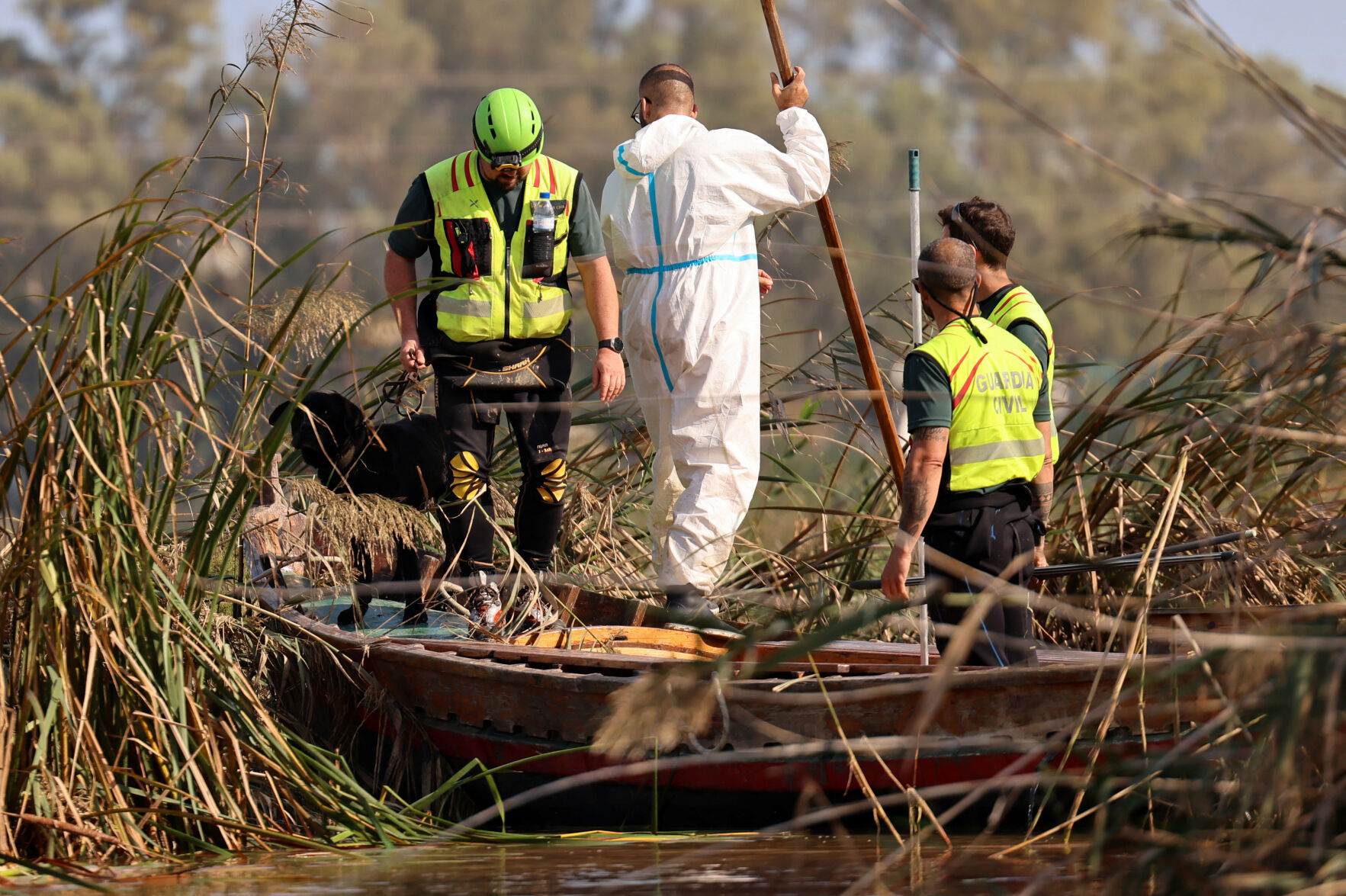
The boat will join a wider effort by police and soldiers who have expanded their searches for bodies and the missing beyond the devastated towns and streets. Searchers have used poles to probe into layers of mud while sniffer dogs tried to find scent traces of bodies buried in canal banks and fields. They are also looking at beaches that line the coast.
Members of Guardia Civil patrol Albufera rice fields in search of victims following flooding caused by heavy rains near Valencia, Spain.
Reuters
The first area the Ramón Margalef is searching is the stretch of sea off the Albufera wetlands, where at least some of the water ended up after ripping through villages and the southern outskirts of Valencia city.
Recommended for you
Carrera, 60, is head of the fleet of the research vessels run by the Spanish Institute of Oceanography, a government-funded science center under the umbrella of the Spanish National Research Council.
He boarded the Ramón Margalef in Alicante, located on Spain's south coast, from where it will set sail to reach Valencia's waters before dawn Saturday. The plan is to go straight to work with the 10 scientists and technicians and 14 sailors working non-stop in shifts. The boat also helped research the impact from the lava flow that reached the sea from the 2021 La Palma volcano eruption in Spain's Canary Islands.
Finding a body at sea, Carrera said, is highly unlikely. So the focus is on large objects that shouldn't be there.
The boat's submersible robot loaded with cameras can dive to a depth of 60 meters to attempt to identify cars. Ideally, they will try to locate license plates, although visibility could be extremely limited and the cars could be smashed to bits or engulfed in the muck, Carrera said.
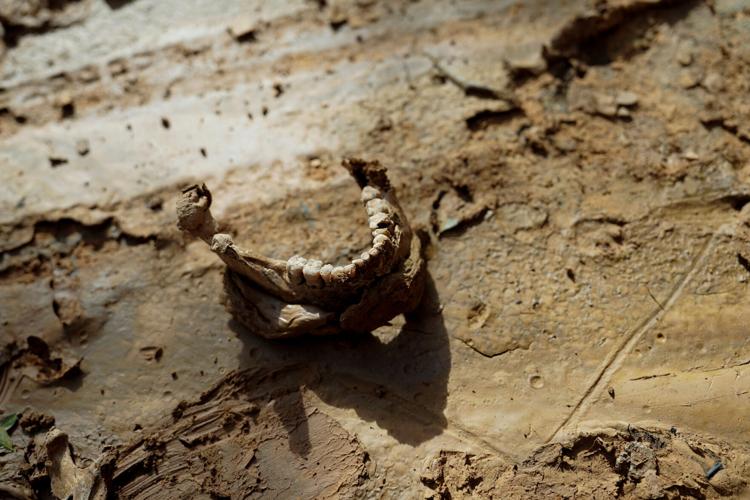
A skeleton jaw is seen in the mud in the aftermath of the flooding caused by heavy rains in the cemetery of Alfafar, Spain.
Reuters
In the longer term, he said his team will also evaluate the impact of the flood runoff on the marine ecosystem.
Those findings will contribute to initiatives by other Spanish research centers to study Spain's deadliest floods of the century.
Spain is used to the occasional deadly flood produced by autumn storms. But the drought that has hit the country for the past two years and record hot temperatures helped magnify these floods, scientists say.
Spain's meteorological agency said that the 30.4 inches of rain that fell in one hour in the Valencian town of Turis is an all-time national record.
"We have never seen an autumn storm of this intensity," Carrera said. "We cannot stop climate change, so we have to prepare for its effects."
Keep the discussion civilized. Absolutely NO
personal attacks or insults directed toward writers, nor others who
make comments. Keep it clean. Please avoid obscene, vulgar, lewd,
racist or sexually-oriented language. Don't threaten. Threats of harming another
person will not be tolerated. Be truthful. Don't knowingly lie about anyone
or anything. Be proactive. Use the 'Report' link on
each comment to let us know of abusive posts. PLEASE TURN OFF YOUR CAPS LOCK. Anyone violating these rules will be issued a
warning. After the warning, comment privileges can be
revoked.
Please purchase a Premium Subscription to continue reading.
To continue, please log in, or sign up for a new account.
We offer one free story view per month. If you register for an account, you will get two additional story views. After those three total views, we ask that you support us with a subscription.
A subscription to our digital content is so much more than just access to our valuable content. It means you’re helping to support a local community institution that has, from its very start, supported the betterment of our society. Thank you very much!







(0) comments
Welcome to the discussion.
Log In
Keep the discussion civilized. Absolutely NO personal attacks or insults directed toward writers, nor others who make comments.
Keep it clean. Please avoid obscene, vulgar, lewd, racist or sexually-oriented language.
Don't threaten. Threats of harming another person will not be tolerated.
Be truthful. Don't knowingly lie about anyone or anything.
Be proactive. Use the 'Report' link on each comment to let us know of abusive posts.
PLEASE TURN OFF YOUR CAPS LOCK.
Anyone violating these rules will be issued a warning. After the warning, comment privileges can be revoked.