

School districts across the state have struggled with finding and retaining staff, and educators have warned of a mass exodus from the field.
The South San Francisco Unified School District is trying to combat the problem in partnership with TeachStart, a company helping future educators traverse the at-times challenging career path.
About 8,000 students file into classrooms across South San Francisco Unified School District’s 17 elementary, middle and high schools led by about 440 educators. Filling those educator positions, even temporarily with substitute teachers, has grown increasingly competitive, said Jay Spaulding, the district’s assistant superintendent of Human Resources and Student Services.
TeachStart is helping to address both position gaps. The newly-formed company — a subsidiary of Scoot Education, a national company helping with education staffing — pays future teachers while they’re employed as a substitute at a school and simultaneously earning their teaching credentials and obtaining required in-class experience.
The company helped place 10 full-time substitutes at SSFUSD campuses for the most recent school year, three of whom are poised to begin next semester as full-time educators with their own classrooms. Each fellow was paid $55,000, provided with a week of training before starting at their respective campuses, monthly workshops and paid time for completing their studies.
Funding for the program comes in part from philanthropic support and in large part through participating districts that, rather than pay each fellow the substitute day rate directly, sign a contact with TeachStart, which takes on the responsibility of distributing the salaries.
“Our bet, and our belief, was, and continues to be, that there are a ton of people who want to be teachers if we could just get out of their way. But there are so many financial barriers, bureaucratic barriers, logistical barriers that make it really challenging for people,” TeachStart Executive Director Jenny Jordan said. “One of the things we’re trying to do is create a pathway for people where they can try on teaching and see if it’s right for them before being locked into a career they may not actually thrive in.”
A total of 260 fellows participated in TeachStart’s inaugural year with about 75% remaining active in the program. Jordan said the organization is looking to enroll 356 more educators next year, given the demand the company has seen from districts and campuses.
Spaulding said he’s looking to double the number of TeachStart fellows on SSFUSD campuses next school year and Jonathan Covacha, principal of Martin Elementary School, said he hopes his campus is assigned another fellow. Their last fellow, Sarah Sepehr, will be “graduating” from the program after accepting a full-time position teaching third grade at the campus.
Finding the way
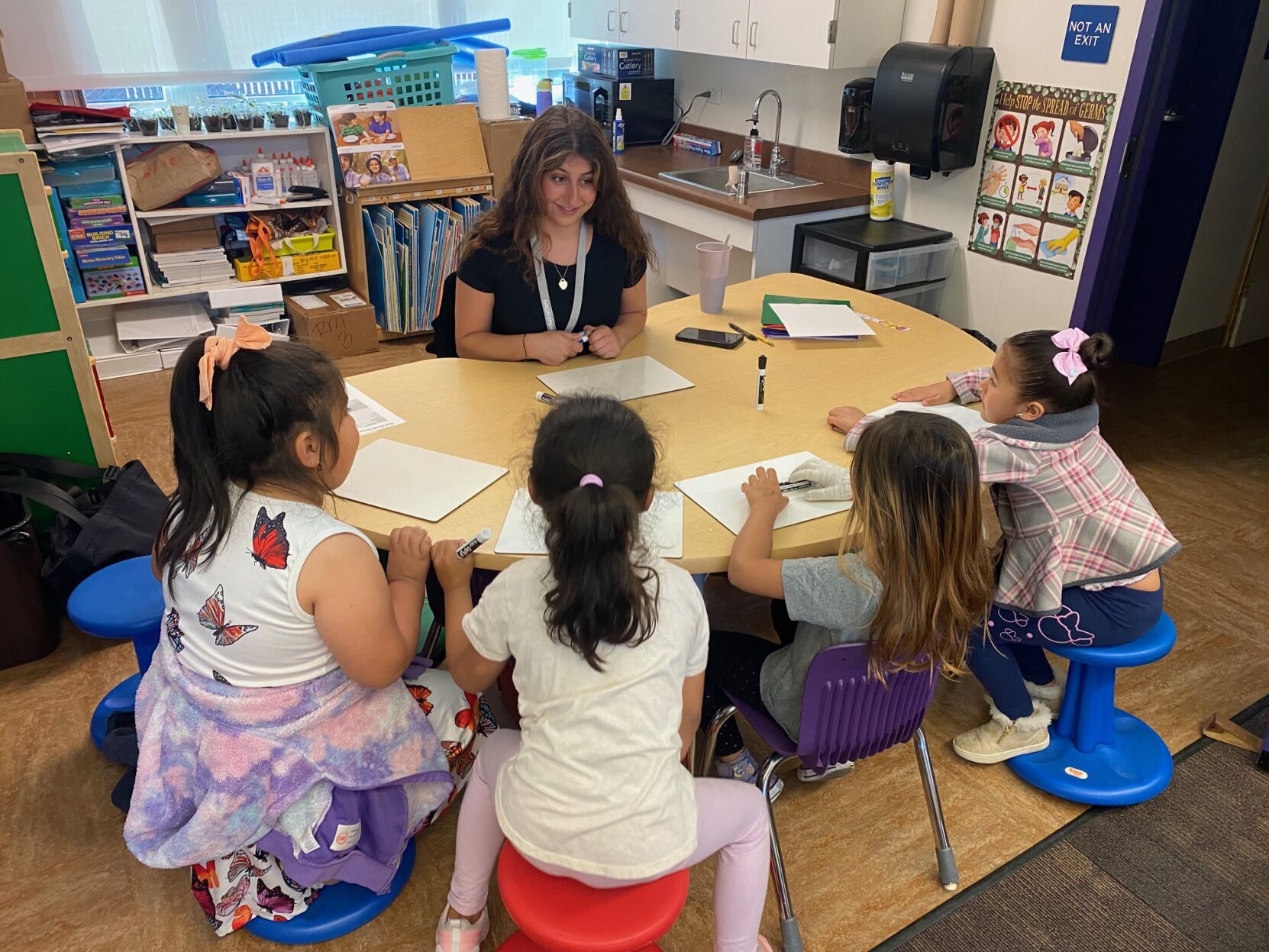
Sepehr spent much of the past school year at Martin Elementary School jumping around from room to room, either working with small breakout groups or leading lessons, depending on what was needed that day. The environment was enriching, she said, noting she ended each day just as energized as she was at the start.
Sepehr hadn’t always wanted to be a teacher but she did always have plans to work with kids. The San Francisco resident earned a degree in human development and family studies with ambitions of becoming a school psychologist.
But after the nonprofit she worked for folded during the pandemic, Sepehr was ready for a career pivot. The experience, she said, showed her the importance of having educators on campuses who know how to identify and work with students who have experienced trauma and abuse.
“That pushed me and motivated me to go into teaching so they know there are adults who are safe and positive who see them as human and not just students,” Sepehr said.
Recommended for you
She began working for the San Francisco Unified School District as a paraeducator assisting teachers in and out of the classroom while searching for credentialing programs. But Sepehr ultimately found she and the district weren’t a good fit.
She began searching on job listing websites and there’s where she found the substitute teaching opportunity with TeachStart. After one call with her recruiter, Sepehr said she was fully on board.
“At first, I was like, this is too good to be true. There’s no way they’re paying me to go get experience and teach. But it is good,” Sepehr said. “Scoot is literally my saving grace. The moment I had that phone call I was like wow things are going to be OK.”
The issue by numbers
Becoming an educator in California can be time consuming and expensive, Jordan said. In addition to obtaining a bachelor’s degree, future teachers must complete an accredited teacher preparation program like a master’s program and 600 hours of student teaching, obtain one of three credential types — multiple subject, single subject or special education — depending on the type of classroom they want to lead, and pass a series of tests.
More than 10,000 teaching positions went unfilled in the state during the 2021-22 school year, according to data from the California Commission on Teacher Credentialing. Across all of San Mateo County, districts were looking to hire more than 22,000 educators for the 2022-23 school year, according to data reported to the California Department of Education from each district.
In the South San Francisco Unified School District, 56 positions were needed. Spaulding said the district was able to fill its vacant positions, typically left by people who have either struggled to make ends meet in the Bay Area or have decided to move somewhere where their dollar stretches further.
But, he noted, competing with larger districts able to offer more has been a struggle. Beyond pay — the district pays educators between about $66,000 and $121,500 annually and recently raised its daily substitute rate to $240 — Spaulding said the district is looking at investing into workforce housing to help attract staff.
“Retention is a huge concern. The cost of living is astronomical and people have to weigh the cost of living here versus someplace else,” Spaulding said. “In the future, what I really see is a continued teacher shortage not only throughout the country but in high rent areas because people can’t live here.”
The district’s pool of substitute teachers was already on a decline before the pandemic hit, Spaulding said, from an average of 150 to about 80. For this most recent school year, Spaulding said the district had about 90 substitutes on its roster.
The drop in filled substitute teacher position means the district has had to cover vacancies internally by having a teacher cover a class during their break, splitting classes into two or having an administrator lead the class.
In the 2018-19 school year, 90% of the district’s 5,000 vacancies were covered by substitute staff. During the 2021-22 school year, the district was able to cover about 65% of its 4,500 vacancies it saw through April with substitutes. And during the most recent school year, when there were more than 5,600 vacancies, substitutes could cover a little less than 87%, Spaulding said.
He credited the uptick in coverage between the two recent years to TeachStart fellows. And their coverage is more seamless for students. The fellows know the school, students and lesson plans, enabling them to pick up where a teacher left off.
“Subbing is a difficult position so it provides truly a petri dish of an opportunity to grow, and say is this really something I want to pursue,” Spaulding said. “This kind of pipeline is beneficial because somebody is actually experiencing the day-to-day life of what it’s like to teach in a setting, a district, a classroom with various cultures.”





(0) comments
Welcome to the discussion.
Log In
Keep the discussion civilized. Absolutely NO personal attacks or insults directed toward writers, nor others who make comments.
Keep it clean. Please avoid obscene, vulgar, lewd, racist or sexually-oriented language.
Don't threaten. Threats of harming another person will not be tolerated.
Be truthful. Don't knowingly lie about anyone or anything.
Be proactive. Use the 'Report' link on each comment to let us know of abusive posts.
PLEASE TURN OFF YOUR CAPS LOCK.
Anyone violating these rules will be issued a warning. After the warning, comment privileges can be revoked.