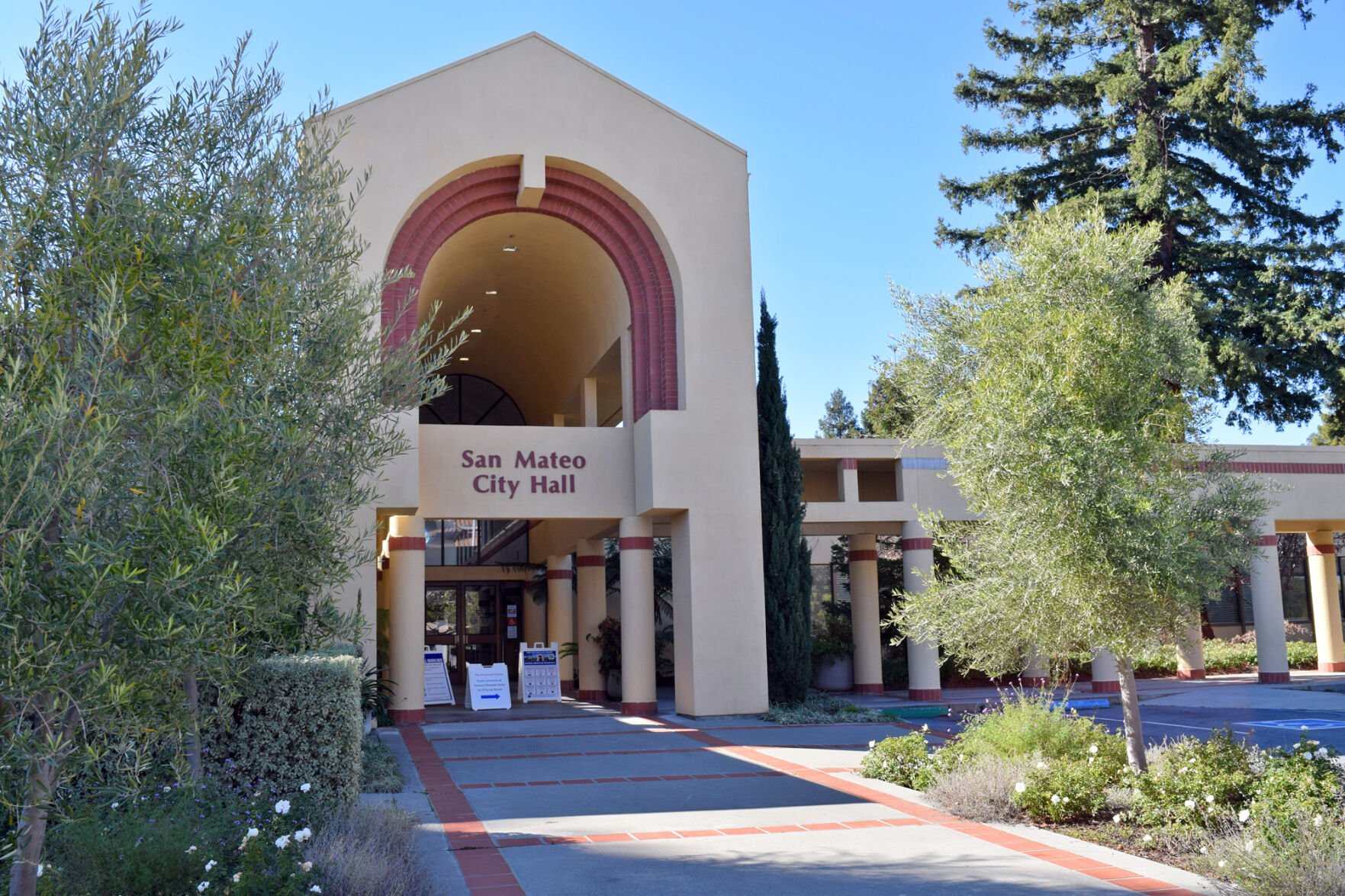
The San Mateo City Council is moving forward with changes to the city’s mayoral rotation process, as well as council compensation increases and other eligibility requirements for board members and commissioners.
Largely motivated by a controversial mayoral rotation in December 2022, in which the city was left without a leader for about one week, city staff began working on proposed updates to the rotation process last year to avoid a similar situation in the future.
The changes would codify the rotational sequence as a charter amendment, rather than relying on the assumption councilmembers will appoint the upcoming mayor due to historical precedent.
San Mateo is one of the many jurisdictions in the county that operates such an appointment system, whereby the most senior councilmember moves into the mayoral position for one year. But the process was disrupted in 2022 when now Mayor Lisa Diaz Nash and Deputy Mayor Rob Newsom objected to appointing a new mayor before a vacant council seat was filled.
The amendments would also update the process by which councilmember vacancies are filled if it occurs in the middle of their term. Rather than allowing the mayor to appoint a vacant seat if the council is deadlocked, the council would vote on the new member, and a special election would take place if they are unable to do so within 60 days of the vacancy.
Councilmembers also addressed compensation updates, a topic of discussion in several cities throughout the county, as the recent Senate Bill 329 expands pay limits for general law cities depending on their population size. Currently, San Mateo councilmembers are paid $600 per month, which runs down the middle compared to other cities’ monthly payments, such as South San Francisco and Millbrae, which provide $1,000 and $345, respectively. The city’s maximum monthly compensation according to the legislation would be $1,900, although councilmembers agreed to move forward with an increase to $1,000.
Recommended for you
“For me, It’s more important to fix it for future councilmembers. … It doesn’t mean a lot to me. If we were doing this job for the money, well, we probably wouldn’t be up here,” Newsom said.
Led by state Sen. Bill Dodd, D-Napa, the legislation was lauded as a way to extend opportunities for more diverse councils, as the lack of pay is seen as a barrier to entry for those who are not as financially secure.
“I now have the lived experience of somebody who has spent multiple weeks of paid vacation from my other employer to attend council functions, to make myself available for trainings. Personally, I appreciate the privilege of being able to do that but not everybody has that privilege,” Councilmember Adam Loraine said. “It is important to broaden the opportunity for others to run for council in the city of San Mateo.”
Loraine and Councilmember Amourence Lee also noted interest in having staff research compensation changes to members of other boards and commissions as well, who currently do not receive payment, apart from reimbursement for expenses incurred while acting in their respective roles.
The new compensation for the City Council would not go into effect until after the next election is held.
Correction: A change has been made to clarify there would be a special election, rather than mayoral appointment, if the council is deadlocked.
The current Charter does not initially give the Mayor the power to appoint a candidate to fill a vacancy on the Council. Per Section 2.8 Vacancies in Office, "A vacancy on the city council from whatever cause arising shall be filled by appointment by the council provided, that if the council fails to agree or for any other reason does not fill such vacancy within 30 days after the same occurs, then such vacancy shall be filled by the mayor."
The proposed changes extend the appointment term from 30 days to 60 days and then push to the decision to a special election (instead of the Mayor) if the vacancy is not filled by the end of that period.
The concern raised by then Councilmembers Nash and Newsom (and others) in December 2022, that the votes for Mayor and Deputy Mayor occur before any vacancies are filled, would still be applicable.
The potential extension of the period during which a seat remains vacant seems problematic given the shift to districts. It'd be less bad if you were doing what Albany (in the East Bay, not the New York one) is doing, with the Council elected using a Proportional Representation system, rather than districts. (There's also the fact that a special election is just _expensive_, and it's not like city coffers are overflowing with extra cash.)
Keep the discussion civilized. Absolutely NO
personal attacks or insults directed toward writers, nor others who
make comments. Keep it clean. Please avoid obscene, vulgar, lewd,
racist or sexually-oriented language. Don't threaten. Threats of harming another
person will not be tolerated. Be truthful. Don't knowingly lie about anyone
or anything. Be proactive. Use the 'Report' link on
each comment to let us know of abusive posts. PLEASE TURN OFF YOUR CAPS LOCK. Anyone violating these rules will be issued a
warning. After the warning, comment privileges can be
revoked.
Please purchase a Premium Subscription to continue reading.
To continue, please log in, or sign up for a new account.
We offer one free story view per month. If you register for an account, you will get two additional story views. After those three total views, we ask that you support us with a subscription.
A subscription to our digital content is so much more than just access to our valuable content. It means you’re helping to support a local community institution that has, from its very start, supported the betterment of our society. Thank you very much!







(2) comments
The current Charter does not initially give the Mayor the power to appoint a candidate to fill a vacancy on the Council. Per Section 2.8 Vacancies in Office, "A vacancy on the city council from whatever cause arising shall be filled by appointment by the council provided, that if the council fails to agree or for any other reason does not fill such vacancy within 30 days after the same occurs, then such vacancy shall be filled by the mayor."
https://law.cityofsanmateo.org/us/ca/cities/san-mateo/charter/2.08
The proposed changes extend the appointment term from 30 days to 60 days and then push to the decision to a special election (instead of the Mayor) if the vacancy is not filled by the end of that period.
The concern raised by then Councilmembers Nash and Newsom (and others) in December 2022, that the votes for Mayor and Deputy Mayor occur before any vacancies are filled, would still be applicable.
The potential extension of the period during which a seat remains vacant seems problematic given the shift to districts. It'd be less bad if you were doing what Albany (in the East Bay, not the New York one) is doing, with the Council elected using a Proportional Representation system, rather than districts. (There's also the fact that a special election is just _expensive_, and it's not like city coffers are overflowing with extra cash.)
Welcome to the discussion.
Log In
Keep the discussion civilized. Absolutely NO personal attacks or insults directed toward writers, nor others who make comments.
Keep it clean. Please avoid obscene, vulgar, lewd, racist or sexually-oriented language.
Don't threaten. Threats of harming another person will not be tolerated.
Be truthful. Don't knowingly lie about anyone or anything.
Be proactive. Use the 'Report' link on each comment to let us know of abusive posts.
PLEASE TURN OFF YOUR CAPS LOCK.
Anyone violating these rules will be issued a warning. After the warning, comment privileges can be revoked.