When Mission Dolores was established in 1776, the Mission became responsible for the land from the head of the Peninsula to the San Francisquito Creek (Palo Alto).
This land was used for growing the food for the Mission and raising cattle, sheep and horses. Immediately south of San Bruno Mountain the land was called Buri-Buri; the San Mateo Creek area was designated San Mateo; and south of the San Mateo Creek was named de las Pulgas — “land of the fleas.”
When the Mexican government took over California in the 1820s, the land was designated by Ranchos — Buri Buri Rancho, San Mateo Rancho and Rancho de las Pulgas. The 15,000-acre Rancho Buri Buri was granted to Jose Antonio Sanchez in 1835; the 35,000-acre Rancho de las Pulgas was granted to the Arguello family and the Rancho San Mateo was granted to a Mexican, Arenas, as payment of a debt to the governor. Arenas promptly sold the 6,000 acres to the partnership of Mellus and Howard.
Contrary to what was promised to the Rancho grantees before 1850, with the advent of California statehood in 1850, this land grant became embroiled in legal battles in the courts over ownership.
Rancho de las Pulgas was confirmed to the Arguello family by the shrewd work of a Puerto Rican lawyer of Spanish descent, Simon Menzes. Menzes spoke English as well as Spanish, a distinct advantage in the courts, and he had political influence. Putting these factors to work, he charged the Arguello family 15 percent of the land for his services and thereby accumulated over 5,000 acres of prime land in the Rancho de las Pulgas when it was confirmed to the Arguellos.
His first act after confirmation in the courts was to plat out Redwood City (which he called Menzesville) and collect money from the many squatters who had taken over part of the Rancho. Some had built on the property, such as a man named Harris who had built a large two-story hotel in 1853, the American Hotel, along the Redwood slough.
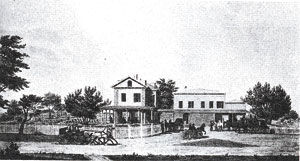
On the Rancho San Mateo, Nicholas de Peyster had moved into the abandoned Mission Hospice (granary) that stood north of the San Mateo Creek. He promptly cleaned out the old granary-hospice and opened a store and a public house. The Howard-Mellus owners ordered him off, but he stayed until he could buy land from the Arguello family on the south side of the creek in 1851. South from the creek along the Country Road (El Camino Real) he bought 75 acres of land and built a wooden two-story structure. Business was good, and he took on a partner, David S. Cook, in 1852. Cook’s wife, Eliza, bore the first white child in San Mateo County, daughter Elinor.
Recommended for you
The San Mateo House was enlarged in 1853 by the addition of a large frame building that was shipped here from the East coast.
In 1856, Cook bought out de Peyster and on October 12, 1857, Cook was appointed San Mateo’s first postmaster. The position of postmaster was short lived, as it was discontinued in 1858 due to lack of use. In 1861 the position was reinstated.
In 1857, the House was sold to a partnership, Stockton and Shafter. The exciting but brief era of the Butterfield Stage began at the San Mateo House. Travelers from hundreds of miles away now stepped off the stage at the House and brought news of the outside world. The Butterfield Stage crossed the country from Missouri, by way of Los Angeles, and made its destination San Francisco.
In 1858, the San Bruno toll road was built and the stop was discontinued in San Mateo. Uncle Tom’s Cabin, a roadhouse at the junction of El Camino and San Mateo Avenue in San Bruno became the stagecoach stop. In the early 1860s the completion of the San Jose and San Francisco Railroad doomed most of the stagecoaches along the Peninsula.
Tony Oaks bought the house in 1860 and sold it to Capt. Edward Taylor in 1863. Capt. Taylor was related to the Mills and Eastons as he had married A.I. Easton’s sister, Fanny. They moved the structure back from the road, added a wing to it and lived in it until his death in 1899.
The once famous San Mateo House became the possession of the future Mills Hospital and was finally demolished in 1964 when it made room for a parking garage at the corner of El Camino Real and Second Avenue.
Rediscovering the Peninsula by Darold Fredricks appears in the Monday edition of the Daily Journal.
Keep the discussion civilized. Absolutely NO
personal attacks or insults directed toward writers, nor others who
make comments. Keep it clean. Please avoid obscene, vulgar, lewd,
racist or sexually-oriented language. Don't threaten. Threats of harming another
person will not be tolerated. Be truthful. Don't knowingly lie about anyone
or anything. Be proactive. Use the 'Report' link on
each comment to let us know of abusive posts. PLEASE TURN OFF YOUR CAPS LOCK. Anyone violating these rules will be issued a
warning. After the warning, comment privileges can be
revoked.
Please purchase a Premium Subscription to continue reading.
To continue, please log in, or sign up for a new account.
We offer one free story view per month. If you register for an account, you will get two additional story views. After those three total views, we ask that you support us with a subscription.
A subscription to our digital content is so much more than just access to our valuable content. It means you’re helping to support a local community institution that has, from its very start, supported the betterment of our society. Thank you very much!






(0) comments
Welcome to the discussion.
Log In
Keep the discussion civilized. Absolutely NO personal attacks or insults directed toward writers, nor others who make comments.
Keep it clean. Please avoid obscene, vulgar, lewd, racist or sexually-oriented language.
Don't threaten. Threats of harming another person will not be tolerated.
Be truthful. Don't knowingly lie about anyone or anything.
Be proactive. Use the 'Report' link on each comment to let us know of abusive posts.
PLEASE TURN OFF YOUR CAPS LOCK.
Anyone violating these rules will be issued a warning. After the warning, comment privileges can be revoked.