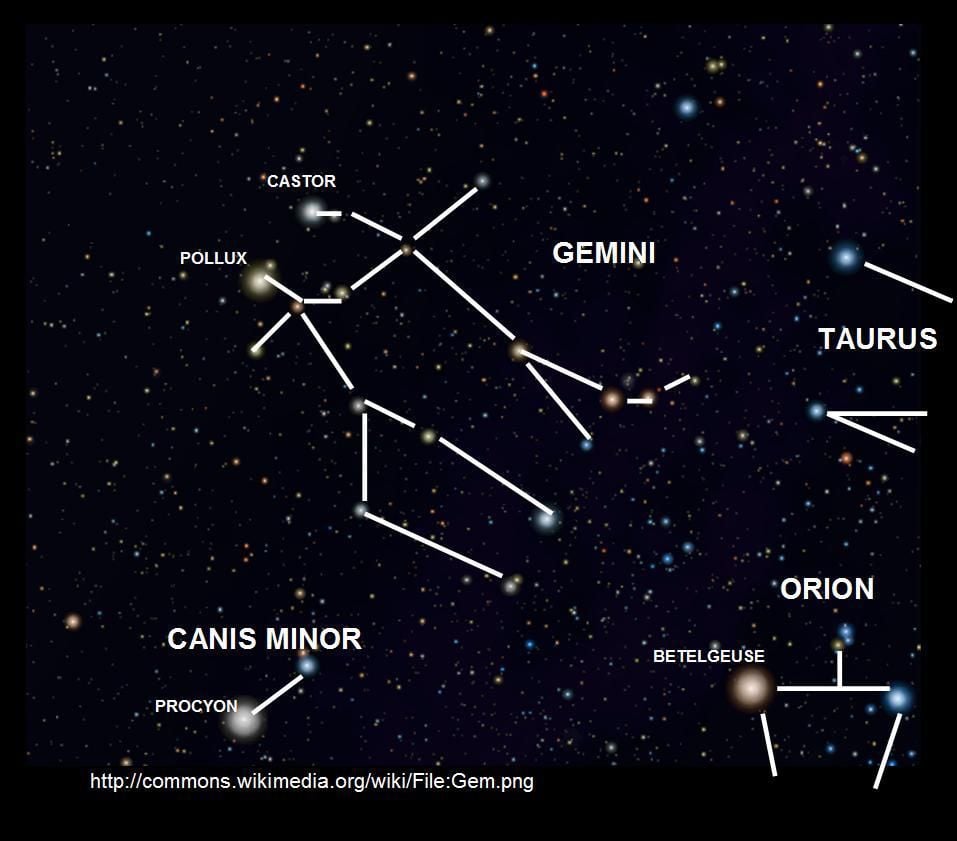
Our night sky continues to change as we move deeper into spring. We are well past our halfway point. As noted on March 25 after the spring equinox, Orion is known for being a winter constellation. Now the three familiar stars of Orion are barely visible at sunset and with the clouds and fog clinging to the horizon, they’re no longer visible. Yet Venus continues to shine brightly in the northern sky. Now where the three bright stars of the Orion’s belt used to be, there’s a bright star that’s part of the constellation that makes up one of his hunting dogs. This star is called Procyon and can be seen in the west sky after the sunsets. It’s one of the first stars that’s visible after Venus rises. If you recall from March 11, according to Stardate.org, Procyon’s name means “before the dog.” This constellation is called, Canis Minor. In Greek mythology, it represents the smaller of Orion's two hunting dogs that accompany him as he hunts Lepus, the rabbit.
Between Venus and Procyon, another two stars become visible before many other stars. They are the top two stars of the Gemini constellation. According to EarthSky.org, most people see this constellation as just two bright stars — Castor and Pollux. In Latin, Gemini, means “twins.” In Greek mythology, Castor and Pollux were the sons of a mortal mother, Leda. Castor was the mortal brother, son of Tyndareus, king of Sparta, and Pollux the immortal brother, son of Zeus. Castor and Pollux were joyfully united in spirit, yet sorrowfully divided by circumstance. When Castor was slain in battle, Pollux was inconsolable and begged Zeus to relieve him of the bonds of immortality. Zeus granted his request and so Pollux and Castor stand reunited in the heavens as a tribute to the redemptive power of brotherly love. However, these two stars aren’t really twins. Pollux is a red giant star that is 33 light-years from Earth and has at least one massive planet orbiting it, according to NASA. While Castor is about 51 light-years away from us and has two companion stars.
Gemini is a constellation that both amateur and experienced stargazers can enjoy. According to Space.com, other objects in the constellation include the Eskimo Nebula, Medusa Nebula and Geminga, a neutron star. Gemini also includes a star object known as Messier 35 or M35. (Messier objects are a set of 110 astronomical objects first cataloged in 1771 by French astronomer Charles Messier.) M35 is just barely visible to the naked eye under a dark sky free from light pollution, and in low-power binoculars, this object looks like a cloud with bright stars in it.
The Gemini constellation is also the radiant point for a meteor shower called the Geminids. It occurs every year around mid-December. Astronomy experts say the Geminids display is one of the best annual meteor showers because the individual meteors are bright and move quickly. These meteors are especially visible when there is no full moon in the sky to wash out the starlight. The Geminids come from a near-Earth asteroid called 3200 Phaethon, which is shedding particles likely because of a collision in its ancient past. As our planet runs into these particles in its orbit, some of the rock bits fall into our atmosphere and produce spectacular meteor trails.
Look Up appears in the weekend edition. If you have any astronomical questions or facts you’d like to share email news@smdailyjournal.com with the subject line “Look Up.”
Keep the discussion civilized. Absolutely NO
personal attacks or insults directed toward writers, nor others who
make comments. Keep it clean. Please avoid obscene, vulgar, lewd,
racist or sexually-oriented language. Don't threaten. Threats of harming another
person will not be tolerated. Be truthful. Don't knowingly lie about anyone
or anything. Be proactive. Use the 'Report' link on
each comment to let us know of abusive posts. PLEASE TURN OFF YOUR CAPS LOCK. Anyone violating these rules will be issued a
warning. After the warning, comment privileges can be
revoked.
Please purchase a Premium Subscription to continue reading.
To continue, please log in, or sign up for a new account.
We offer one free story view per month. If you register for an account, you will get two additional story views. After those three total views, we ask that you support us with a subscription.
A subscription to our digital content is so much more than just access to our valuable content. It means you’re helping to support a local community institution that has, from its very start, supported the betterment of our society. Thank you very much!






(0) comments
Welcome to the discussion.
Log In
Keep the discussion civilized. Absolutely NO personal attacks or insults directed toward writers, nor others who make comments.
Keep it clean. Please avoid obscene, vulgar, lewd, racist or sexually-oriented language.
Don't threaten. Threats of harming another person will not be tolerated.
Be truthful. Don't knowingly lie about anyone or anything.
Be proactive. Use the 'Report' link on each comment to let us know of abusive posts.
PLEASE TURN OFF YOUR CAPS LOCK.
Anyone violating these rules will be issued a warning. After the warning, comment privileges can be revoked.