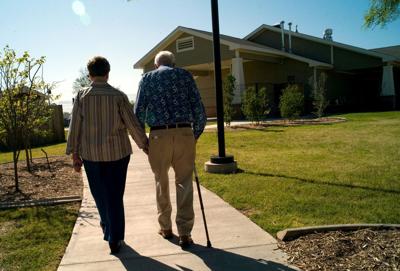
The United States is ill-prepared to ensure housing and care for the growing ranks of America's older people. Without enough government assistance many older adults will have to forgo needed care or rely on family and friends for assistance. Many will become homeless.
PHOENIX (AP) — Michael Genaldi's road to homelessness began early this year when a car slammed into the rear of his motorcycle, crushed three of his ribs, and left him in a coma for over a month.
The 58-year-old lost his job as a machine operator, then his home, and he was living in his truck when he was diagnosed with stage 2 lung cancer. Too young to get Social Security, Genaldi now lives temporarily in a shelter for people 55 and older in Phoenix while he navigates the process of qualifying for disability payments.
As its population ages, the United States is ill-prepared to adequately house and care for the growing number of older people, concludes a new report being released Thursday by Harvard University's Joint Center for Housing Studies.
Without enough government help, "many older adults will have to forgo needed care or rely on family and friends for assistance," warned Jennifer Molinsky, project director of the center's Housing an Aging Society Program. Many, like Genaldi, will become homeless.
Molinsky said more governmental assistance could better help the upsurge of older Americans who are baby boomers born after World War II.
The report says that in 2021, federal housing assistance like Section 8 or Section 202 — which provides housing with supportive services such as cleaning, cooking and transportation for older people — was only sufficient for a little more than a third of the 5.9 million renters ages 62 and over who were eligible.
Creative ideas are especially needed now to house people with fixed or dwindling incomes and with insufficient savings, the report says. Think house or apartment sharing to cut back on costs rather than living alone, in accessory dwelling units or ADUs known as casitas, granny flats and in-law units. There are also co-housing communities where individual homes — sometimes even tiny homes — are arranged around a building with a communal space such as a dining room.
Over the next decade, the U.S. population over the age of 75 will increase by 45%, growing from 17 million to nearly 25 million. And many of those people are expected to struggle financially. The report notes that in 2021, nearly 11.2 million older adults were "cost burdened," which means they spend more than 30% of their income on housing.
Some of the highest cost-burden rates for renters 65 and older were in Sunbelt areas traditionally popular for retirement: Las Vegas; San Diego; Raleigh, North Carolina; Miami and Daytona Beach, Florida.
Like renters, many older homeowners also struggle to keep a roof over their head.
Green House Project
Recommended for you
The report says that mortgage debt among older adults is rising, with the median mortgage debt for homeowners 65 to 79 shooting up over 400% from $21,000 in 1989 to $110,000 in 2022 as people increasingly need to access cash for basic needs and care.
Many older adults also find it challenging to obtain the additional services they need as they age, with the costs of long-term care averaging over $100 a day.
The report says the households of older people of color are far more likely to be cost burdened than older white households, especially Black and Latino households. Older people who live alone are also more likely to be cost burdened than married or partnered couples: 47% versus 21% of couples.
In Phoenix, Angelita Saldaña, 56, became homeless after her marriage fell apart. The granddaughter of Mexican immigrants, Saldaña initially lived in her truck with her pet dog Gaspar, but they now live at the 60-bed shelter where Genaldi stays with his pet dog Chico.
Saldaña said her $941 monthly disability check isn't enough to pay for even a studio apartment in the area, where average rents start at around $1,200. A caseworker is trying to help her find something she can afford.
In the meantime, she has a motel room to herself with a private bathroom.
"Here, I can sleep good," she said, unlike the months she spent at the state's largest shelter in downtown Phoenix, which has ten times as many beds.
Lisa Glow, the CEO for Central Arizona Shelter Services, which operates both facilities, said older people do much better in a shelter designed with their needs in mind — including more space, limited stairs and wider doorways for wheelchairs.
Glow spoke of an 82-year-old man with dementia who struggled to sleep on a bunk bed at the downtown shelter before he was transferred. Staff members tracked down his family and got him transferred to a skilling nursing facility for more personalized care.
"The downtown shelter is not a good place for an aging adult with chronic conditions," said Glow. "We see a lot of people there in their 70s and 80s."
"I've been shocked to see so many seniors on the street," she added. "People with wheelchairs. People with walkers."
Keep the discussion civilized. Absolutely NO
personal attacks or insults directed toward writers, nor others who
make comments. Keep it clean. Please avoid obscene, vulgar, lewd,
racist or sexually-oriented language. Don't threaten. Threats of harming another
person will not be tolerated. Be truthful. Don't knowingly lie about anyone
or anything. Be proactive. Use the 'Report' link on
each comment to let us know of abusive posts. PLEASE TURN OFF YOUR CAPS LOCK. Anyone violating these rules will be issued a
warning. After the warning, comment privileges can be
revoked.
Please purchase a Premium Subscription to continue reading.
To continue, please log in, or sign up for a new account.
We offer one free story view per month. If you register for an account, you will get two additional story views. After those three total views, we ask that you support us with a subscription.
A subscription to our digital content is so much more than just access to our valuable content. It means you’re helping to support a local community institution that has, from its very start, supported the betterment of our society. Thank you very much!



(0) comments
Welcome to the discussion.
Log In
Keep the discussion civilized. Absolutely NO personal attacks or insults directed toward writers, nor others who make comments.
Keep it clean. Please avoid obscene, vulgar, lewd, racist or sexually-oriented language.
Don't threaten. Threats of harming another person will not be tolerated.
Be truthful. Don't knowingly lie about anyone or anything.
Be proactive. Use the 'Report' link on each comment to let us know of abusive posts.
PLEASE TURN OFF YOUR CAPS LOCK.
Anyone violating these rules will be issued a warning. After the warning, comment privileges can be revoked.