
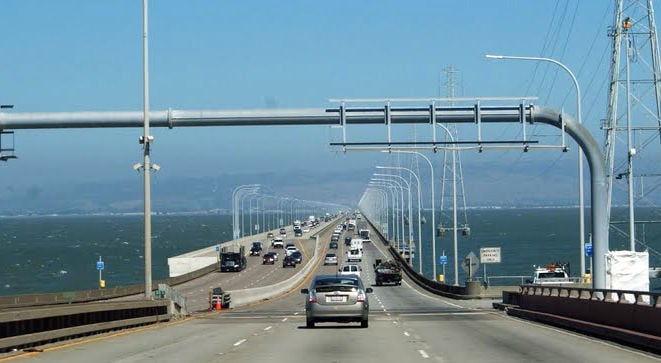
Regional Measure 3 on the June 5 ballot would gradually raise bridge tolls to fund a long list of transportation projects throughout the region that proponents say will go a long way to relieving increasing traffic congestion, while critics argue the measure is too vague and unfairly burdens commuters who would see little improvement in travel time for their costly investment.
If approved by a majority of voters in the nine Bay Area counties, tolls on all Bay Area bridges except the Golden Gate would increase by $1 three separate times in January of 2019, 2022 and 2025 for a total of $3 over seven years, after which tolls could be further raised for inflation without voter approval.
Those toll increases are expected to bring in $4.45 billion for highway and transit projects over 25 years, with 25 percent of revenue allocated for transit operations annually. Revenue would be collected by the Metropolitan Transportation Commission and doled out to 38 projects, including an expansion of BART’s fleet for $500 million and extension of BART service to San Jose for $375 million; $300 million would fund the express lanes project, which would add two additional lanes with tolls to Highway 101 from Whipple Road to Interstate 380 in San Mateo County; another $300 million would be dedicated to enhanced ferry service, and $325 million would extend Caltrain to downtown San Francisco. Another $130 million would go to Dumbarton corridor improvements and $50 million would be allocated to work on the Highway 101/State Route 92 interchange.
“It seems like a grab bag of projects that won’t come to fruition,” said Linda Koelling, a former Foster City mayor who is part of the San Mateo County effort to sink the measure. “It’s a Band-Aid being put on a problem that’s not well thought out. We can’t just keep adding a BART car here or a train to Caltrain — those are Band-Aids.
“It’s a costly item to be put on the backs of a few people; the few who can probably least afford it. It’s misleading and egregious to the public,” she said, adding that the burden on commuters is compounded by recent gas tax increases and other proposed taxes.
Koelling’s concerns were echoed by San Mateo resident Lisa Taner who said non-commuters will also feel the effects of bridge toll increases in the form of higher prices for goods and services.
“We’ll be paying for it one way, it’s not a present,” she said.
All trucks would be subject to the same toll hikes as other vehicles, but the measure offers a 50-percent discount on the RM3 portion of the toll for all commuters crossing two state-owned bridges during commute hours and using FasTrak. In other words, after the toll rises by $1, commuters would see a 50-cent discount when crossing the second bridge — but not the Golden Gate — within a one-day period. RM3 also maintains the 50 percent discount on bridge tolls for carpools during commute hours, and MTC is considering a program to reduce transit fares for low-income commuters.
Carl Guardino, president and CEO of the Silicon Valley Leadership Group, argued current bridge tolls are actually a bargain for commuters considering the cost of tolls back East and inflation. If adjusted for inflation, the Bay Bridge toll in 1936 would be higher than $20 today, he said.
“The last time we passed a gas tax was in 1992 and it wasn’t adjusted for inflation and we don’t want to make that mistake again,” he said.
Adam Alberti, who is part of the group advocating for RM3 along with Guardino, said bridge drivers tend to have higher incomes, and pointed to polling that suggests voter support for RM3 across all economic levels.
Proposed benefits
While opponents of the measure say bridge toll revenue should be spent on bridges, and would rather see specific, case-by-case solutions to congestion, Alberti said the variety of projects benefiting from RM3 offers a comprehensive strategy for addressing the region’s traffic woes.
“It’s a mix of important principles: better flow throughout the region and viable alternatives to get people off bridges and reduce congestion that way and incentivize transit,” he said.
RM3 advocates often emphasize the funding it will provide for public transit, which they say will not only ease congestion, but offset the equity concern many have with respect to toll increases. Similar arguments have been made for the Managed Lanes project, which will be funded in part by RM3 revenue.
“I think it’s a progressive plan because it will incentivize transit for more commuters,” said Caltrain Chief Communications Officer Seamus Murphy. “It’s going to make travel times faster and easier for those people to get from their communities to their jobs and that’s progressive. It facilitates the creation of new transit alternatives for people who need them most.”
Beyond the aforementioned BART and Caltrain improvements and enhanced ferry service, RM3 will also devote $20 million to a regional express bus program and $140 million for an expansion of Muni’s fleet and facilities.
Express buses are meant to travel along Highway 101’s tolled express lanes when they’re constructed, just one example of how the seemingly random collection of RM3 projects are actually interconnected, advocates argue, and the benefits of those projects will be seen around the region.
“Almost all of these improvements cross county lines and in some cases multiple county lines,” Guardino said. “Extending Caltrain deeper into downtown San Francisco is a huge benefit for Santa Clara and San Mateo county residents, whether they use trains or not.”
Fairness concerns, oversight
Art Kiesel, also a former Foster City mayor, questioned the fairness of commuters living in one Bay Area county funding a project located in another county, and said the measure raises concerns about accountability and transparency as it shifts local control to unelected officials.
“How will the money get doled out and when to various projects?” Kiesel asked. “Will they tackle a specific project or not and who decides that and how does it not become a politically motivated priority scheme?”
MTC will manage RM3 funds, and the measure entails various oversight components, including the creation of a citizen oversight committee and office of BART inspector general to ensure RM3 spending is consistent with the expenditure plan; and performance measures would be implemented to make sure the goals of the measure are met.
Recommended for you
Despite those efforts, critics of regional measures continue to doubt revenue will be allocated as advertised, and often point to the Dumbarton Corridor, which never saw the funding it was promised under RM2.
Murphy said a similar outcome would not be possible under RM3 and not just because of additional oversight.
“Funds in the previous regional measure were more flexible and not specific to the Dumbarton Corridor so funds were allowed to be moved around to other priorities,” he said. “And those funds are still improving projects in the region so it’s not a waste.
“Dumbarton wasn’t as important then as it is today as we have Facebook and further job creation in the region so congestion has grown exponentially on that corridor. RM3 includes $130 million specifically reserved for Dumbarton.”
For Guardino, the results of the first two regional measures should convince voters of the need for RM3.
“We have a track record of projects delivered as promised,” Guardino said, referencing the Carquinez Bridge replacement, Caldecott tunnel fourth bore and seismic retrofits. “Those improvements came to pass.”
Voters in 1988 approved RM1, which established a $1 base toll on Bay Area bridges for major bridge and highway projects, and in 2004, RM2 raised tolls by $1 to finance highway, transit, bicycle and pedestrian projects in bridge corridors as well as operating support. Other increases were for seismic improvements, according to the MTC website.
Impact of tech companies, self-help
These days, many attribute increasing traffic congestion to the rise of Silicon Valley tech companies.
“No one wants to restrict the economy of the Bay Area, but there has to be some accountability here,” Koelling said, suggesting companies open satellite locations where their workers live rather than expanding their Silicon Valley headquarters.
But Guardino doesn’t see those companies as part of the problem. He said employer buses seat 42 and take as many cars off the road, and also pointed to private sector contributions to transit, including $50 million that employers have committed to the Managed Lanes project.
“There will always be more we can do and will do, but the way employers have stepped up is nothing less than precedent setting,” he said.
Murphy credited the “economic competitiveness” of the private sector for the “extended growth and maintenance” of sales tax revenue for transit.
He also said the private sector is encouraged to contribute more to transportation if measures like RM3 are adopted.
“We shouldn’t be blind to the idea that we can unlock private sector investment if we create more self-help opportunities,” he said.
Murphy described transportation funding as a chain reaction in which not just private sector but state and federal funding becomes more attainable after regional “self-help” measures are adopted.
But for critics of RM3, “self-help” does not entail a regional solution.
“Every area needs to be looked at individually rather than regionally,” Koelling said, adding that RM3 offers no long-term solutions to traffic.
To mitigate congestion, Koelling said improvements to the State Route 92/Highway 101 interchange should be at the top of the list. And David Schonbrunn, president of Transportation Solutions Defense and Education Fund, or TRANSDEF, who submitted the official ballot argument against the measure, said solo driving during commute hours is the root cause of congestion, which he said MTC has ignored for decades.
“Regional Measure 3 is merely a hodgepodge of pet projects, offering something to everyone,” he wrote. “You pay higher tolls while congestion worsens.”
(650) 344-5200 ex. 102





(13) comments
Another 92/101 project? Was the last one not sufficient to handle the commute? An easy change to Dumbarton expressway would be to eliminate the traffic signal
Intersections at Marsh, Willow and University. 101 south and north need unimpeded travel to and from Dumbarton. Just like 92. How many years must pass before 84 is constructed efficiently?
I'll vote no on RM3, it's too big of a promise at the sacrifice of east bay commuters. Split the projects up, trash the bullet train project.
I do not like the way this is to be funded. Most people will benefit from the proposed projects so most (everyone) should contribute - not just the bridge commuters. It is the easy way out to have the majority impose a tax on the minority - a higher gasoline tax would be a better and more fair approach.
Hi, do some quick research and you will find that the s/b 101 at Marsh Road flyover to east bound Marsh Rd was blocked by the City of Atherton and specifically one councilmember. Somehow that was going to ruin the quality of life in a city that doesn't even touch Highway 101. He was against Caltrain too.
If we are going to have great transportation infrastructure we have to be willing to pay for it. There is no free lunch.
I thought the 12 cent gas tax was suppose to go toward road improvements and transportation issues. Funny how we keep shelling out money for roads and transportation and see no results
Who is going to get the $50 million contract "New Generation Clipper Transit Far Payment System? (See Page 13 of the 22 page RM3 insert in your Sample Ballot.) Sounds like a sweet deal for someone, at our expense. VOTE NO ON RM3!
Vote no, no money should go to BART. In addition they should be prohibited from issuing debt since half will go to interest expense. Govt agencies keep floating their debt since rates have been low, but rates are going up the refunding game is about to end.
Regarding 92/101 intersection. There are 8 lanes (from 101 north and south and 92 West) that try to feed into 3 lanes on the San Mateo Bridge. Increase the capacity of the San Mateo Bridge, perhaps building it into a double decker bridge. This should be a priority. RM3 funds probably would not address this.
Indeed, there is no free lunch. But RM 3 is not good lunch. It piles up on an already unaffordable cost of living in the Bay Area, it weakens the rules on what is a fee and what is a tax, costs will be paid mainly by lower-income commuters in Alameda to subsidize projects in higher-income Silicon Valley; and who can keep track of all those projects! Hopefully, a collective NO vote might encourage planners to design more focused, accountable projects, that charge the people who benefit.
I agree with Steve. I't an unfair tax.
When the Golden Gate Bridge was originally pitched, tolls were going to be imposed only until the cost of construction was recovered. HA-HA-HA.
Another example of the current super majority in charge of California imposing taxes because there is money to be had. And had those paying it are. The additional revenue will be necessary to keep propping up many of the "mass transit" systems that are losing their shorts.
There are many reasons why I am voting no - many have already covered the reasons well, so I placed my "Vote No on RM3" on Facebook so many of you can do the same. Spread the word!
"I have a magic wand!" said RM3, but will voters believe it? Besides being wrought with promises it can't keep, I never vote for anything when tons of tax dollars would be overseen by a non-elected group of who knows who. Nor do I vote for anything which gives said non-electeds the power to raise fees again, any time, without telling us. No. No. No. Worse yet, is the underhanded way they try to get this passed - not by a regular vote of the people, where they need a higher percentage to win - but by a 'regional vote' where they can glop us all together, and win marginally. Oh, and using our own tax dollars to sell us the entire idea by printing glossy magic wand cards...The whole thing smells.
Welcome to the discussion.
Log In
Keep the discussion civilized. Absolutely NO personal attacks or insults directed toward writers, nor others who make comments.
Keep it clean. Please avoid obscene, vulgar, lewd, racist or sexually-oriented language.
Don't threaten. Threats of harming another person will not be tolerated.
Be truthful. Don't knowingly lie about anyone or anything.
Be proactive. Use the 'Report' link on each comment to let us know of abusive posts.
PLEASE TURN OFF YOUR CAPS LOCK.
Anyone violating these rules will be issued a warning. After the warning, comment privileges can be revoked.