
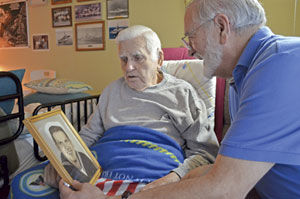
Exactly 75 years after the infamous attack on Hawaii’s Pearl Harbor, Jack Vaessen is proud to have survived the tragic catalyst that jolted the United States into war.
At 100 years old, the San Mateo resident and former Navy engineer lives amongst a collection of photographs and historic memorabilia reminiscent of his service during World War II.
Having celebrated his own centennial earlier in the year, Vaessen’s hearing and sight ail. But he retains a few vivid memories of the tumultuous hours in which he became one of the nation’s heroes.
“Well, it wasn’t happy hour,” Vaessen said with a slight chuckle as he recalled being 25 years old when the Japanese attacked Pearl Harbor Dec. 7, 1941.
Vaessen was aboard the USS Utah, a trainer ship and one of the first to be hit by a torpedo when the surprise raid on Pearl Harbor began shortly before 8 a.m. A Sonoma County native, Vaessen had only recently arrived in Hawaii where he was stationed and worked as an engineer with the Navy.
But that December morning, as he helped sort out equipment in the Utah’s engine room, Vaessen’s world would be turned upside down — literally.
The Utah sustained two hits and began to tilt and capsize. Vaessen was in the engine room hull and, despite commands to abandon ship, stayed aboard in a valiant effort to keep the electricity running for his fellow sailors to escape.
When the torpedoes first hit, he was initially unaware of what was occurring around him — hundreds of Japanese fighter planes and submarines triggering chaos and destruction atop the military base where thousands lost their lives.
As the Utah began to take on water and the hull rose to break the ocean’s surface turning the rooms and corridors upside down, Vaessen said fear sunk in.
“When the torpedo hit, I was down below near the engine room. … I was down below and couldn’t get out,” Vaessen said, adding he wasn’t fearful at first. “But later on when you see water coming in places it shouldn’t, you know something’s wrong.”
Armed with a wrench, Vaessen made his way further into the hull that was beginning to broach above water. He recalled opening an upside-down door and being bombarded by asbestos stored underneath the ship that was sinking into the Pacific.
“You don’t think or plan things,” Vaessen said. “You just move along the best you can. … You don’t know if you’re going to make it.”
He continued to move deeper into the ship but toward the water’s surface. Then, he began to hear noises. At first it was faint, just a tap, tap. With the wrench still in his hand, Vaessen said he responded by banging against the ship hoping someone would hear.
Recommended for you
And someone did. As he describes it, a strong boy from Idaho and his mates were on another ship that avoided being hit. They rushed to the Utah and helped rescue the crew trapped inside.
Standing outside atop the base of the ship, they used a torch to cut a narrow hole through thick inches of metal. For Vaessen, the dark abyss of the Utah’s hull suddenly lit up as sparks flew and he watched the red glow from the torch on the ship.
Eventually, the big strong Idaho farm boy took a hammer and broke through, exposing Vaessen to daylight.
“Once in a while I get a flash of it,” Vaessen said about his rescue. “It was other people that made it so I could survive.”
He recalled rushing to shore after escaping the bowels of the ship, astonished by the mayhem that was occurring around the harbor.
Most of Vaessen’s fellow crew on the Utah escaped but a reported 64 perished. The ship was one of the few to have been left at Pearl Harbor — like the more notorious USS Arizona, a battleship where more than a thousand lost their lives after it was struck and sunk. Those who died aboard were never exhumed and the ships serve as maritime tombs at the Pearl Harbor memorial.
Vaessen has returned several times to the Hawaii naval base during memorial services and was invited this year but will stay in California. After the war, he worked at the Mare Island Naval Shipyard before moving to San Mateo where he has lived for 50 years.
For the most part, he maintains a light-hearted humor when telling his war stories. For instance, he was awarded for his bravery in staying behind to keep the power running on the Utah. He jokes that when he was decorated with the Naval Cross — one of the highest medals of valor — he asked what church it belonged to. Another favorite tale is of a fellow soldier who, immediately after the attacks, fretted over a tattoo he’d recently gotten because he was warned to stay out of the water.
But there are also solemn stories as Vaessen is lucky to have avoided death on more than one occasion. After Pearl Harbor, he continued in the Navy and was aboard a ship during the Battle of Okinawa. A kamikaze pilot struck, killing several shipmates and causing Vaessen to suffer hearing loss in one ear. Eventually, he was discharged around the time World War II concluded.
Modest in his service, Vaessen is tempered in his reflections on the war and what led to him witnessing what would go on to become one of the nation’s most infamous days in history.
“I didn’t go off to war,” Vaessen said. “The war came to me.”
(650) 344-5200 ext. 106






(0) comments
Welcome to the discussion.
Log In
Keep the discussion civilized. Absolutely NO personal attacks or insults directed toward writers, nor others who make comments.
Keep it clean. Please avoid obscene, vulgar, lewd, racist or sexually-oriented language.
Don't threaten. Threats of harming another person will not be tolerated.
Be truthful. Don't knowingly lie about anyone or anything.
Be proactive. Use the 'Report' link on each comment to let us know of abusive posts.
PLEASE TURN OFF YOUR CAPS LOCK.
Anyone violating these rules will be issued a warning. After the warning, comment privileges can be revoked.