
San Francisco is jam-packed with history. A lot of it had to do with the maritime events that started here in the mid-1850s.
The Yerba Buena Cove became too busy and crowded when gold was discovered in the foothills. Thousands of boats were left along the shores and in the Bay as their crews jumped ship and left to try their luck at panning gold that was there for the picking. After the gold fever subsided, the port area became the lifeblood to get supplies that the Bay Area lacked. Ships of all kinds were needed to navigate the water in the Bay and move people as well cargo.
Many historic ships have been preserved at Hyde Street Pier and Pier 45. The fleet of ships at Hyde Street Pier now include: An 1886-built square rigged sailing ship, the Balclutha; an 1895 built lumber schooner, the C. A. Thayer; an 1890-built steam ferryboat; an 1891-built scow schooner, the Alma; a 1907-built steam tugboat, Hercules; and a 1914-built paddlewheel tug, the Eppleton Hall.
At the Hyde Street Pier is berthed the Eppleton Hall. The Eppleton Hall was built in England in 1914 as a ship to tow colliers (coal ship) from sea to the wharf and back. This was cheaper than the ships docking and paying fees for this service. This is one of the last surface condensing side-lever engines of the “grasshopper” type. Her two functioning engines helped her with docking ships. After many frustrating attempts to obtain her after she was taking out of service, she was donated to the National Park Service in 1979.
In 1954, Pacific Queen was acquired by the San Francisco Maritime Museum and renamed Balclutha. The Pacific Queen had many names starting off as the Star of Alaska, Pacific Queen or sailing ship Balclutha. After being built in Scotland in 1886 and being a steel-hulled full rigged ship being the only square-rigged ship left in the Bay Area, the museum was happy to get this ship after it led a full life on the seas. She rounded the Cape Horn 17 times in 13 years carrying wine, case oil and coal from Europe and the East Coast of the United States. She carried nitrate from Chile, wool from Australia and New Zealand, Burma rice, San Francisco grain and lumber from the Pacific Northwest.
In 1902, the Alaska Packers Association chartered her and later bought her after running aground on an island. The Balclutha was used for the next years in the salmon fishing trade. At one time, she was used in the movie Mutiny on the Bounty with Clark Gable and Charles Laughton. In 1954, she was acquired by the San Francisco Maritime Museum which renamed her Balclutha. She is a great asset to the Maritime Museum at the Hyde Street Pier.
Recommended for you
The tugboat Hercules was built in 1907 in Camden, New Jersey and then was sailed to San Francisco. She was used extensively for towing sailing ships when the wind stopped blowing. Her engine made it possible to move in all types of weather and she made many trips to Hawaii and the Northwest timber area to haul log-rafts to San Francisco. In 1924, she was acquired by the Western Pacific Railroad and used for shuttling railroad cars across the Bay. In 1975, the California State Park Foundation acquired the Hercules and the National Park Service took over her restoration in 1975.
In 1895, a Danish shipbuilder built a three-masted lumber schooner (the C.A. Thayer) near Humboldt Bay by Eureka. One half of the lumber was carried below deck and the remaining lumber stacked above deck. The crew of eight or nine men loaded the schooner and unloaded it when it reached port. After a brutal wind damaged it in 1912, its days as a lumber carrier were ended. Steam-driven boats were more economical and reliable and the wind-driven boats were being phased out. Each April, starting in 1912, life was ejected into the Thayer when she became used in the fishing industry in Alaska. She was loaded up with 28-foot gill-net boats, bundles of barrel staves, and tons of salt that were used in the next months of fishing for salmon. After a summer of fishing, she returned to San Francisco loaded with salted salmon. From 1925 to 1930, the Thayer did cod fishing in the Bering Strait. In 1942, the U.S. Army purchased the Thayer, removed her masts and used it, as a barge, for transporting ammunition in British Columbia. After this ended, the boat returned to cod fishing until her final trip in 1950. In 1957, the State of California purchased the C.A. Thayer and after repairs and refitting, it opened for display in San Francisco.
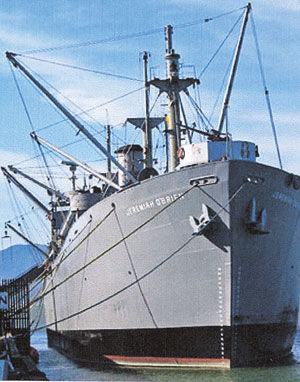
Two ships are docked at Pier 45 that need to be seen as they are World War II historic ships that represent the war many of the old-timers still remember. The SS Jeremiah O’Brien is one of two of the 6,939-ship armada that stormed Normandy on D-Day and won the war of the waters. The O’Brien is one of only two operational Liberty Ships (out of 2,710 built) that were built to carry the constantly needed supplies that the soldiers needed to complete the defeat of the Germans and Japanese during World War II. For an exceptional and personal tour to the O’Brien, be there on Thursday and Sundays and Angelo Demattei will be there to give you a tour of this exceptional boat.
Just a short distance from the O’Brien is the USS Pampanito, a submarine that made six patrols in the Pacific, after having her keel laid in 1943, where she sank six Imperial Japanese ships and damaged four others. Having survived damage of depth charges, she returned to Pearl Harbor for refit and repairs. After six successful patrols, by Dec. 15, 1945, she was decommissioned at Mare Island in reserve until she was stricken from the Navy Register on Dec. 20, 1971. She became open to the public March 15, 1982, Exciting trips can be made in the submarine as organized groups and children can sleep overnight in the submarine’s 48 bunk beds.
Allow a lot of time to fully absorb these visits to these historic ships. One visit is not enough.
Rediscovering the Peninsula by Darold Fredricks appears in the Monday edition of the Daily Journal.




(0) comments
Welcome to the discussion.
Log In
Keep the discussion civilized. Absolutely NO personal attacks or insults directed toward writers, nor others who make comments.
Keep it clean. Please avoid obscene, vulgar, lewd, racist or sexually-oriented language.
Don't threaten. Threats of harming another person will not be tolerated.
Be truthful. Don't knowingly lie about anyone or anything.
Be proactive. Use the 'Report' link on each comment to let us know of abusive posts.
PLEASE TURN OFF YOUR CAPS LOCK.
Anyone violating these rules will be issued a warning. After the warning, comment privileges can be revoked.