From left, Laura Cox, Tatiana Elliston, Chang Meng and Nanci Williams share a laugh in their 1880’s clothing for the Taube Family Carriage House groundbreaking ceremony in Redwood City Thursday. The carriage house is expected to open in 2025.
The San Mateo County Historical Association’s 30 horse-drawn carriages will be featured in a new community venue, which will serve as a time capsule that will tell stories of people who lived and worked in the county 150 years ago.
“When these carriages were very much a part of everyone’s lives, you know, they were utilized by the elite but the estates covered the entire Bayside and our whole economy was based on servicing those estates,” Mitch Postel, president of the San Mateo County Historical Association, said. “We are going to show what it was like to work for these people, and we have coachman’s uniforms and period costumes for the women and all kinds of stuff that will be the upstairs and downstairs story.”
The most valuable carriage is worth around $200,000. The carriages’ manufacturing years range from 1870 to 1912. They were all used locally. The nine Brewster carriages in the association’s collection were donated by Lurline Roth, a former owner of Filoli, at around the same time she donated Filoli to the National Trust for Historic Preservation in 1975. Another 10 carriages were contributed from the Holbrook-Palmer estate in Atherton, and Joseph Sammut, who founded Artichoke Joe’s Casino in San Bruno, also donated vehicles to the collection, among others, Postel added.
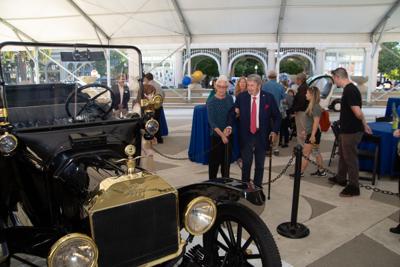
Keystone donor Tad Taube admires a Model T at the groundbreaking.
J Ennis Kirkland
The Taube Family Carriage House and Automobile Gallery will construct a 15,000-square-foot, three-story community venue at the back end of the history museum on Marshall Street between Hamilton Street and Middlefield Road in Redwood City. The $13.5 million project, nearly half of it donated by philanthropist Tad Taube, officially broke ground during a ceremony Thursday, Sept. 14, and is expected to be completed in 2025.
The ground floor will feature a rotating gallery displaying collections from community enthusiasts with the second floor showcasing the association’s collection of 10 historic Brewster carriages, one of the top manufacturers of carriages in the mid-19th century, alongside Victorian-era gowns and the museum’s textile collection.
Those vintage vehicles will be featured in the rotating Automobile Gallery. Kaia Eakin, the Historical Association’s development specialist and a member of the Redwood City Council, said the rotating gallery will help the community bridge the gap between the past and present.
Recommended for you
“It helps people have a perspective that we are all part of history,” Eakin said.
The second floor showcases the association’s collection of 10 historic Brewster carriages, one of the top manufacturers of carriages in the mid-19th century, alongside Victorian-era gowns and the museum’s textile collection. A conservation corner on the second floor will offer visitors viewing access to the historical association’s automobile restoration efforts, separated by a window. An interactive corner will also allow children to sit in a two-bench buggy providing them the experience of driving a horse-drawn carriage.
The stories of Victorian engineers and mechanical engineers in the gallery aim to inspire the next generation, Eakin said.
The top floor will include a covered rooftop terrace and banquet room, more than doubling the number of events the museum could host annually. With 4,670 square feet of space, events could have up to 200 people.
Barbara Pierce, a member of the Historical Association Board of Directors and a former Redwood City mayor, helped spearhead the idea of adding a third floor. She said the process began around 2016. She is most excited to unveil the carriage collection that has been hidden from the public for years.
“Now we have the opportunity of taking things that have essentially been in storage and bringing them out and really telling a story,” Pierce said. “People now have no vision of what life was like when those carriages were used and the critical part it played in the economy.”
Keep the discussion civilized. Absolutely NO
personal attacks or insults directed toward writers, nor others who
make comments. Keep it clean. Please avoid obscene, vulgar, lewd,
racist or sexually-oriented language. Don't threaten. Threats of harming another
person will not be tolerated. Be truthful. Don't knowingly lie about anyone
or anything. Be proactive. Use the 'Report' link on
each comment to let us know of abusive posts. PLEASE TURN OFF YOUR CAPS LOCK. Anyone violating these rules will be issued a
warning. After the warning, comment privileges can be
revoked.
Please purchase a Premium Subscription to continue reading.
To continue, please log in, or sign up for a new account.
We offer one free story view per month. If you register for an account, you will get two additional story views. After those three total views, we ask that you support us with a subscription.
A subscription to our digital content is so much more than just access to our valuable content. It means you’re helping to support a local community institution that has, from its very start, supported the betterment of our society. Thank you very much!







(0) comments
Welcome to the discussion.
Log In
Keep the discussion civilized. Absolutely NO personal attacks or insults directed toward writers, nor others who make comments.
Keep it clean. Please avoid obscene, vulgar, lewd, racist or sexually-oriented language.
Don't threaten. Threats of harming another person will not be tolerated.
Be truthful. Don't knowingly lie about anyone or anything.
Be proactive. Use the 'Report' link on each comment to let us know of abusive posts.
PLEASE TURN OFF YOUR CAPS LOCK.
Anyone violating these rules will be issued a warning. After the warning, comment privileges can be revoked.