Caltrain’s ridership has been increasing since electrification, but its fiscal deficit still looms large, and several agency and county leaders remain apprehensive over a regional transit measure that could financially benefit the agency.
The Metropolitan Transportation Commission, the Bay Area’s transit financing agency, has been working on a 2026 ballot measure meant to shore up finances for dozens of the region’s transit agencies, especially the largest operators like Bay Area Rapid Transit and Caltrain.
Starting in 2033, Caltrain is facing a $100 million annual deficit, and BART faces a $300 million shortfall in just a few years.
Earlier this month, commissioners decided to move ahead with polling voters on several ballot measure options for the 2026 election.
One option is a 30-year, half-cent sales tax generating $540 million applying to San Francisco, Alameda, Contra Costa and San Mateo counties, though the other Bay Area counties could opt in. About 90% of the funds in the first eight years would go to the highest-need operators, like Caltrain and BART. The second option is also 30 years, but would generate $1.5 billion as it would cover all nine Bay Area counties and would be funded via payroll or parcel tax. Other potential measures could include a shorter, 10-year version of the first option or incorporating different types of taxes into whichever measure is favored.
Gina Papan, MTC commissioner and former Millbrae councilmember, has expressed skepticism over the county’s proposed involvement in recent transit measure discussions — highlighting a contentious relationship the county has long had with operators like BART. Papan and others have pushed back against previous efforts that they believe would “bail out” BART by providing them with funds without enacting sufficient oversight.
During the meeting Dec. 9, she said she could not support moving ahead with any of the measures, including voter polls, without the option for San Mateo County to opt out if needed.
“We’ve asked many, many times … for the opt-out option, which is not present in any of the measures,” Papan said. “We are not seeing any of the requested accommodations in what is being presented, so our voter approval would not be something San Mateo County could consider at this point in time.”
Recommended for you
Ray Mueller, San Mateo County supervisor and Caltrain board member, said he is skeptical that Peninsula voters will support a measure that doesn’t involve Santa Clara County, which is one of the measure options being considered.
“BART is going to be extending all the way to Santa Clara County and, in the future, we’ll have more passengers coming from Santa Clara than San Mateo County. … Obviously they enjoy Caltrain too, so with BART and Caltrain going to Santa Clara, I think San Mateo County voters are going to be hard pressed to support something that doesn’t involve [Santa Clara County].”
While San Mateo County houses six BART stops, it is not a part of the BART district, which comprises San Francisco, Alameda and Contra Costa counties. That means it does not have much say in the agency’s operational and financial decisions, but it also means it gets to contribute less financially. In fiscal year 2023, the three BART district counties contributed about $388 million in sales and property tax to the agency’s operating costs. Santa Clara is financially responsible for the operating costs of its Silicon Valley extension, which amounted to about $43 million in fiscal year 2023. In that same year, San Mateo County contributed about $3 million, mostly coming from sales tax revenue.
However, ridership levels at San Mateo County’s BART stops are much lower than those counties in the BART district, Mueller said, an important factor to consider when evaluating its contribution levels.
“Our ridership is far less than San Francisco, Alameda and Contra Costa. And after the new extension in Santa Clara County, it’ll be less than theirs too,” he said. “San Mateo County really has been a donor county.”
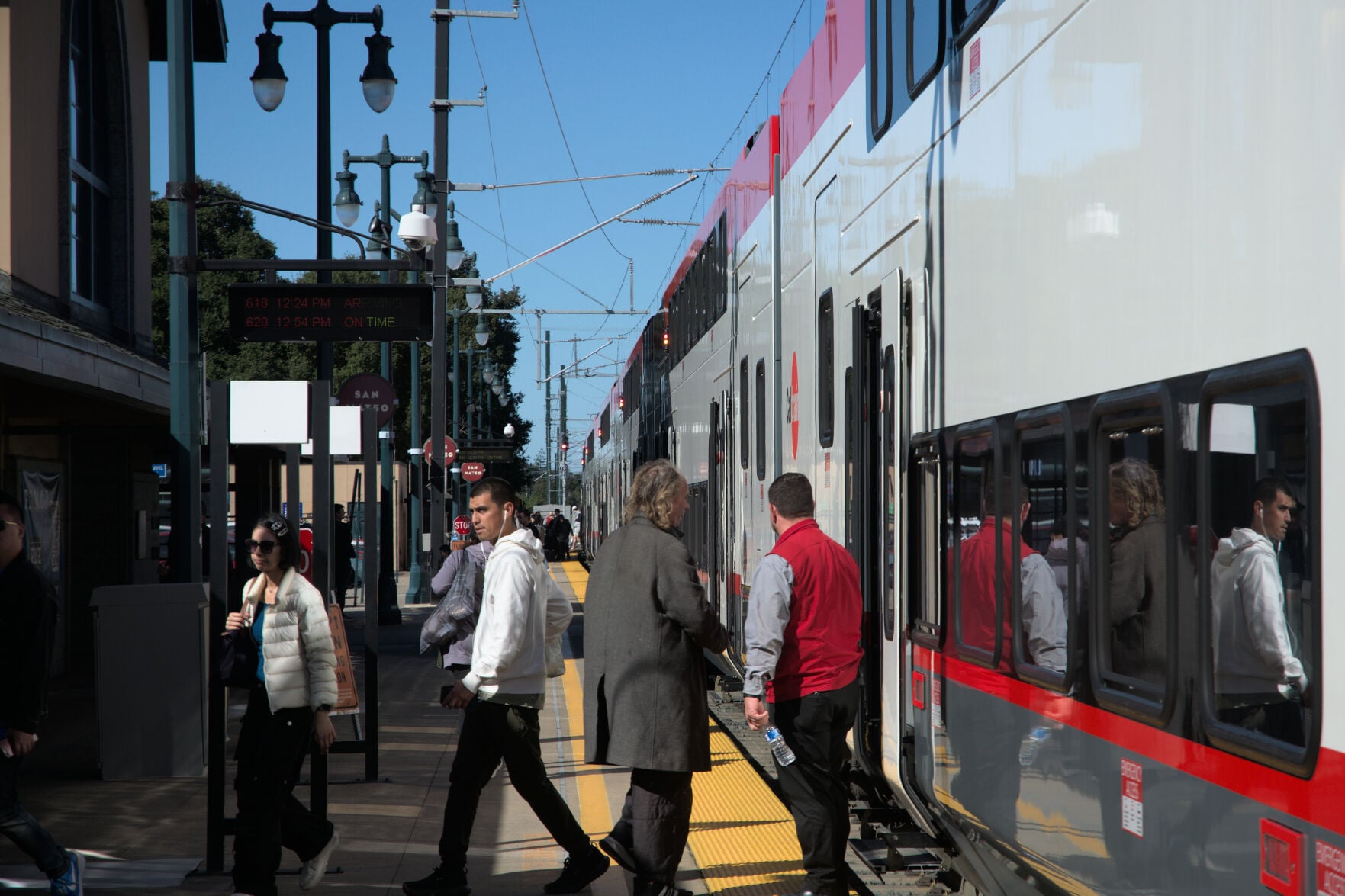
The agency’s full electrification launched in September and weekend ridership has jumped since, with overall ridership boosts looking favorable as well. But while Caltrain’s ridership is relatively similar to BART — in terms of the rate of recovery compared to 2019 — a 42% recovery still won’t get the agency out of its looming fiscal cliff, but the potential measures would certainly minimize its deficit.
“We’ll give it a good faith look at the [Caltrain] board, but I come to it somewhat skeptical that we could get it into a good position without Santa Clara County’s involvement,” he said.
Polling is expected to be completed by February 2025.
Folks, pay no attention to the increased ridership because ridership is still well below normal with no indications it will get better. Also, pay no attention to the scare tactics regarding shortfalls. It’d be interesting to see poll questions and whether an option of “NO ballot measure” or “None of the above” was provided, because I’d bet that option would win.
Meanwhile, let’s all remember that none of these transit companies were fiscally responsible during COVID and even to now – choosing to run at 100% capacity with 50% ridership or less. It’s obvious that any money given to transit companies will go only towards paying ever increasing salaries and pensions and benefits while they continue operating at 100% capacity, regardless of ridership numbers. I bet if there was 10% ridership or less, they’d still operate at 100% capacity. For any ballot measures proposed, Vote NO. And continue voting NO until transit companies practice fiscal management.
Money from bridge tolls that should be funding public transportation has been going to car-projects and capital improvements instead (Mercury News).
San Mateo County has wasted millions on the Dumbarton Railroad and then stopped claiming it would benefit the East and South Bay more than them.
Caltrain and SamTrans seem to be focused more on re-organizations and buying new headquarters than increasing service and ridership (where are our bus shelters Ray Mueller?)
Now VTA doesn't want to participate despite the fact that they have a multi-billion dollar BART tunnel project in the works.
Suddenly when they would have to share tax revenue, suddenly they are all too rich to play.
There should be absolutely no money going to SamTrans, BART, CalTrain or any of the other 25 transportation agencies until they start merging into one led by one central agency.
Keep the discussion civilized. Absolutely NO
personal attacks or insults directed toward writers, nor others who
make comments. Keep it clean. Please avoid obscene, vulgar, lewd,
racist or sexually-oriented language. Don't threaten. Threats of harming another
person will not be tolerated. Be truthful. Don't knowingly lie about anyone
or anything. Be proactive. Use the 'Report' link on
each comment to let us know of abusive posts. PLEASE TURN OFF YOUR CAPS LOCK. Anyone violating these rules will be issued a
warning. After the warning, comment privileges can be
revoked.
Please purchase a Premium Subscription to continue reading.
To continue, please log in, or sign up for a new account.
We offer one free story view per month. If you register for an account, you will get two additional story views. After those three total views, we ask that you support us with a subscription.
A subscription to our digital content is so much more than just access to our valuable content. It means you’re helping to support a local community institution that has, from its very start, supported the betterment of our society. Thank you very much!







(2) comments
Folks, pay no attention to the increased ridership because ridership is still well below normal with no indications it will get better. Also, pay no attention to the scare tactics regarding shortfalls. It’d be interesting to see poll questions and whether an option of “NO ballot measure” or “None of the above” was provided, because I’d bet that option would win.
Meanwhile, let’s all remember that none of these transit companies were fiscally responsible during COVID and even to now – choosing to run at 100% capacity with 50% ridership or less. It’s obvious that any money given to transit companies will go only towards paying ever increasing salaries and pensions and benefits while they continue operating at 100% capacity, regardless of ridership numbers. I bet if there was 10% ridership or less, they’d still operate at 100% capacity. For any ballot measures proposed, Vote NO. And continue voting NO until transit companies practice fiscal management.
Money from bridge tolls that should be funding public transportation has been going to car-projects and capital improvements instead (Mercury News).
San Mateo County has wasted millions on the Dumbarton Railroad and then stopped claiming it would benefit the East and South Bay more than them.
Caltrain and SamTrans seem to be focused more on re-organizations and buying new headquarters than increasing service and ridership (where are our bus shelters Ray Mueller?)
Now VTA doesn't want to participate despite the fact that they have a multi-billion dollar BART tunnel project in the works.
Suddenly when they would have to share tax revenue, suddenly they are all too rich to play.
There should be absolutely no money going to SamTrans, BART, CalTrain or any of the other 25 transportation agencies until they start merging into one led by one central agency.
Welcome to the discussion.
Log In
Keep the discussion civilized. Absolutely NO personal attacks or insults directed toward writers, nor others who make comments.
Keep it clean. Please avoid obscene, vulgar, lewd, racist or sexually-oriented language.
Don't threaten. Threats of harming another person will not be tolerated.
Be truthful. Don't knowingly lie about anyone or anything.
Be proactive. Use the 'Report' link on each comment to let us know of abusive posts.
PLEASE TURN OFF YOUR CAPS LOCK.
Anyone violating these rules will be issued a warning. After the warning, comment privileges can be revoked.