
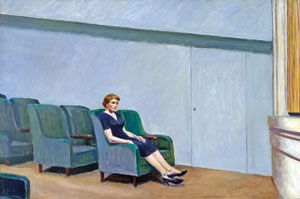
The San Francisco Museum of Modern Art (SFMOMA) has announced the acquisition of Edward Hopper’s Intermission (1963), among the artist’s largest and most ambitious paintings, and one of the last significant Hopper works remaining in private hands. Intermission was acquired from Fraenkel Gallery, San Francisco, in part through gifts from the Fisher and Schwab families, and is now on view at the museum. Known as one of the most singular 20th-century American painters, Hopper has influenced generations of artists, writers, filmmakers and photographers with his moody, quiet tableaux. His best-known paintings investigate everyday scenes in which isolated figures are contained within interiors of common locations — such as theaters, hotels, bedrooms, offices, train stations or restaurants — or outdoors on city or country streets.
Gary Garrels, SFMOMA Elise S. Haas, Senior Curator of Painting and Sculpture, said, ”Intermission is an iconic work, exemplary of Hopper’s late period and style, and establishes him as a contemporary master beyond his historical achievements of the early 20th century. The painting is also significant in relation to SFMOMA’s deep holdings of work by artists of the Bay Area Figurative tradition, such as Robert Bechtle, Richard Diebenkorn and Wayne Thiebaud, as well as photographers strongly represented in the collection, like William Eggleston, Walker Evans, Robert Frank and Stephen Shore, who share affinities with Hopper.”
Hopper came up with the idea for Intermission while he was watching a movie, and his wife, Josephine Hopper, arranged for him to work on the painting in an empty theater. However, Hopper decided to complete Intermission at his home and studio in New York City. A surviving preparatory sketch for the painting reveals that he considered including another figure in the third row. In an interview Hopper revealed, "There’s half another person in the picture.” The final composition depicts a solitary woman in a theater, sitting alone in the first row of a side aisle. Seemingly waiting for others to return from intermission, she appears lost in thought, staring off into the distance as she sits contently in a comfortable-looking dark green theater seat with her ankles crossed.
While it is known that Hopper’s wife insisted on modeling for all of her husband’s female figures, she suggests in notes left in her record book that Intermission is more of a psychological portrait rather than a straightforward representation of herself. Hopper explained during an interview that he thought of the sensibly dressed woman in the painting as "Nora,” and that she was an "egghead.” In her notes, Josephine Hopper writes: "Nothing of the comfortably bleak [is] lost on the highly conscious ‘Nora,’ with strong, long hands.” She further describes her as "not the kind to slip [her] feet out of the long, reasonably high heeled pumps” and "an efficient secretary or priced chatelaine of [a] big house.”
SFMOMA Director Neal Benezra said, "This acquisition brings to the Bay Area a truly exceptional work by Hopper, arguably the most profound visual poet of individual human experience that this country has ever produced. We are enormously grateful to the Schwab and Fisher families for their continued generosity, and for supporting our vision for the growth of SFMOMA’s collection by ensuring that it includes work of only the finest quality.”
Recommended for you
Hopper sold his first painting at age 31, Sailboat (1913), and did not sell another work for 10 years. At this point in his career, Hopper had developed what would become his signature style of placing solitary figures in sparse interiors or public spaces with a strong focus on light and shadow. Two on the Aisle (1927) is the artist’s first complete canvas on this subject, in which he depicts two people taking their seats in a nearly empty theater; the only other person in the audience sits alone reading.
The theater and movies would continue to be one of the main subjects addressed in his compositions including the well-known canvas New York Movie (1939), in which Hopper depicts a female usher standing beneath a hallway light. She appears lost in thought as the audience focuses on the film screening. Importantly, two of the last four paintings that Hopper made before his death were of the theater, Intermission (1963) and Two Comedians (1965), underscoring the sustained significance of this subject matter in his oeuvre.
The San Francisco Museum of Modern Art is located at 151 Third St., near the Moscone Center. It can be reached on public transportation from the Peninsula by taking Caltrain to the main San Francisco station and transferring to a bus for the short ride to the museum. For more information call (415) 357-4000 or visit www.sfmoma.org.
Susan Cohn can be reached at susan@smdailyjournal.com or www.twitter.com/susancityscene.


(0) comments
Welcome to the discussion.
Log In
Keep the discussion civilized. Absolutely NO personal attacks or insults directed toward writers, nor others who make comments.
Keep it clean. Please avoid obscene, vulgar, lewd, racist or sexually-oriented language.
Don't threaten. Threats of harming another person will not be tolerated.
Be truthful. Don't knowingly lie about anyone or anything.
Be proactive. Use the 'Report' link on each comment to let us know of abusive posts.
PLEASE TURN OFF YOUR CAPS LOCK.
Anyone violating these rules will be issued a warning. After the warning, comment privileges can be revoked.