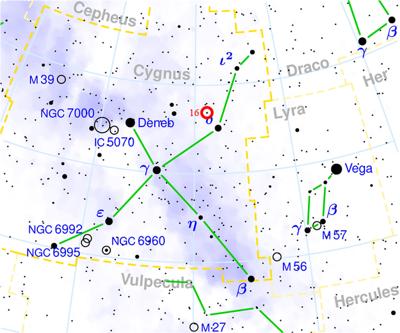
Vega, right, is the fifth-brighest star in the sky, while Deneb, upper left, is the northern most point of Cygnus constellation, AKA the Northern Cross.
Now that the sunsets so early, it’s best to pick a specific time to step outside to look up.
Vega, right, is the fifth-brighest star in the sky, while Deneb, upper left, is the northern most point of Cygnus constellation, AKA the Northern Cross.
Wikipedia
A good time seems to be 7:30 p.m., so if you step outside and Look UP, there’s lots to look at when the skies are clear. The last quarter of moon will be Saturday and then will be a waning crescent as it gets thinner and thinner. However, it won’t be out at 7:30 p.m. since it doesn’t rise until after 11:15 p.m. Friday — for those of us in San Mateo. Then it rises about an hour later each night so unless you’re out late, it will be a moonless night, which is perfect for stargazing.
As usual, I look west and still Jupiter is the brightest “star.” Since I’m on the north end of town, it might be a bit further north for those in other parts of town. The other bright star near it is Saturn.
Then if you look further north or to the left and up in the sky, there are a bunch of bright stars. One that is particular bright and is almost comparable to Jupiter is the star Vega. If you’ve read previous “Look UP”s, hopefully this name sounds familiar to you. Vega is the fifth-brightest star in the sky and was explored when we observed the Lyra constellation. I have often described it as being one of the first stars to twinkle, after the planets, once the sun sets.
Another bright star near it is Deneb. From Vega, Deneb is at about a 45-degree angle pointing to the left. If you follow this imaginary line from Vega to the next brightest star, that should be Deneb. It is part of the Cygnus constellation.
The Cygnus constellation is also known as the Northern Cross because the shape of this constellation looks like a cross. Since I didn’t go someplace dark to see it, I could only see the top half of the cross. Like many constellations, it was first recorded the by Greek astronomer Ptolemy in the second century. In Latin, Cygnus means swan so its shape looks like a flying bird. Next week we’ll explore the different Greek myths that surround Cygnus.
Keep the discussion civilized. Absolutely NO
personal attacks or insults directed toward writers, nor others who
make comments. Keep it clean. Please avoid obscene, vulgar, lewd,
racist or sexually-oriented language. Don't threaten. Threats of harming another
person will not be tolerated. Be truthful. Don't knowingly lie about anyone
or anything. Be proactive. Use the 'Report' link on
each comment to let us know of abusive posts. PLEASE TURN OFF YOUR CAPS LOCK. Anyone violating these rules will be issued a
warning. After the warning, comment privileges can be
revoked.
Please purchase a Premium Subscription to continue reading.
To continue, please log in, or sign up for a new account.
We offer one free story view per month. If you register for an account, you will get two additional story views. After those three total views, we ask that you support us with a subscription.
A subscription to our digital content is so much more than just access to our valuable content. It means you’re helping to support a local community institution that has, from its very start, supported the betterment of our society. Thank you very much!






(0) comments
Welcome to the discussion.
Log In
Keep the discussion civilized. Absolutely NO personal attacks or insults directed toward writers, nor others who make comments.
Keep it clean. Please avoid obscene, vulgar, lewd, racist or sexually-oriented language.
Don't threaten. Threats of harming another person will not be tolerated.
Be truthful. Don't knowingly lie about anyone or anything.
Be proactive. Use the 'Report' link on each comment to let us know of abusive posts.
PLEASE TURN OFF YOUR CAPS LOCK.
Anyone violating these rules will be issued a warning. After the warning, comment privileges can be revoked.